

There is a particular moment most people can point to in their working lives. Not the day they got the job, or the day they got a promotion. The moment a manager sat across from them, or sent a message, or carved out an hour on a crowded calendar, and said: I think you can do more than this. Let me help you get there.
It may sound small, but in employee training statistics for 2026, this kind of moment repeatedly shows up as the difference between retention and resignation.
That moment is the seed of something companies spend billions trying to replicate through platforms, programmes, and performance cycles, and often fail to do so, because the technology is easier to procure than the intent behind it. The main intent behind every training initiative is: we see you. We are investing in who you are becoming, not just what you can do for us right now.
Something shifted in the workforce over the past decade, and it accelerated sharply after 2020. Employees – across generations, industries, and income levels – began recalibrating what work was for. The salary still mattered, of course. But the salary alone stopped being enough. People began asking, sometimes quietly and sometimes very loudly: Does this place want me to grow? And when the answer was no, or vague, or buried under a compliance training module nobody opened – they left.
This isn’t a soft, feel-good observation. It’s now one of the most data-dense findings in modern HR research. 76% of employees report they would stay with an organisation if ongoing learning opportunities were genuinely available. And 4 in 10 say they would quit outright if none were offered at all. In a labour market where replacing a single person can cost anywhere from 50% to 200% of their annual salary, the math becomes very uncomfortable for organisations that have treated training as a line item to trim.
The workforce has not become needier. It has become clearer about what it wants and about what it will and will not accept. People want to be challenged. They want to be developed. After all, they want to work somewhere that believes their best work is still ahead of them. Training, done well, is how organizations make that belief tangible.
The statistics that follow are not just numbers. They are the aggregate story of millions of those small moments – the ones that happened, the ones that were promised and never came, and the growing business case for making sure more of them happen.
Key employee training statistics for 2026
The key statistics point to one central tension: investment is rising, but execution is lagging. The money is there, but the reach is not.
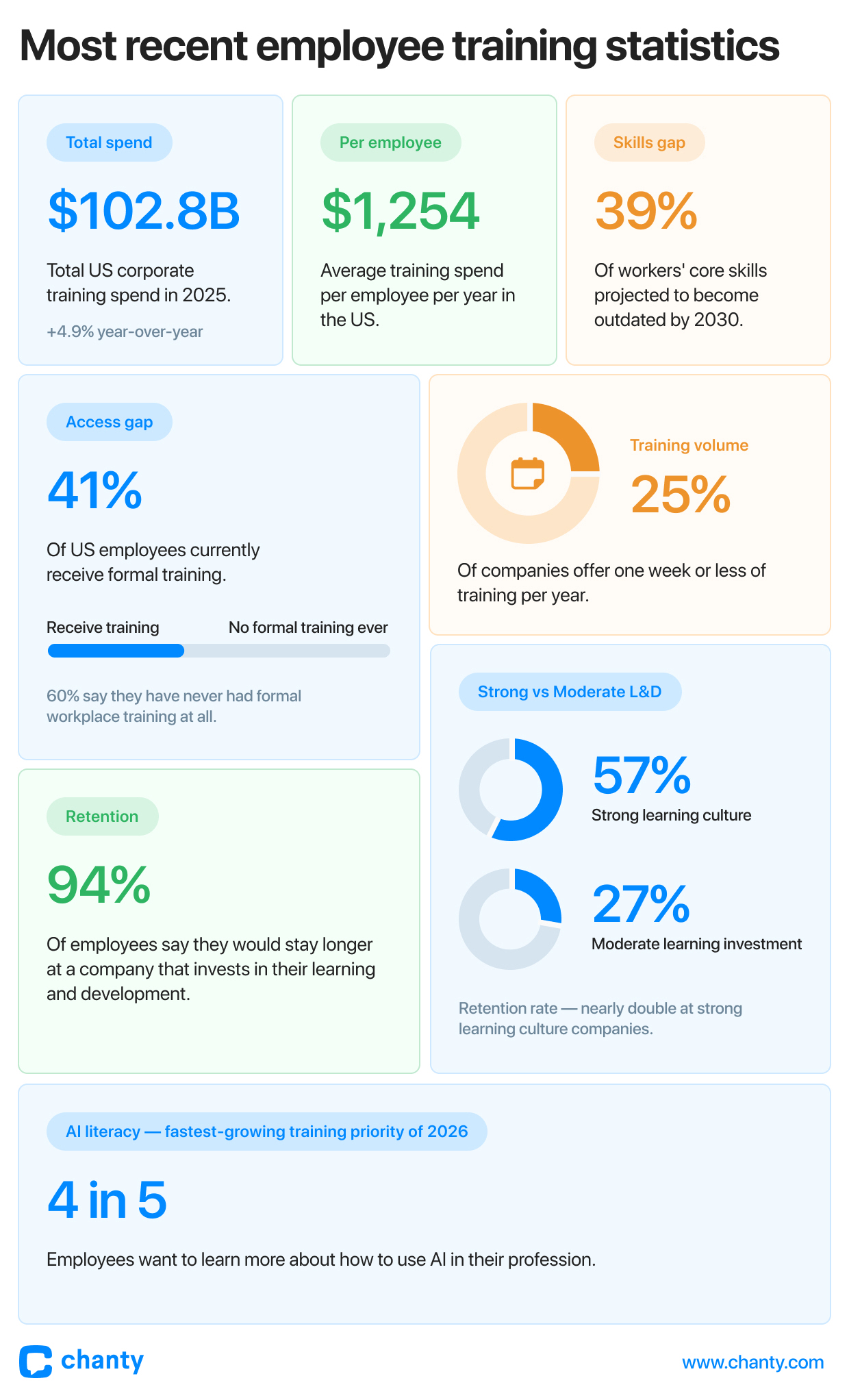
- $102.8 B total US corporate training spent in 2025 – a 4.9% increase year-over-year.
- 94% of employees say they would stay longer at a company that invests in their learning and development (LinkedIn Workplace Learning Report)
- 39% of workers’ core skills are projected to become outdated by 2030 (World Economic Forum, 2025)
- $1,254 average training spend per employee per year in the US (ATD, 2025)
- 57% higher retention rate at companies with a strong learning culture – nearly double the 27% rate at companies with only moderate learning investment.
- 4 in 5 employees want to learn more about how to use AI in their profession – making AI literacy the fastest-growing training priority of 2026 (McKinsey)
Despite these numbers, the execution gap is stark.
- Only 41% of US employees currently receive formal training. A full 60% say they have never had formal workplace training at all.
- 25% of companies offer one week or less of training per year.
The investment is real, the reach – less so.
63% of employees cite skills gaps as their single biggest barrier to business transformation – yet only 7% of training budgets are dedicated to upskilling for technical and role-specific skills
The reskilling urgency underpins everything. 85% of employers plan to prioritise reskilling their workforce over the next five years, and 59% of all employees will need some form of retraining by 2030: 29% upskilled in their current roles, 19% redeployed with new skills, and 11% at risk of missing the reskilling window entirely, according to the WEF, 2025 Future of Jobs report. The global skills gap, left unaddressed, is projected to cost the economy $11.5 trillion by 2028. And, according to McKinsey, 87% of executives say they are already experiencing skills gaps now, or expect them within five years.
Why does employee training matter more than ever right now?
Employee training matters in 2026 because it’s no longer just a development tool – it’s the primary driver of retention, productivity, and competitive advantage. Organisations that invest in it consistently outperform those that don’t, across profit margins, talent acquisition, and employee engagement. Those that do not are paying for it in turnover, skills gaps, and the quiet departure of people who have found a better place.
Retention is now inseparable from learning
The data is unusually consistent across sources. 90% of organizations now rank providing learning opportunities as their primary retention strategy – ahead of compensation, benefits, and flexibility. When development disappears from the equation, so do people: 40% of employees leave within their first year when they feel undertrained or unsupported. And 31% are gone within the first six months.
When you consider that replacing an employee typically involves recruiting costs, lost productivity, and onboarding time amounting to 50-200% of their annual salary, the ROI case for investing in development becomes very easy to make, and very hard to ignore.
The link to productivity and profitability is measurable
218% higher income per employee at companies with strong training programmes (ATD research), alongside 24% higher profit margins
Well-trained employees are 17% more productive on average. Companies that invest in training see a return of $4.53 for every $1 spent. Employees satisfied with their training are 27% more productive than their under-trained peers. These are not soft metrics – they translate directly to the bottom line
It is becoming a competitive signal for talent acquisition
More than 8 in 10 hiring managers now view a company’s training culture positively when attracting candidates. In a tight labour market, the presence or absence of a credible L&D programme functions as a signal of organisational quality – especially for Gen Z candidates, who consume more learning material than other generations and expect development to be a part of the deal from day one.
Does employee training actually give workers a stronger sense of purpose?
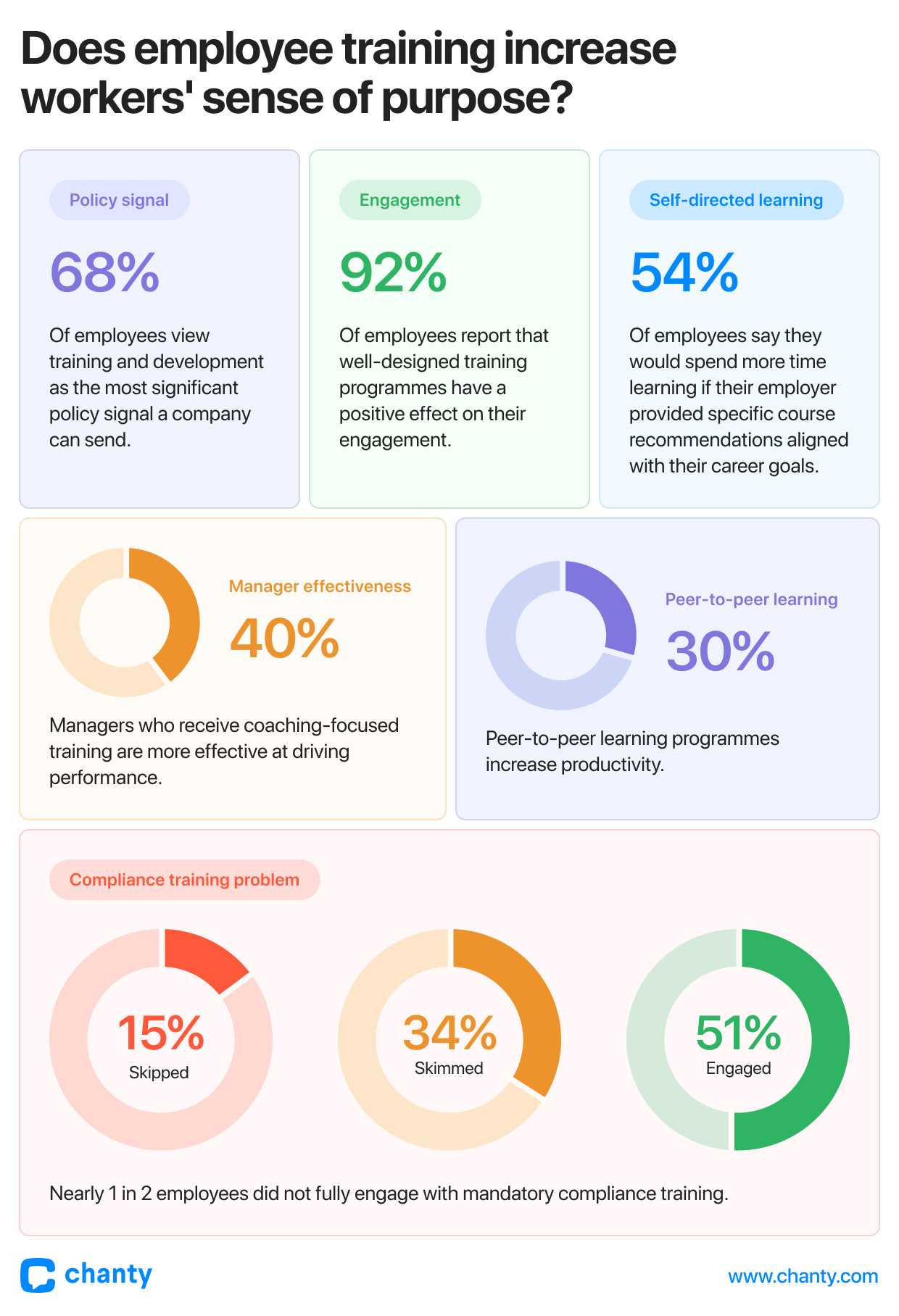
Yes – when done well, employee training is one of the clearest signals an organisation can send that it believes in its people’s future. 92% of employees report that well-designed training programmes have a positive effect on their engagement.
68% of employees view training and development as the most significant policy signal a company can send. Not the most visible, not the flashiest – the most significant one. What that word implies is that training is read as a statement of intent: this organisation believes you are worth developing.
According to the LinkedIn Learning Report, 54% of employees say they would spend more time learning if their employer provided specific course recommendations aligned with their career goals.
There is also a growing body of evidence connecting training to psychological safety and confidence at work. Managers who receive coaching-focused training are 40% more effective at driving performance. McKinsey’s research shows that peer-to-peer learning programmes increase productivity by 30%. There are not just efficiency gains – they reflect people who feel more capable, more seen, and more anchored to their work.
The caveat is consistency. Training that is mandatory, generic, or disconnected from real job demands tends to produce the opposite effect – disengagement, cynicism, and the suspicion that the company is checking a compliance box, rather than investing in people. 15% of respondents in one study admitted to clicking through mandatory compliance training without reading or listening to it. 34% said they only skimmed it. Purpose requires authenticity, and authenticity requires design.
The organisations getting this right are those that treat learning as infrastructure – embedded into the flow of work, personalised to the individual, and visibly championed by leadership. When those conditions are met, training doesn’t just build skills – it builds belonging.
What are the biggest challenges holding employee training back in 2026?
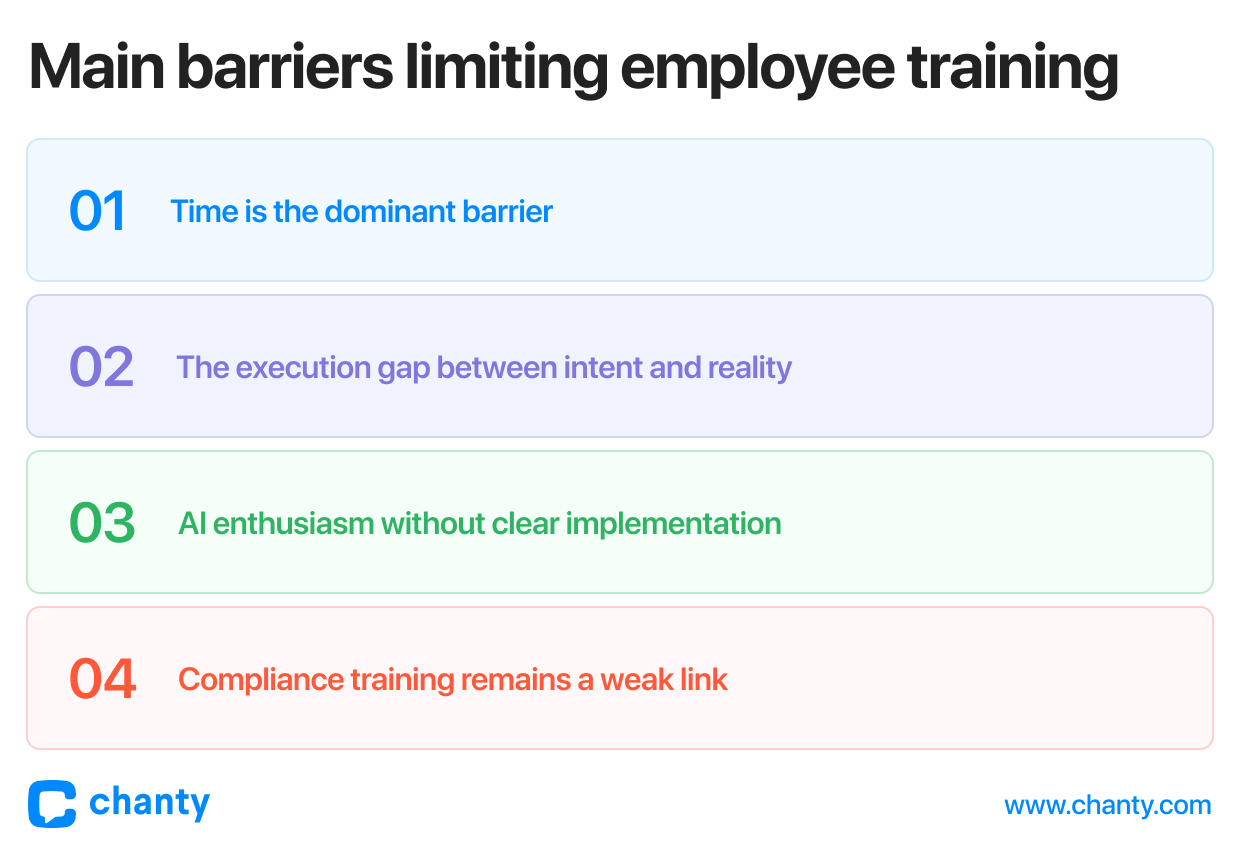
The biggest challenges holding employee training back in 2026 are time scarcity, an execution gap between strategy and delivery, unclear AI implementation, and persistent weaknesses in compliance training. These aren’t new problems – but they are deepening as expectations rise faster than the infrastructure built to meet them.
Time is the dominant barrier
More than 50% of L&D professionals cite time as the single biggest barrier to creating and delivering effective training. Employees have, on average, less than 1% of their working week available for formal learning – roughly 24 minutes in a 40-hour week. Yet most traditional training modules are built around hour-long sessions or multi-day programmes. The mismatch is built in.
The execution gap between intent and reality
88% of organisations say retention is a top concern and point to learning as the primary solution – yet 16.7% of L&D teams report a lack of the necessary skills within their own departments to deliver on that promise. Impressive training catalogues sit alongside under-resourced delivery sistems. Ambitious upskilling roadmaps coexist with managers who have not been trained to support learner growth. The strategy exists. The infrastructure, for most organizations, does not yet match it.
AI enthusiasm without clear implementation
AI is now both a content area (what employees need to learn) and a delivery mechanism (how they learn it). But 2026 data shows that adoption is rising faster than clarity. 55% of organizations are already providing AI technical upskilling, with 64% planning to increase that budget. Yet many employees still report feeling unsupported around emerging AI skills – largely because organisations have invested in content without investing in the support structures that make content actionable.
Compliance training remains a weak link
43% of companies still rate their compliance programmes as basic. 23% have no formal compliance training plan at all. Given that the average annual cost of non-compliance issues sits around $14.82 million, according to research from the Ponemon Institute, and that 27% of businesses report weekly security breaches, this is a gap with very concrete consequences.
What are the most popular employee training methods in 2026, and do they work?
The training landscape in 2026 is genuinely pluralistic. No single method dominates across all contexts. What has emerged instead is a hierarchy of effectiveness by use case – and a growing consensus that the best programmes blend multiple approaches.
1. Instructor-led training (ITL) – The human standard
What is it: Traditional classroom or virtual sessions facilitated by a trainer or subject-matter expert.
Benefit: Rated the single most effective method for leadership development by both L&D professionals and learners. Enables role-play, peer dialogue, real-time coaching, and the kind of behavioural adjustment that self-paced learning rarely achieves. According to data from Training Orchestra, 28% of training budgets still go to ILT delivery costs – a significant share that reflects its perceived value.
Downside: Expensive to scale, logistically intensive, and difficult to deliver consistently across distributed teams. Travel and facility costs add up quickly, and scheduling across time zones remains a persistent friction.
2. eLearning / LMS platforms – the backbone of modern training
What is it: Online courses delivered through Learning Management Systems (LMS), from simple video modules to full interactive curricula.
Benefit: 70% of employees prefer online self-directed learning. eLearning requires 40-60% less time than classroom learning for equivalent content. Retention rates can improve by up to 60%. People are 95% more likely to retain information delivered via video than via text alone. The LMS market is now the backbone of enterprise training infrastructure, giving L&D teams centralised tracking, adaptive delivery, and scalable content management.
Downside: Without strong design, eLearning becomes the very thing employees dread – static, generic, and easy to click through without absorbing. 72% of enterprises are now using AI-driven LMS platforms, but many still behave, as one analyst put it, like “ a compliance tracker with better graphics.” The technology is only good as the content and support structures around it.
3. AI-powered learning – the fastest-growing approach
What is it: Platforms that use machine learning and behavioural data to personalize learning paths, adjust content difficulty in real time, and flag skill gaps before they become performance problems.
Benefit: AI can generate microlearning content, update training after policy changes, and recommend next steps based on each learner’s progress. Over 70% of employees believe generative AI tools can help them learn new skills. Career development champions 2 organizations with the most robust AI-integrated learning programmes – are 42% more likely to be leaders in AI adoption overall. The learning experience platform (LXP) market is projected to surpass $2 billion in 2026.
Downside: AI outputs are only as good as the content fed into them. Inconsistent source material produces inconsistent training. There is also genuine resistance from L&D teams who fear replacement or distrust AI-generated content. And for skills that require human nuance – leadership, conflict resolution, emotional intelligence – AI personalisation has limits that human facilitation doesn’t.
4. Microlearning – the format built for real schedules
What is it: Short, focused learning modules – typically 3-10 minutes – designed for consumption between meetings, during commutes, or in the margins of a working day.
Benefit: Microlearning improves knowledge retention by 17% compared to longer formats. 57% of employees now expect to learn in a just-in-time way. It fits the 1% of the workweek reality – meeting people where they are, rather than demanding time they don’t have. 50% of employees cite digital, on-demand formats as the most engaging delivery mode.
Downside: Microlearning works exceptionally well for knowledge updates and compliance reinforcement, but it is less effective for complex skill-building that requires sustained practice, reflection, or coaching. Used alone, it can create the illusion of learning coverage without genuine capability development.
5. Virtual reality (VR) training – immersive and increasingly mainstream
What is it: Immersive simulation-based training using VR headsets,
now increasingly enhanced by AI-generated scenarios and real-time adaptive feedback.
Benefit: AI-driven VR training is 76% more effective than traditional methods in controlled studies. Walmart trained over a million associates using VR; their programme boosted employee engagement by 10% and reduced turnover by 20%. Cleveland Clinic cut onboarding time from 18 to 9 months. PwC research found that VR learners complete training up to four times faster than classroom learners, with a 275% boost in confidence. Healthcare students trained with VR showed 230% better accuracy compared to those trained traditionally.
Downside: Hardware costs remain a meaningful barrier for smaller organisations. First-time learners need calibration time that offsets some speed gains. And VR is most powerful for skill practice – less suited to conceptual or knowledge-heavy training, where a well-designed eLearning module or live session would be more efficient.
6. On-the-job and peer learning – the informal foundation
What is it: Experiential learning through real work tasks, mentoring, job shadowing, and colleague knowledge-sharing.
Benefit: 70% of skills are acquired through actual job experience, 20% through peer and colleague interactions, and only 10% through formal training sessions – the 70-20-10 model. 68% of employees say they prefer to learn on the job. Mobile learning, a close cousin of on-the-job formats, increases productivity by 43% for remote workers. This is the most natural, contextually embedded form of development – and often the most durable.
Downside: Highly dependent on manager quality and workplace culture. Without structure, on-the-job learning is inconsistent: some employees receive rich developmental experiences, others receive none. It also does not address formal skill certifications, compliance requirements, or the kind of structured upskilling that AI and digital transformation demand.
What does good employee training actually look like in 2026?
The organisations making meaningful progress share a few characteristics. They have stopped treating their learning platform as a nice-to-have and started treating it like core business infrastructure – on a par with their CRM or HRIS. They blend delivery methods intentionally: ILT for leadership and soft skills, AI-driven LMS for personalised upskilling, microlearning for knowledge reinforcement, VR for high-stakes simulation. And they invest not just in content but in the support structures – manager coaching capability, time protected for learning, and systems that connect training outcomes to business metrics.
Perhaps most tellingly, the organisations getting this right have also stopped treating training as a separate HR initiative and started framing it as the mechanism that enables every other business priority. When that shift happens, the ROI case makes itself.
“When learning becomes part of the culture – not a line item on a calendar – employees stop dreading training day and start seeing it as a normal, useful part of work.” (Diversity Resources, 2025)
The bottom line
Employee training in 2026 is not a nice-to-have, a tick-box exercise, or a perk reserved for high performers. It is the primary lever for retention in a talent market that has fundamentally shifted. It is the infrastructure for navigating AI-driven transformation. And, for an increasing number of employees, it is a direct signal of whether their employer believes they are worth investing in.
Remember the moment we described at the start – that manager leaning across the table, or carving out an hour on a crowded calendar. That signal: I see you, I believe in where you are going. The data confirms what most people already know intuitively: people do not just want a job. They want to work somewhere that makes them better. The organisations that understand this are not just retaining employees. They are building workplaces people actually want to stay in.
The 2026 employee training statistics do not leave much room for ambiguity: train your people, or watch them leave.