
There is a quiet revolution happening at kitchen tables, in coffee shops, on hiking trails in the middle of the week, and in apartments overlooking the streets of Lisbon, Wellington, and Copenhagen. It doesn’t have a slogan because it doesn’t need one. Its message is simple: life is happening now, and more people are no longer willing to postpone it for a career that may never return the sacrifice.
For decades, success followed a familiar script. You found a stable job, stayed loyal to one employer, worked long hours, climbed the ladder, and looked forward to enjoying life after retirement. Stability was the reward. Sacrifice was the expectation.
Then the foundations of that script began to shift. Economic uncertainty made even secure jobs feel fragile. A global pandemic proved that work could happen almost anywhere. At the same time, technology untethered millions of knowledge workers from a single office, while younger generations entered the workforce questioning whether success should be measured by time spent working or by the life work makes possible.
The result wasn’t a rejection of work. It was a redefinition of its place in life.
Today’s professionals still care deeply about meaningful careers, but they increasingly judge a job by what it allows outside working hours as much as what it offers during them. Productivity matters more than performative busyness. Flexibility is valued alongside compensation. Time with family, hobbies, travel, health, and personal growth are no longer rewards for decades of work. They’re expected to coexist with it.
In other words, work-life balance has evolved from a desirable workplace perk into a baseline expectation. People no longer see it as something to negotiate after accepting an offer. They expect employers, and increasingly entire countries, to create environments where ambitious careers and fulfilling personal lives can exist side by side.
That shift in expectations is reshaping global competition for talent. Countries are investing in stronger labor protections, remote work policies, digital infrastructure, and residency programs designed to attract highly skilled professionals who now have more freedom to choose where they live and work. At the same time, organizations that fail to support healthy boundaries are finding it harder to recruit and retain employees who have more options than ever before.
By 2026, the gap between countries with strong work-life balance and those without is no longer a matter of perception. It can be measured through working hours, paid leave, parental support, healthcare access, workplace flexibility, employee wellbeing, and overall quality of life. Together, these indicators reveal which nations have redesigned work around people, rather than expecting people to organize their lives around work.
What work-life balance actually means in 2026
Work-life balance in 2026 is no longer defined by simply working fewer hours. Instead, it reflects whether people can build successful careers without sacrificing their health, relationships, financial security, or control over their own time. It is shaped not only by individual choices but also by the systems surrounding work, from labor laws and employer expectations to social protections and cultural norms that determine when work is expected to stop.
Because balance depends on many interconnected factors, researchers rarely rely on a single statistic. Instead, leading international indices evaluate a combination of indicators that together paint a much more accurate picture of everyday working life.
These commonly include:
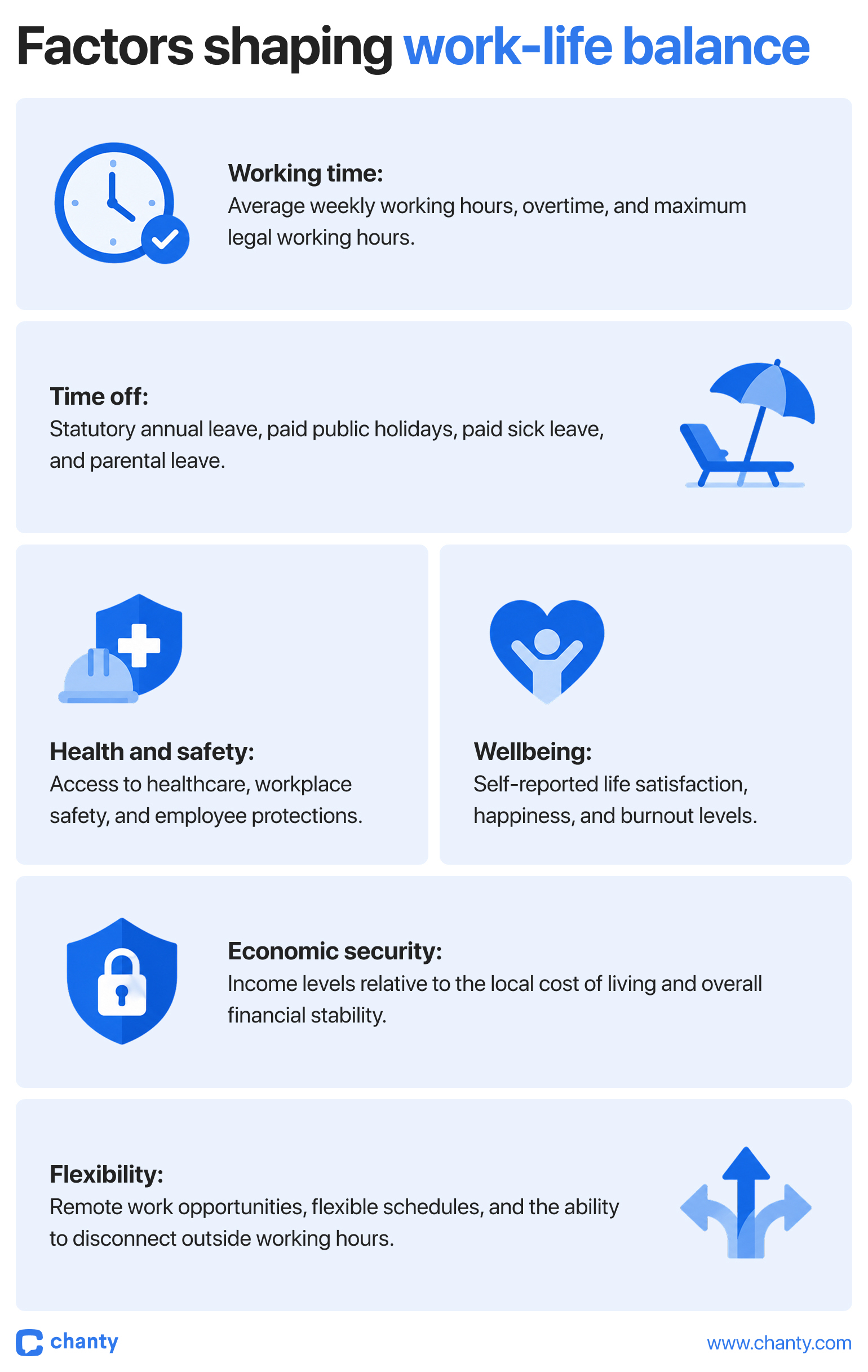
- Working time: Average weekly working hours, overtime, and maximum legal working hours.
- Time off: Statutory annual leave, paid public holidays, paid sick leave, and parental leave.
- Economic security: Income levels relative to the local cost of living and overall financial stability.
- Health and safety: Access to healthcare, workplace safety, and employee protections.
- Wellbeing: Self-reported life satisfaction, happiness, and burnout levels.
- Flexibility: Remote work opportunities, flexible schedules, and the ability to disconnect outside working hours.
No single factor defines work-life balance. A country may offer generous vacation time but score poorly because of expensive healthcare, weak employee protections, or consistently long working weeks. The highest-ranked countries tend to perform well across several of these areas rather than excelling in just one.
Remote work has added another layer to this picture. For millions of professionals, work-life balance depends not only on where their employer is based but also on where they choose to live. The same remote job can provide completely different day-to-day experiences depending on local labor protections, healthcare systems, digital infrastructure, commuting expectations, and cultural attitudes toward switching off after work.
In 2026, location has become an active part of work-life balance rather than simply the place where work happens.
This broader definition reflects three structural shifts that have reshaped the modern workplace:
- Organizations increasingly measure performance by outcomes, not by hours spent online.
- Evidence from large-scale four-day workweek trials has moved the conversation from opinion to measurable business results, showing improvements in productivity, retention, and employee wellbeing.
- The growth of location-independent work has turned work-life balance into a strategic consideration for both employees choosing where to live and governments competing for global talent.
The countries that rank highest today aren’t necessarily the ones where people work the fewest hours. They’re the ones that have built systems allowing people to work productively while still having the time, security, and freedom to enjoy life beyond their jobs..
Quick answer: The top 10 countries with the best work-life balance in 2026
Where you live influences far more than your scenery. It can determine how many hours you work each week, how much time you spend with your family, whether taking annual leave is encouraged or quietly discouraged, and how easy it is to disconnect when the workday ends.
As remote work has expanded career opportunities across borders, choosing a country has become part of choosing a lifestyle. Increasingly, professionals aren’t just asking, “Where can I earn the most?” They’re asking, “Where can I build a successful career without putting the rest of my life on hold?”
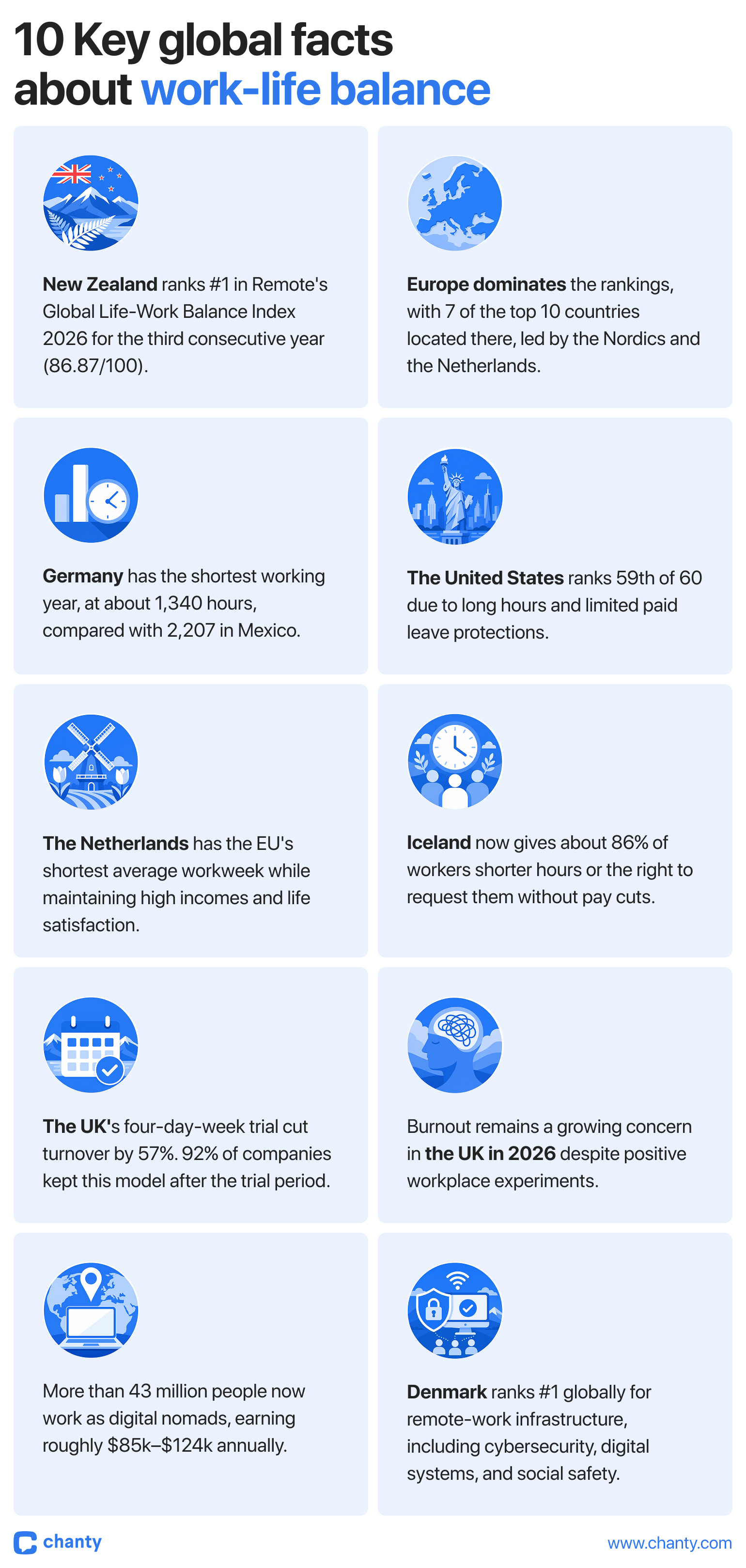
According to the latest Remote Global Life-Work Balance Index, New Zealand ranks first in 2026 with a score of 86.87 out of 100. Europe remains the global leader overall, accounting for seven of the top 10 countries thanks to strong labor protections, generous leave policies, and cultures that place genuine value on life outside work.
Here’s how the top 10 compare:
| Rank | Country | Overall score | Why it stands out | Remote work & digital nomad advantages |
| 1 | New Zealand | 86.87 | 32 days of annual leave, 26 weeks of paid maternity leave, top overall work-life balance | Remote work permitted for foreign employers for up to 9 months, growing remote worker ecosystem |
| 2 | Ireland | 81.17 | Highest-ranked European country, excellent overall work-life balance | Strong tech sector and remote employment opportunities |
| 3 | Belgium | — | Up to 24 days of annual leave, generous sick-pay coverage | Reliable digital infrastructure and central European location |
| 4 | Germany | — | Among the shortest annual working hours in the OECD | Large remote job market and excellent infrastructure |
| 5 | Norway | — | Flexible parental leave, exceptional quality of life | Popular with remote professionals thanks to safety, outdoor lifestyle, and digital connectivity |
| 6 | Denmark | — | Very low share of employees working long hours, high life satisfaction | Ranked No. 1 on NordLayer’s Remote Work Index thanks to cybersecurity, infrastructure, and economic stability |
| 7 | Sweden | — | 480 days of parental leave per child | Strong digital economy and flexible workplace culture |
| 8 | Finland | — | Flexible working legislation, consistently among the world’s happiest countries | Self-employment visa, remote-friendly culture, generous annual leave |
| 9 | Iceland | — | Most employees work or can request a shorter workweek | Excellent internet, remote-friendly work culture, outstanding natural environment |
| 10 | Netherlands | — | Shortest average workweek in the EU, strong right-to-disconnect culture | Excellent infrastructure, international workforce, attractive for digital professionals |
Just outside the top 10: the United Kingdom at 69.68, and Argentina at 14th with 68.35 – the highest-placed South American country, evidence that good work-life balance isn’t an exclusively European or wealthy-nation phenomenon.
The key statistics
- New Zealand tops the global work-life balance ranking for the third consecutive year.
New Zealand ranks first on Remote’s Global Life-Work Balance Index in 2026 with a score of 86.87 out of 100, reinforcing its position as the global benchmark for balancing work, wellbeing, and quality of life. - Seven of the world’s top 10 work-life balance countries are in Europe.
The Nordic countries, alongside the Netherlands, Germany, Belgium, and Ireland, dominate nearly every major international ranking. Their success reflects a combination of strong labor protections, generous leave policies, and workplace cultures that encourage employees to disconnect after work. - Germany records the shortest working year in the OECD.
German employees work approximately 1,340 hours per year, compared with the OECD average of 1,683 hours. At the other end of the scale, Mexico averages 2,207 hours annually and Costa Rica 2,171, highlighting how dramatically working time varies around the world. - The United States ranks 59th out of 60 countries.
Long working hours, the absence of a federal paid leave requirement, and weaker social protections continue to weigh on the country’s overall score. The findings illustrate that national wealth alone does not guarantee a healthy work-life balance. - The Netherlands continues to set the benchmark for shorter working weeks.
Dutch employees work some of the fewest hours among developed economies while maintaining high disposable incomes and consistently strong life satisfaction. Eurostat also reports the Netherlands as having the shortest average workweek in the European Union. - Iceland transformed a workplace experiment into national policy.
Following years of successful trials, 86% of Iceland’s workforce now works shorter hours or has the legal right to request them without a reduction in pay, making it one of the most comprehensive shorter-workweek implementations in the world. - The UK’s four-day-week trial delivered measurable business benefits.
Among the 61 participating companies, revenue remained stable while staff turnover dropped by 57% and burnout fell by 71%. After the trial, 92% of organizations chose to continue operating on a four-day schedule. - Burnout remains a growing concern across the UK’s wider workforce.
Despite encouraging workplace experiments, public concern about burnout continues to rise. Research from MyHealthPal found that Google searches for “burnout symptoms” reached their highest level in spring 2026, remaining elevated throughout April and May. - More than 43 million professionals now live and work across multiple countries.
The global population of location-independent workers continues to grow, with average reported earnings between $85,000 and $124,000 annually. Countries offering strong work-life balance, efficient bureaucracy, and reliable digital infrastructure are becoming increasingly attractive destinations for this highly mobile workforce. - Denmark ranks as the world’s best country for remote work infrastructure.
NordLayer’s Global Remote Work Index placed Denmark first among 108 countries for cybersecurity, digital infrastructure, economic stability, and social safety, demonstrating that successful remote work depends on far more than fast internet alone.
The numbers show which countries consistently perform best. Looking more closely reveals that each has taken a different path toward achieving work-life balance, whether through shorter working hours, stronger family policies, flexible work arrangements, or cultural expectations that encourage people to truly disconnect.
Country profiles: The Leaders in detail
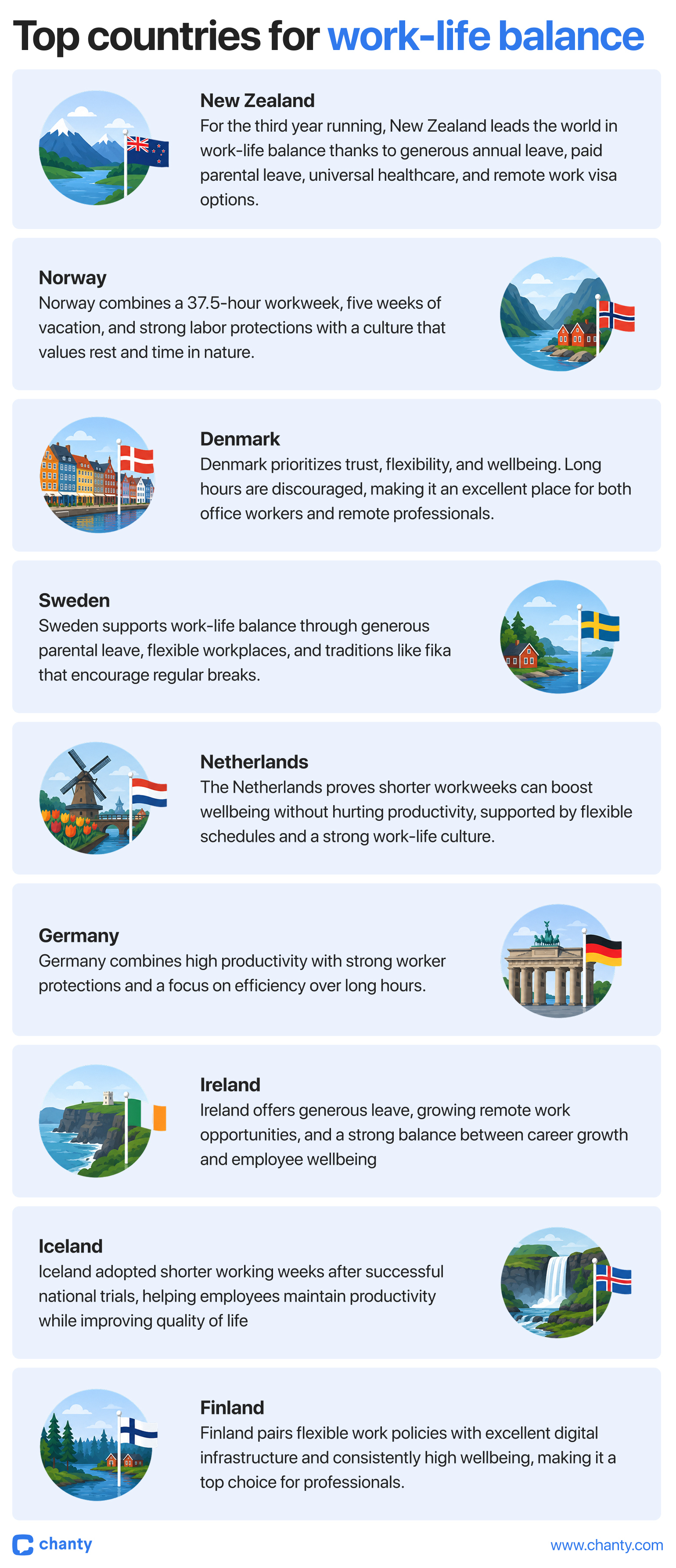
New Zealand
For the third consecutive year, New Zealand remains the global benchmark for work-life balance. Its success comes from combining generous annual leave, fully paid maternity leave, universal healthcare, and recent visa reforms that allow remote employees working for overseas companies to stay for up to nine months. Rather than relying on a single standout policy, New Zealand consistently performs well across nearly every measure that contributes to quality of life.
Norway
Norway’s approach combines strong labor protections with cultural expectations that value recovery as much as productivity. Employees benefit from a standard 37.5-hour workweek, generous overtime compensation, and five weeks of annual vacation. Many Norwegians also spend weekends at hytter (mountain or coastal cabins), reflecting a long-standing cultural habit of disconnecting from work and spending time in nature.
Denmark
Denmark’s workplace culture is built around trust, flexibility, and the concept of hygge, which emphasizes comfort and wellbeing. Working late is generally discouraged, and many offices empty shortly after the official workday ends. Combined with world-leading digital infrastructure, these cultural norms make Denmark one of the strongest environments for both traditional employees and remote professionals.
Sweden
Sweden has built one of the world’s most family-friendly labor systems. Its parental leave model gives families the flexibility to share childcare responsibilities, while workplace traditions such as fika encourage employees to take regular breaks throughout the day. Together, these practices reinforce the idea that productivity and personal wellbeing should support each other rather than compete.
Netherlands
The Netherlands demonstrates that shorter working weeks do not come at the expense of economic performance. Flexible schedules, widespread part-time work by choice, mandatory rest breaks, and a strong culture of disconnecting after work all contribute to consistently high levels of wellbeing. Cycling infrastructure also helps reduce commuting stress, making daily life feel less centered around work.
Germany
Germany pairs one of the world’s most productive economies. Strong collective bargaining agreements, generous sick-pay protections, and a focus on efficiency rather than presenteeism allow employees to maintain high productivity without routinely extending the working day.
Ireland
Ireland has rapidly become one of Europe’s strongest performers by combining competitive employment opportunities with generous leave policies and an expanding remote work ecosystem. Its balance between economic growth and employee wellbeing has helped it become the highest-ranked European country in several recent international comparisons.
Iceland
Iceland’s reputation is built on evidence rather than theory. After large-scale public-sector trials demonstrated that shorter working hours could maintain or even improve productivity, the model was gradually expanded through collective agreements instead of nationwide legislation. Today, shorter working weeks are part of everyday working life for most Icelanders.
Finland
Finland has promoted flexible working for decades, long before hybrid work became mainstream. Combined with consistently high happiness levels, strong digital infrastructure, and accessible options for self-employed remote workers, it has become one of Europe’s most attractive destinations for professionals seeking both career opportunities and quality of life.
The factors that actually move the needle
Sorting through the data, the countries that consistently top work-life balance rankings share a cluster of structural advantages rather than any single standout policy. Working hours are the most visible factor, but they aren’t the whole story – a country with short hours and weak healthcare or low safety still scores poorly, which is part of why composite indices have replaced simple “hours worked” comparisons.
Statutory leave and parental policy function as the backbone of most rankings. Countries that mandate generous, paid annual leave and pair it with substantial parental leave consistently outperform countries where leave is left to employer discretion or capped at statutory minimums far below the European norm. For remote workers, paid leave policies matter even when working abroad – since leave entitlement typically follows the employment contract rather than the physical location.
Average weekly and annual hours remain a strong predictor, but the relationship runs both ways: shorter hours don’t just result from better balance; they actively produce it, freeing time for rest, caregiving, and the kind of unstructured downtime that’s difficult to quantify but shows up reliably in happiness surveys.
Working hours at a glance
| Country | Weekly / Annual Hours | vs. OECD Average |
| Netherlands | 26.8 hrs/week | −10 hrs below EU avg |
| Denmark | ~28.8 hrs/week | Well below average |
| Germany | ~1,340 hrs/year | −343 hrs below OECD avg |
| Belgium | 34.1 hrs/week | Slightly below EU avg |
| EU average | 36.0 hrs/week | Baseline |
| OECD average | 1,683 hrs/year | Baseline |
| United States | ~1,976 hrs/year | +293 hrs above OECD avg |
| Mexico | 2,207 hrs/year | +524 hrs above OECD avg |
Healthcare access and public safety are increasingly weighted in 2026 indices, a direct response to the realization that long vacations mean little if a worker is anxious about medical costs or personal security. This is part of why the US, despite high wages, scores poorly overall – high income doesn’t compensate for thin safety nets. For location-independent professionals, this factor carries extra weight: remote work-life balance collapses quickly if healthcare in the host country is expensive, slow, or bureaucratically inaccessible.
Cultural enforcement of boundaries is harder to quantify but shows up consistently in country-specific data: Denmark’s offices locking at five, the Netherlands’ “laptops stay shut after 6 PM” norm, Finland’s near three-decade history of flexible-hours legislation. Policy sets the floor. Culture determines whether employees feel able to use those protections. Research from the OECD and Eurofound suggests that workplace norms, managerial expectations, and the ability to truly disconnect have a greater influence on employee wellbeing than legislation alone. Countries with strong cultures of work-life balance, such as Denmark and the Netherlands, also consistently rank among the OECD’s highest performers for work-life balance and life satisfaction.
Digital infrastructure and remote readiness have emerged as a distinct factor in 2026 rankings, particularly relevant for the tens of millions of professionals whose work-life balance depends on reliable internet, functional coworking ecosystems, and legal frameworks that allow them to work from abroad without regulatory risk. Singapore leads on raw connectivity – the world’s fastest broadband at around 324.46 Mbps – while Estonia’s e-Residency program and Denmark’s digital governance infrastructure represent a different kind of advantage: administrative simplicity that reduces the overhead cost of living and working internationally.
Wages relative to the cost of living matter less than raw income figures suggest. Dutch workers earn a comparatively modest $2,531 in disposable income on a 26.8-hour week, yet consistently outscore far higher-earning countries, because balance indices weight free time and security over gross pay. This pattern recurs across the top performers: the countries with good work-life balance are rarely the ones paying the highest salaries.
The map is shifting
What the 2026 data makes clear is that work-life balance is no longer an abstract cultural trait some countries happen to have – it’s a measurable outcome of deliberate policy choices, compounding evidence, and, increasingly, employer self-interest. The four-day-week trials didn’t just test a perk; they tested whether output collapses without long hours, and across the UK, Iceland, and the multi-country Nature study, the answer kept coming back the same: it largely doesn’t. Revenue holds. Turnover falls. Burnout drops by double digits.
For the growing population of remote workers – now 43 million globally – the question of which country has the best work-life balance has taken on a new urgency. When where you work and where you live are decoupled, the country you choose becomes as much a productivity and health decision as the job you take. The fact that countries like Denmark, Norway, Finland, and New Zealand consistently top both traditional work-life balance rankings and remote-readiness indices is not a coincidence: the same structural investment in worker wellbeing that produces short hours and generous leave also produces safe, high-functioning societies that remote professionals find liveable.
The countries at the top of these rankings – New Zealand, Ireland, Belgium, Germany, the Nordics, the Netherlands – didn’t get there through a single silver-bullet policy. They got there by stacking shorter hours, generous and genuinely usable leave, accessible healthcare, and a workplace culture that treats disconnection as normal rather than suspicious. The gap to the bottom, where the United States sits 59th of 60 despite high wages, is the clearest evidence yet that income and balance are no longer the same conversation.
For workers, employers, and policymakers watching this data accumulate, the question for the rest of the decade isn’t whether shorter, more protected workweeks are sustainable – the evidence increasingly says they are. The remaining question is which countries, and which companies, choose to act on it before the workforce decides for them.