
Every industry tends to call communication “mission-critical,” and it’s understandable. Without it, almost any task that involves more than one person can quickly turn into a mess. Healthcare has the same basic problem, but the margin for communication errors can be very different.
A hospital floor, a home-care agency, a skilled nursing facility, or a speciality clinic all run on a constant current of messages moving between clinical, administrative, and frontline staff. Tools like Chanty exist because of a specific failure mode in that current: information moves, but it doesn’t always arrive with an owner attached.
In most workplaces, that costs someone twenty minutes. In healthcare, it can mean a follow-up call that never happens, a handoff that loses a critical detail, or protected patient information ending up somewhere it was never supposed to go.
That makes it worth separating two things that get treated as the same:
- Communication means that information was shared.
- Coordination means that the information reached the right person and led to the right next step.
Healthcare organizations already have plenty of ways to communicate – email, phone calls, the EHR, shared drives, internal systems, written notes, even instructions shouted on the run or given near a nurses’ station. Information moves constantly.
What’s harder is making sure it turns into action with all the details in mind. A message can be read and forgotten. An instruction can be acknowledged but never followed up on. An important detail can get buried in a busy conversation between two other, louder ones.
That’s the real gap in healthcare communication: turning “this was mentioned” into “this was owned, tracked, and closed.” It’s also exactly where using Chanty in healthcare settings starts to make practical sense. Not as another inbox competing for attention, but as the thread that keeps a conversation connected to the action it was supposed to trigger.
Why healthcare communication is different
Healthcare does not have a communication problem because people aren’t talking enough. If anything, there is often too much happening at once. A nurse may pull information from the EHR, a shift report, a secure message, a phone call, a provider order, a morning huddle, or an anxious family member – all while also dealing with call lights, alarms, medication passes, rounds, admissions, discharges, and the usual interruptions of a clinical shift.
The hard part isn’t generating information. It’s keeping this all connected to the right patient, the right person, and the right next action.
A handoff is more than passing information
In a typical office job, handing something over might mean sending a document or leaving a few notes for the next person. In healthcare, a handoff can also mean transferring responsibility for what happens next. That’s precisely why healthcare has developed structured approaches addressing the same basic problem: sending information doesn’t guarantee the other person understood it, or knows what to do with it.
- SBAR (Situation, Background, Assessment, Recommendation) – a standardized shape for the handoff itself
- I-PASS – a structured framework built specifically to reduce handoff errors
- Check-backs and closed-loop confirmation – practices from TeamSTEPPS designed to verify a message actually landed, not just that it was sent
The reality of a nursing shift rarely matches the framework’s tidiness. Report runs over because the oncoming nurse has questions. Someone interrupts with a new development. The outgoing nurse is finishing documentation while trying to talk.
The problem usually isn’t that people failed to communicate – they may have talked for twenty straight minutes. The problem is whether the important information, the context, and the responsibility actually made it to the next person, intact.
Not every message deserves the same urgency
Part of why handoffs and shift communication break down isn’t a lack of information – it’s that everything arrives with the same visual weight. A routine supply update and an urgent staffing gap land in the same feed, competing for the same fraction of attention from someone who’s already interrupted a dozen times an hour.
This is where notification structure stops being a UI detail and becomes a clinical-adjacent one. Separating urgent from routine notifications (so a genuinely time-sensitive message doesn’t get lost in the scroll of routine chatter) is a direct answer to alert fatigue among bedside and field staff – a problem healthcare has been fighting for years across clinical systems, not just messaging apps.
Having information is not the same as being able to act on it
Healthcare has no shortage of documented information. Lab results, medication lists, progress notes, orders, and discharge instructions are typically all sitting somewhere in the EHR. But information existing in the system doesn’t mean the person who needs it has seen it, understood why it matters, or even knows it requires action from them specifically.
A few common ways this breaks down:
| The gap | What it looks like |
| Mentioned, not assigned | A follow-up comes up in conversation, but no one is named as the owner |
| Documented in one place, owned in another | A change is logged in the EHR while the responsible person is reached through a different channel entirely |
| Delivered too late to matter | A home-care worker gets an operational update after the visit it was meant to change |
The information technically exists in all three cases. The workflow around it is what’s incomplete – which is exactly why healthcare puts so much weight on closed-loop communication. The goal isn’t simply to send information; it’s to confirm it was received, understood, and acted on. In practice, that means moving from “I told them” to something closer to “they received it, they know what it means, and someone owns the next step.”
Continuity makes the problem harder
Healthcare work rarely happens in one place or within one person’s shift. Responsibility keeps moving even when the patient doesn’t:
- A patient can move from the ED to an inpatient unit, from a hospital to a skilled nursing facility, or from a facility to home.
- Within a single organization, responsibility can also move between shifts, departments, and teams.
- The patient, meanwhile, stays exactly the same through every one of those transitions.
Information about their condition, pending tasks, follow-ups, and changes in care has to move with them. That’s where a small communication gap turns into a coordination failure. If the next person has to reconstruct what happened from a pile of messages, notes, phone calls, and half-remembered conversations, the organization has technically preserved the information, but made the next person responsible for excavating it.
The communication channel can also become a security issue
There is another consideration that does not apply in quite the same way to ordinary workplace communication: some of what’s being exchanged is protected health information.
Healthcare organizations therefore have to consider not only whether a message can reach the right person, but also who can access it, how access is controlled, whether activity can be audited, and how electronic protected health information is protected. HIPAA’s Security Rule sets out specific expectations around access controls, authentication, audit controls, and transmission security.
None of that means healthcare workers can’t communicate electronically – obviously they do, constantly. It means the communication method has to fit inside the organization’s broader security and compliance program. Worth saying plainly, because it’s easy for vendors to gloss over: a platform does not make an organization HIPAA-compliant on its own. Software is one component of the system, alongside policies, permissions, configuration, staff training, and every other safeguard the organization puts in place around it.
Two specific pieces of that safeguard layer are worth naming directly, because they answer a risk healthcare IT and compliance teams raise constantly rather than occasionally:
- Role-based access, tied to identity. SSO and directory integration mean access follows the organization’s existing identity system rather than a separate login to manage. That matters most at the moment someone leaves – a departed employee who still has an active seat in a communication tool is a named, recurring finding in security reviews, not a theoretical risk.
- Retention and audit trail. Message history and data retention aren’t just a convenience for finding an old conversation. Paired with task tracking, they’re what makes an acknowledgment or an escalation defensible after the fact – not just reassuring in the moment it happened.
Taken together, these constraints make healthcare communication considerably more demanding than simply finding a convenient place to send messages. Information has to reach the right person, carry enough context to be useful, stay tethered to clear responsibility, and be handled appropriately whenever sensitive patient information is involved.
That’s the exact point where communication becomes coordination – and it’s the part of the process actually worth fixing.
Healthcare is not one workflow
Another reason is the difficulty of talking about “healthcare communication” as if it were a single, uniform problem: healthcare organizations do not work in the same way.
A hospital runs on departments, shifts, rounds, admissions, discharges, and shifting multidisciplinary teams. A small primary care practice might have only a handful of people, with the same staff switching between clinical, administrative, and patient-facing work throughout a single afternoon. A home-care agency faces another version entirely, a workforce that spends most of its day away from any office and relies on timely updates from coordinators to stay in sync.
The right tool for one setting won’t necessarily solve the main coordination problem in another.
| Healthcare setting | Where coordination gets difficult |
| Hospitals and health systems | Information has to move across departments, shifts, and multidisciplinary teams without losing responsibility or context. |
| Primary care practices | Small teams often have to coordinate clinical work, scheduling, referrals, patient communication, and administration at the same time. |
| Specialty and outpatient clinics | Providers and staff need to keep referrals, follow-ups, patient updates, and internal tasks from falling between roles. |
| Home health and home care | Staff are distributed across patients’ homes, so important updates cannot depend on everyone being in the same place at the same time. |
| Skilled nursing and senior living | Shift changes, multiple care roles, and ongoing resident needs make continuity and handoffs especially important. |
| Behavioral and community care | Teams work across locations while handling sensitive information that demands careful access control |
The details change, but the underlying problem is familiar: information has to reach the people responsible for doing something with it.
That is also why a generic “we help healthcare communicate better” pitch doesn’t say much on its own. For a healthcare leader evaluating another communication platform (Chanty included), the more practical question is whether it solves a problem the organization actually has. Does it help a hospital keep an operational update from getting lost between shifts? Help a home-care coordinator reach a distributed team? Give a small practice a clearer way to turn internal conversations into assigned follow-ups?
Healthcare may be one market, but it is not one workflow.
From communication to coordinated work
Across all of these different settings, the coordination problems tend to look surprisingly alike:
- Important updates get buried in email threads, group chats, or informal hallway conversations
- A request goes out, but it’s never quite clear who owns the next step
- Managers spend their time chasing people for updates instead of simply seeing what’s done and what’s still open
- Staff know a piece of information exists somewhere, but finding it takes several messages, a phone call, or a frustrating scroll back through an old conversation
None of this necessarily means an organization lacks a communication tool. In many cases, it’s the opposite – there are plenty of channels available. The real problem is what happens after the message is sent.
Was the request understood? Who’s responsible for it? When does it actually need to happen? Can someone check its status without having to ask? And if the original conversation matters later, can whoever picks up the work find that context without starting from scratch?
A message that identifies a problem is not, on its own, a task. Someone still has to decide what happens next, who owns it, when it’s due, and whether it actually got done. That process can be thought of as a simple chain:
conversation → decision → task → owner → deadline → status
Take a routine example. A clinic manager asks a coordinator to follow up on a referral if the specialist’s office doesn’t respond within a set window. In the moment, the request is clear. A few hours later, though, half a dozen other requests have arrived, and the referral is just one more item quietly competing for attention.
Turning that request into a task changes its nature entirely. There’s now a named person responsible, a deadline, and a status anyone can check. The original conversation still supplies the context – but the task is what actually gets tracked.
It’s a small distinction on paper. In practice, it’s the difference healthcare teams are actually missing. They don’t need more places to talk. They need fewer gaps between communication and the work that communication was supposed to set in motion – which is the specific gap this piece is built around, and the specific gap Chanty is designed to close.
Does Chanty fit for healthcare?
Chanty is not an EHR, clinical documentation system, patient portal, billing platform, or replacement for specialized clinical communication tools. Its role is narrower.
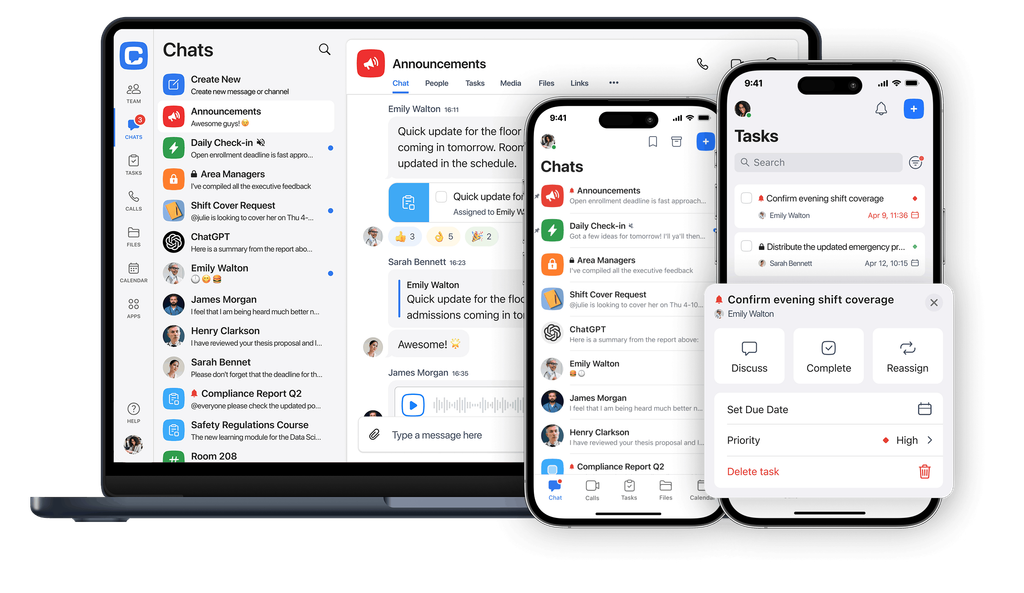
Chanty sits around those systems as an internal work-coordination system – a shared space where everyday communication connects directly to the work it’s supposed to trigger. That includes internal updates, operational requests, task assignment, follow-up tracking, shared context, and coordination between people who may not share a location or even a shift.
That distinction matters because healthcare organizations already have purpose-built systems for specialized parts of the workflow: the EHR holds clinical information, scheduling systems manage appointments, and other platforms may handle referrals, billing, staffing.
But there is often another layer wrapped around all of those systems – the layer where the everyday work gets coordinated:
- Someone asks a coordinator to follow up on a referral.
- A supervisor needs the team to review an updated procedure.
- A home-care coordinator needs to pass an operational update to caregivers working across a dozen different addresses.
- A facilities issue needs to land with the right person before the next shift starts.
That work currently lives in email, group chats, phone calls, hallway conversations, spreadsheets, or, more often than anyone would like to admit, someone’s memory. Chanty’s place in that picture is straightforward: give teams a shared space where the conversation and the action stay connected, instead of quietly drifting apart the moment the message is sent.
The security side deserves the same directness. Using Chanty, or any communication platform, does not, by itself, make a healthcare organization HIPAA-compliant. Any organization considering Chanty for healthcare use should evaluate its security controls, data handling, access management, and configuration against its own compliance requirements, including whether a business associate agreement is appropriate for the intended use.
Practical healthcare use cases
The value of using Chanty in healthcare becomes much easier to see in ordinary situations than in an abstract feature list.
Updating an emergency protocol
A facility updates its emergency response procedure. The document itself may be easy to distribute. The harder question is what happens afterwards.
Staff work different shifts and locations, so not everyone sees the announcement at the same time. Some employees are off duty when it goes out; others see it mid-shift while managing patients and mean to review it “later,” which sometimes means never.
A shared team communication space gives the announcement and its supporting document a permanent home, while an attached task assigns individual responsibility for reviewing and confirming it. Structuring channels around actual care teams, departments, and facilities – rather than one flat, generic “company chat” – keeps a facility-wide update from getting mixed in with a single unit’s day-to-day conversation. The point isn’t just that the protocol was posted. It’s that the update has a clear place to live and a clear path connecting it to the work required to put it into practice.
Following up on a referral
A physician asks a coordinator to send a referral and follow up with the specialist’s office if there’s no response. The initial request is clear in the moment. The problem shows up later, once several other requests have piled on and the referral becomes just one more thing competing for attention in a crowded inbox.
Turning the request into a task gives it an owner and a due date from the start. The original conversation stays attached, so the coordinator never has to reconstruct why the task exists or dig through old messages to find the relevant details.
Referrals also surface a coordination problem that’s easy to overlook: the people involved aren’t always inside the organization. A few examples of where this shows up:
- A referring physician outside the practice needs to weigh in on one specific case
- A family caregiver needs visibility into one thread, not the whole team’s daily chatter
- A community partner or EMS contact needs to be looped in for a single, time-boxed handoff
Each of these needs to be part of one conversation without needing, or being trusted with, full access to everything else the team discusses. Scoped, time-boxed guest access is built for exactly that. For post-acute referrals, EMS handoffs, and behavioral or community care coordination, where cross-organization communication is routine, not an edge case – that’s a meaningfully different posture than most internal communication tools offer.
Coordinating home-care teams
Home-care work creates a distinct communication challenge, because most of the workforce isn’t sitting in an office. Caregivers move between homes throughout the day, while coordinators and managers stay responsible for schedules, operational changes, and team-wide updates.
A message sent to a distributed workforce has to remain accessible well after the moment it’s sent. A schedule change, a safety instruction, a staffing update – none of it should depend on a coordinator individually tracking down every person who needs to know. A few tools tend to do different jobs here:
- Channels and targeted groups – a general announcement doesn’t have to become a round of one-to-one messages
- Direct messages and task assignment – an individual request doesn’t need to interrupt the entire team
- Voice messages – a real fit for hands-busy roles (CNAs mid-task, field case managers between visits) where typing a paragraph one-handed is its own kind of friction
- Calls – the immediate-escalation layer for the moments when a written message isn’t fast enough, paired naturally with priority notifications for anything urgent enough to interrupt
For organizations with linguistically diverse frontline staff – common across home health, skilled nursing, and behavioral health – the ability to communicate across languages inside the same shared space, rather than routing non-English-speaking staff around it, is worth treating as a genuine coordination requirement, not a nice-to-have.
Keeping work visible across shifts
Shift-based environments create their own version of the same problem. Work doesn’t end just because the person who started it clocked out.
In a skilled nursing facility or senior living community, an operational issue raised on one shift often needs attention from the next: a supply shortage, a maintenance request, a staffing gap, an internal instruction. It starts as a conversation but still needs someone, specifically, to take ownership of it. Keeping the relevant context and outstanding tasks in one shared workspace makes it far easier for the next shift to see what’s already happened and what’s still waiting.
Worth being clear about here: this isn’t a substitute for formal clinical handoff procedures, which have their own structure and their own requirements. The point is that healthcare organizations also run a large volume of operational work around those formal processes – and that layer of work needs continuity too.
Coordinating across multiple sites
The continuity problem compounds for any organization running more than one location – a multi-facility skilled nursing chain, a physician group with several offices, a multi-site veterinary hospital group. A few things tend to matter more at that scale than they would for a single-site practice:
- Reporting and analytics that give a CFO or COO real operational visibility across every site, without requiring anyone to micromanage each one individually
- Administration that scales cleanly across locations, rather than turning into a separate, manually managed instance per facility
- A consistent structure organization-wide, while still giving each site its own space to operate day to day
None of this is the headline pitch for a five-person clinic, but it’s often the deciding factor for an operator running a dozen of them.
What coordinated work actually looks like in practice
When communication and follow-up are kept together, the payoff isn’t necessarily fewer messages – healthcare work is too complex for that to be realistic. The more honest goal is reducing how much effort it takes to manage the messages that already exist.
- A manager shouldn’t have to remember every request they’ve made in order to know which ones are still open.
- An employee shouldn’t have to search through five conversations to find the context behind an assignment.
- A person taking over a task shouldn’t have to ask “what happened with this?” simply because the original conversation happened on a different shift.
Instead of chasing people for updates one at a time, a manager can look at the work itself. Instead of treating every request as one more message to remember, a team can turn the ones that need follow-through into visible, trackable tasks. It’s a small shift in workflow – but it addresses a real and persistent source of friction: the coordination work that quietly accumulates around the actual work.
One practical note for any organization actually rolling this out: frontline healthcare staff are, understandably, among the least likely groups to self-train on a new tool between patients. Structured onboarding and hands-on training – not just a login and a help article – tends to be the difference between a platform that gets adopted at the bedside and one that quietly reverts to text messages within a month.
Healthcare is never going to become a place where people communicate less. There will always be handoffs, updates, questions, requests, calls, announcements, and last-minute changes. Eliminating that communication was never the goal.
The more useful question – the one worth returning to – is what happens in the space between someone saying “this needs to be done” and the work actually getting done. That gap matters more in healthcare than almost anywhere else, because teams are scattered across shifts, departments, locations, and roles. Information can exist without being operationally accessible. A request can be communicated without ever having a clear owner. A decision can be made without any reliable way to track what happened next.
That gap is exactly the space a work-coordination platform is built to close – and it’s exactly the reason using Chanty in healthcare settings is worth serious consideration for organizations tired of losing follow-through to fragmented tools. Chanty’s role was never to replace the systems healthcare organizations already depend on. It’s to connect the everyday conversations happening around those systems to the tasks, responsibilities, and follow-up that actually keep the organization moving – reliably, shift after shift, message after message.
Communication shouldn’t end when the message is sent. For the parts of healthcare work that need someone to do something next, the conversation should have a clear way to lead to action.