Imagine two people. Both talented. Both were hired in the same month by competing companies in the same city, doing almost identical work for almost identical salaries.
The first one sits at a desk surrounded by a fully stocked snack bar, a company-branded coffee machine, and a neon sign above the break room that reads “Work Hard, Play Harder.” Branded swag arrives on her birthday. There’s a rooftop terrace. On Fridays, the office DJ plays until 4 PM.
The second one doesn’t have a snack bar. What he has is this: a healthcare plan that actually covers therapy, the freedom to work from his kitchen table on Tuesdays and Thursdays, a $1,200 annual learning stipend, and a manager who sent a handwritten note when his father was hospitalized.
Twelve months later, the first one is already polishing her LinkedIn profile. While the second one just turned down a recruiter offering him 15% more elsewhere.
This is not a story about salary.
This is a story about what it actually means to take care of people, and the staggering cost of getting it wrong.
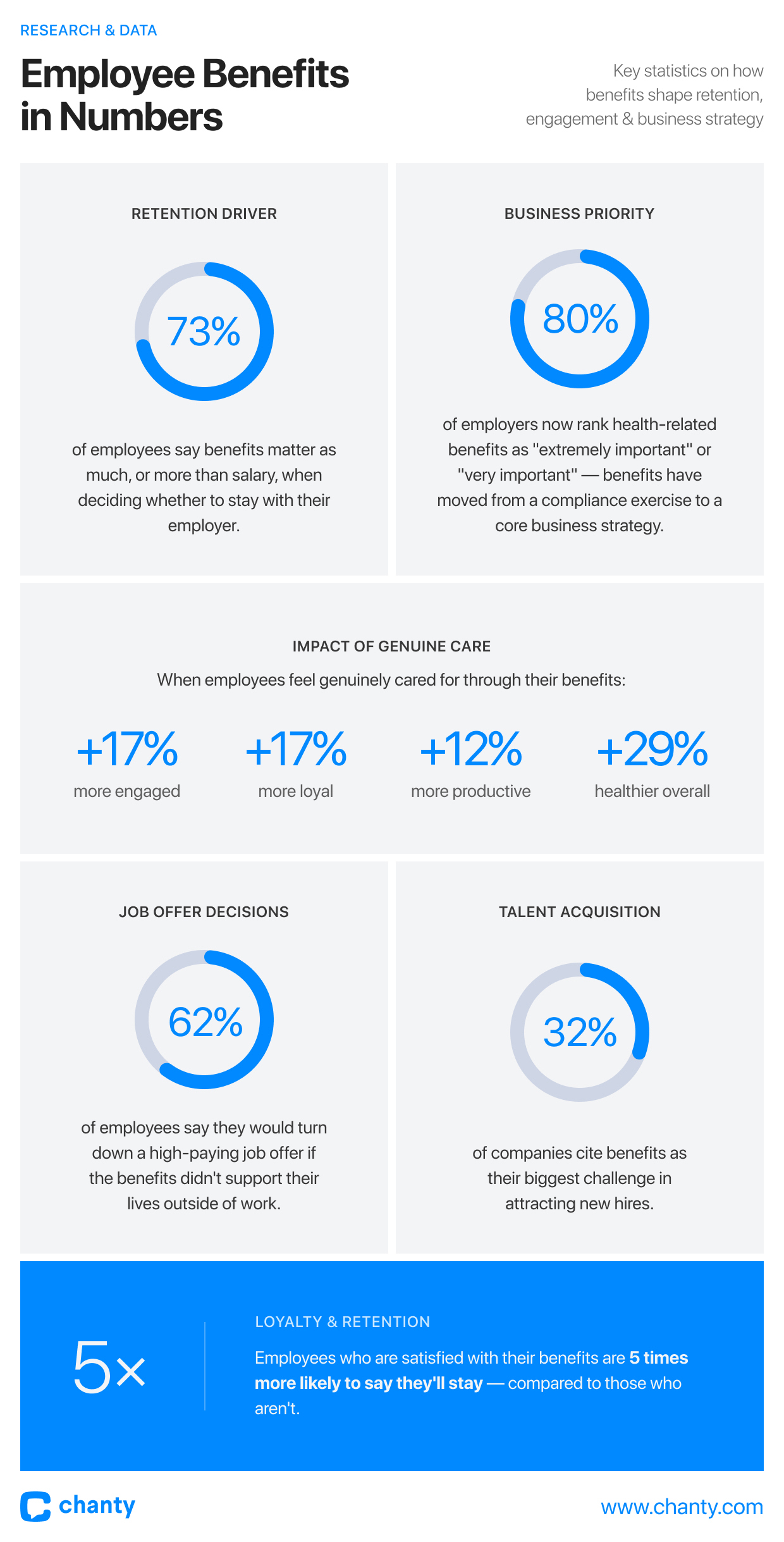
73% of employees say benefits matter as much, or more than salary, when deciding whether to stay with their employer.
We are living through a quiet revolution in the relationship between employees and employers. After the upheaval of the pandemic years, the frantic recalibration of the Great Resignation, and the economic turbulence of the mid-2020s, something fundamental has shifted. Employees are no longer simply looking for a paycheck and a few nice-to-haves. They are looking for concrete, tangible proof that their employer gives a damn about their lives outside the office walls, not in a performative way, but in a human, empathetic one.
The companies that understand this are pulling ahead. The ones that don’t – still convinced that a ping-pong table and cold brew on tap constitute a “great culture” – are haemorrhaging talent, often without ever understanding why.
This article is for anyone who wants to understand what is actually happening in the world of employee benefits in 2025 and 2026: what the data says, what different generations truly want, what works, what spectacularly fails, and, most importantly, how to build something better.
The employee benefits stakes have never been higher
Benefits used to be simple. Medical coverage, maybe a pension, and two weeks of paid vacation if you were lucky. For decades, that was the deal, and most employees accepted it without much negotiation.
That world is gone.
Today, the U.S. Bureau of Labour Statistics tracks dozens of benefit categories spanning paid leave, insurance, retirement savings, legally mandated protections, and supplemental pay. The SHRM 2025 Employee Benefits Survey – one of the longest-running annual studies in the field– finds that 80% of employers now rank health-related benefits as “extremely important” or “very important.” That number might seem obvious until you realize what it implies: benefits have moved from a compliance exercise to a core business strategy.
And the stakes of getting it wrong are eye-watering.
- 62% of employees say they would turn down a high-paying job offer if the benefits didn’t support their lives outside of work.
- 5x more likely to say they’ll stay: employees who are satisfied with their benefits vs. those who aren’t
- 32% of companies cite benefits as their biggest challenge in attracting new hires.
Think about what those numbers mean in practice. If you’re hiring for a competitive role, nearly two-thirds of your strongest candidates may decline your offer, not because of the title, not because of the salary – but because your benefits package doesn’t tell them what they need to hear. And if you’re managing your current workforce, failing to get benefits right doesn’t just cost you in recruitment. It costs you in the daily disengagement of people who are physically present but emotionally checked out.
ADP’s 2025 research puts a sharper point on it: when employees feel genuinely cared for through their benefits, they are 17% more engaged, 17% more loyal, 12% more productive, and 29% healthier overall. These are not marginal improvements. These are the kinds of gains that separate thriving organizations from stagnant ones.
Meanwhile, the cost of replacing a single employee who leaves ranges from 50% to 200% of their annual salary, accounting for recruiting fees, onboarding time, lost institutional knowledge, and the productivity dip that lingers for months. Benefits are not an expense. They are a hedge against something far more expensive.
One workplace, four different worlds
Here is a fact that still catches many HR leaders off guard: for the first time in modern history, four distinct generations are simultaneously active in the workforce. Baby Boomers born just after the war. Generation X, the often overlooked middle child of the generational family. Millennials are now the single largest cohort in the global workforce. And Generation Z, digital natives who entered working life during a pandemic and have never known an office as a default. And now all of them continue working, navigating the world full of conflicts and uncertainty.
Each of them has a radically different relationships with work, money, health, and loyalty. And each of them looks at benefits package and sees something completely different.
Approximately one-third of employees across all generations believe their benefits should align specifically with their individual circumstances. The cruel irony is that most companies still design one benefits package for everyone – and then wonder why it satisfies almost no one completely.
Baby Boomers: the stability seekers
Boomers are, in many respects, an underappreciated workforce asset. As labor shortages persist and experienced talent becomes harder to retain, the generation that built the modern economy is increasingly being recruited back into it. But they come with distinct expectations.
For Boomers, work is closely tied to identity. A solid 71% of Boomer respondents in the Checkr 2025 survey maintain that financial benefits should remain the foundation of any job offer – salary, retirement security, and comprehensive health coverage. They want recognition for long-term contributions, not foosball or free coffee. They want to know that their decades of expertise are valued. And they want a retirement plan that actually prepares them for what comes next.
Critically, Boomers are also the most likely to bring an indispensable quality to any organization: institutional memory. Lose them for the wrong reasons – inadequate healthcare, poor retirement options, a feeling of being overlooked in a youth-obsessed culture, and you lose something no hiring algorithm can replace.
Generation X: the invisible juggler
If Boomers are underappreciated, Gen X is practically invisible in benefits conversations. This is a serious oversight. They are the managers. The directors. The people holding organizations together while simultaneously caring for aging parents and financing their children’s educations.
Mercer’s Health on Demand research puts a number on it: 74% of Gen Xers classify themselves as caregivers. They are, as researchers now call them, the sandwich generation – pressed from the both sides. They pioneered the concept of work-life balance and have been fighting for it longer than any other generation. They value autonomy, flexible schedules, and the right to exist outside their job description.
Eagle Hill Consulting’s January 2026 Employee Retention Index shows Gen X employees strongly desire both genuine flexibility and meaningful in-person collaboration, not one or the other. For Gen X, this isn’t a perk to negotiate. It’s an expectation to meet.
Millennials: the generation that changed the rules
Millennials have spent the past decade being misread. They were labeled entitled when they asked for purpose. They were called uncommitted when they asked for flexibility. They were dismissed as unrealistic when they asked their employers to care about their wellbeing.
They were ahead of the curve.
Now the largest workforce cohort on the planet, expected to represent up to 74% of the global workforce by 2030, Millennials have won most of those arguments. Flexibility is table stakes. Mental health support is expected, and career development is non-negotiable: 87% consider job development important, according to Gallup.
But the defining financial reality for Millennials is debt. The average American student loan borrower carries $39,574 in outstanding debt, and more than 14 million Millennials are still repaying loans. For this generation, student loan repayment assistance isn’t a quirky benefit, it’s the kind of concrete financial relief that can determine where they spend a decade of their career.
Employees satisfied with their benefits are five times more likely to say they’ll stay. For Millennials, that loyalty calculus hinges on family-oriented benefits and visible career investment.
Generation Z: the pragmatic idealists
Gen Z is frequently dismissed as fragile or demanding. The data tells a more nuanced story: they are stressed, pragmatic, highly educated about their options, and unwilling to sacrifice their mental health for a job.
Consider this: 40% of Gen Z workers report high levels of stress and anxiety in everyday life. Another 60% say they’ve worked while mentally unwell in the past year. And 89% are actively job hunting or open to new opportunities at any given moment. Their loyalty, to put it plainly, is not guaranteed.
What can earn it? Mental health support – real, accessible, stigma-free. Financial welness programs that acknowledge the economic reality they inherited. Flexible, asynchronous, digital-first work arrangements. Employers who align with their values on diversity, equity, and inclusion. And, critically, learning and development: Deloitte’s 2025 Gen Z and Millennial Survey finds that 70% of Gen Zers develop new skills at least once a week, and L&D ranks among the top three reasons they choose an employer.
One more thing: they are the least educated about their own benefits. A full 42% report feeling “a little, or not at all” informed about what their employer offers.
This points to a quieter problem. Not what companies offer, but how poorly they explain it. If your benefits package is buried in a PDF nobody reads, Gen Z is not finding it, and they’re not valuing it.
The great sorting: what actually moves people
Let’s be direct about something the industry often dances around: a lot of what gets called “benefits” is theater.
The snack bar. The neon motivational sign. The branded hoodies. The office ping-pong tournament. The Friday gatherings in the kitchen for free pizza. These things are not useless, but they don’t keep people. They are, at best, surface-level signals layered on top of a much more serious exchange.
What keeps people is much simpler, and much harder to fake.
The Checkr Workforce Report puts it bluntly: 55% of workers believe most workplace perks are designed to keep employees at their desks longer, not to improve their quality of life. Among Gen Z, that skepticism rises to 66%. When the majority of your youngest employees think your perks are a manipulation strategy, you have a cultural credibility problem that no cold brew can fix.
So what does work?
The non-negotiables
Across every survey, every generation, every geography covered in the last 2025 research landscape, three benefits emerge as absolute bedrock:
- Health insurance is the undisputed cornerstone. ADP’s 2025 survey finds 82% of employees rank it as their single most important benefit, with 93% placing it in their top three. This is not a preference. It is the filter through which every other benefit is judged. A company that skimps on health coverage has told employees something profound, and they are listening.
- Retirement savings matching has, for the first time in ADP’s survey history, tied dental insurance for second place – a jump of 11 percentage points in two years. Economic uncertainty is sharpening people’s focus on long-term financial security. The SECURE 2.0 Act now offers tax credits to help employers enhance their 401(k) offerings. There is no longer a credible excuse not to.
- Flexible and hybrid work has become the most commonly offered non-mandatory benefit in the world. The Pew Research Center found that 46% of remote-capable employees would quit if forced to return to the office full-time. Randstad’s Work Monitor 2025 goes further: work-life balance has surpassed pay as the primary workplace consideration for all age groups. Flexibility is no longer a perk – it is a baseline for retention.
The high-return investments
Beyond the bedrock, a tier of benefits consistently generates outsized returns on investment in retention and satisfaction:
- Mental health support and EAPs:70% of employees would trade most in-office perks for just one guaranteed paid mental health day per month. The American Psychological Association finds 92% of workers value employer-provided mental health support. Yet meaningful access – not just a hotline number buried in a welcome packet – remains rare.
- Learning and development programs: LinkedIn’s Workplace Learning Report finds companies that invest in L&D see 32% higher retention than those that don’t. Nearly 89% of organizations also agree that upskilling is more cost-effective than hiring new talent. And yet L&D budgets are consistently the first to be slashed during financial pressure – a short-sighted decision that routinely costs more in hiring than it saves.
- Financial wellness benefits: Student loan repayment assistance, emergency savings accounts, financial coaching, and access to early wage advances address what most surveys identify as the primary source of employee stress – money. For Millennials and Gen Z especially, an employer who helps them manage their financial reality earns a loyalty that salary increases alone cannot buy.
- Parental and family leave: 63% of Millennials and Gen Z consider family-friendly benefits essential (PwC). Extended, inclusive parental leave, covering all genders, adoption, and surrogacy, signals that an employer understands employees as people with lives outside of work. It is also one of the most powerful recruiting differentiators in competitive talent markets.
The illusions
And then there are the things that look good in a company brochure but do remarkably little to change behavior:
The Robert Half 2025/2026 Salary Guide is characteristically unambiguous: only 20% of professionals say they would change jobs for one-site perks. The Ipsos/AMF research finds that company cars and subsidized lunches score the lowest of any benefit category in influencing job decisions. People enjoy them. They don’t stay for them.
Perhaps more importantly, generic benefits packages, regardless of how generous they sound on paper, consistently underperform because employees don’t use what they don’t understand. And a significant portion of workers never fully understand their benefits at all. Aflac’s research finds that 74% of employers believe their staff are satisfied with their benefits, while only 67% of employees agree. That seven-point gap represents real people who feel invisible.
There is a better way, and it’s not that complicated
Here is the part where most articles about workplace research turn fatalistic – listing the problems, gesturing vaguely at solutions, and leaving you to figure out the rest. This one isn’t going to do that.
Because here’s what the research, in all its breadth and nuance, ultimately points toward: the organizations that get benefits right aren’t doing something magical. They are doing something simpler and harder at the same time – they are paying attention.
They survey their people and actually read the answers. They look at what gets used and what sits untouched. They talk to their multigenerational workforce as if it were genuinely, meaningfully diverse – because it is. They protect what matters most even when budgets tighten. And they tell their employees clearly, in human language, what is available to them and how to access it.
The Selerix survey captures something important: 84% of employees who understand their benefits well are very satisfied with them, compared to just 49% of those who don’t. That is not a gap in the benefits themselves. That is a gap in communication – and it’s entirely fixable.
So let’s end with something practical. Ten things you can start doing differently in 2026. Not all at once. Not all for free. But each one is grounded in data, and each one is capable of meaningfully changing the experience of the people who show up for you every day.
The programs that are actually gaining ground in 2026
Every year, a new crop of benefits gets labeled “emerging” in industry reports, celebrated in press releases, and rolled out with a company-wide email that nobody reads past the subject line. Most of them die quietly in the employee portal, untouched and unloved.
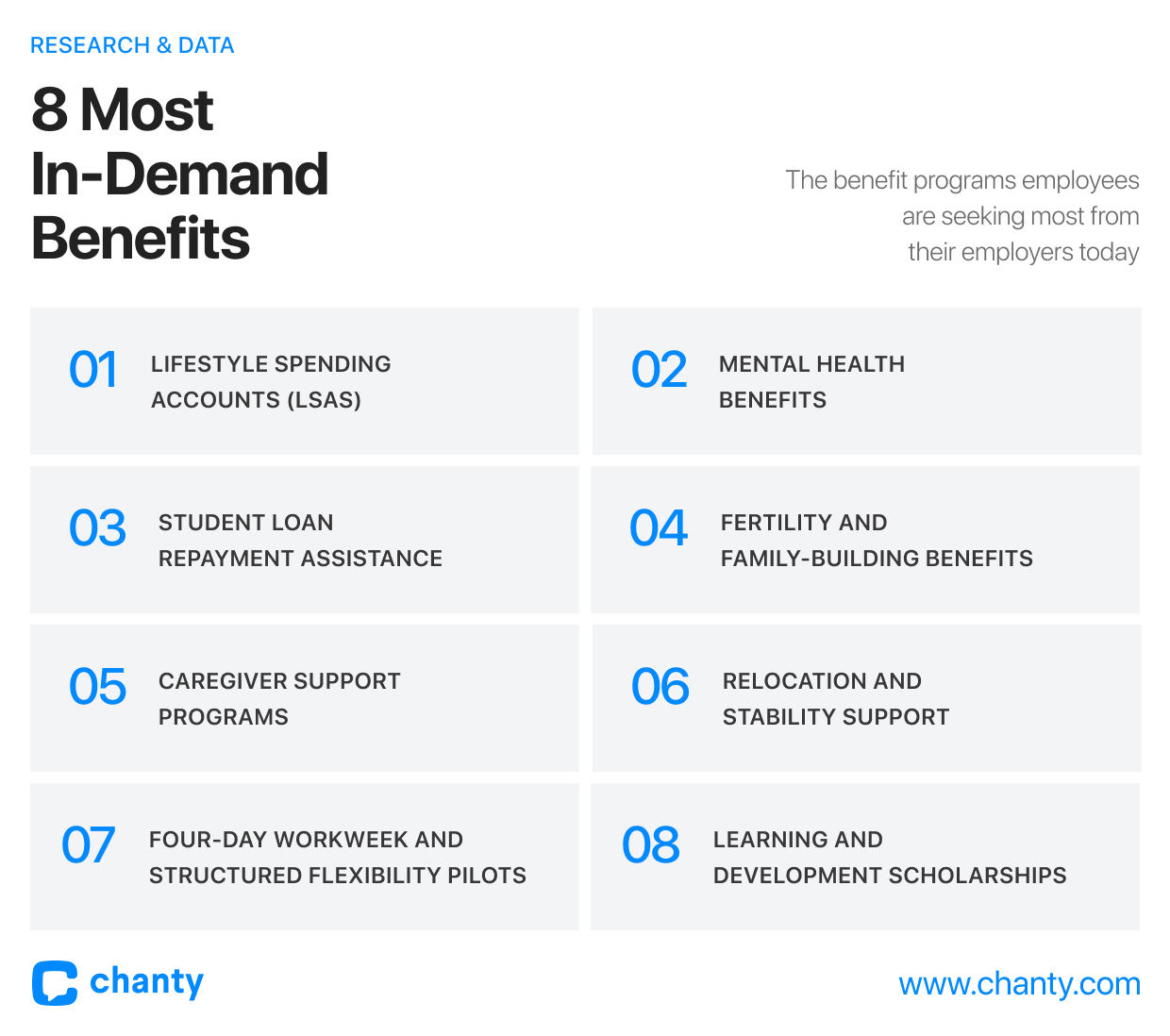
But some programs are genuinely reshaping the relationship between employers and employees in 2026. Not because they’re trendy, but because they solve real problems that real people bring to work with them every day. Here’s what’s actually moving the needle, and more importantly, how to make each one mean something.
Lifestyle Spending Accounts (LSAs)
The premise is elegant: instead of guessing what employees want, give them a defined budget and let them choose. Customizable benefit wallets and lifestyle spending accounts allow employees to direct funds toward whatever matters most to them – gym memberships, childcare, home office upgrades, or long-term savings. A 26-year-old cyclist and a 44-year-old parent of three don’t want the same things. An LSA doesn’t pretend they do.
The danger: an LSA with a $300 annual limit and a 12-page reimbursement form is not a benefit – it’s a bureaucratic obstacle wearing a benefit’s clothing. To make it real, set a meaningful budget (think $1,000–$2,000 annually), make the reimbursement process frictionless, and don’t restrict eligible categories to the point of absurdity. The message an LSA sends – “we trust you to know what you need” – is worth more than the dollar amount.
Mental health benefits with actual teeth
Employees can now access teletherapy and other mental health services, with real, measurable effects on their sense of support at work. That’s kind of progress that actually matters. But the gap between “we offer an EAP” and “we genuinely support your mental health” remains vast. Holistic mental health coverage in 2026 includes therapy sessions, burnout prevention programs, and digital mental health coverage accessible to both in-office and remote employees – not just an 800-number with a six-session cap buried in an onboarding document.
To make it real: partner with a provider that offers same-week appointments, not same-month. Offer dedicated paid mental health days – not floating holidays that require a manager’s approval and a silent admission that you’re struggling. And train your managers, because the research is clear that the most important mental health variable in any employee’s life is the person they report to.
Student loan repayment assistance
For millions of Millennial and Gen Z employees, student debt is not a background worry – it’s a monthly financial reality that shapes every major life decision. Employers are responding with practical tools like emergency savings programs, student loan assistance, and Roth 401(k) matching to reduce day-to-day financial strain. Wellhub The SECURE 2.0 Act now allows employers to match employee student loan payments with 401(k) contributions – meaning employees who can’t afford to save for retirement while repaying debt no longer have to choose.
To make it real: don’t offer a token $50/month contribution and call it a program. Work with a dedicated platform, communicate eligibility clearly, and treat it with the same visibility you give health insurance. For the right demographic, this benefit can be the single reason someone chooses you over a competitor paying 10% more.
Fertility and family-building benefits
Fertility coverage options now commonly include IVF, fertility medication support, adoption and surrogacy assistance, and navigation services that help employees understand their options and manage the process. A decade ago this was considered progressive. Today, in competitive talent markets, its absence is conspicuous.
The important nuance here: inclusive means inclusive. Benefits that cover only certain paths to parenthood, or only certain relationship types, signal exclusion as clearly as the absence of benefits at all. To make it real, ensure your policy covers adoption, surrogacy, same-sex couples, and single parents – and communicate that coverage explicitly, so people don’t have to guess whether they qualify.
Caregiver support programs
This is one of the most underbuilt categories in corporate benefits, and one of the most urgently needed. Caregiver referral networks, elder care coordination services, and backup care programs are gaining traction – particularly for mid-career employees who might otherwise feel forced to step away from work during difficult life transitions. Selerix Remember: nearly three quarters of Gen X employees identify as caregivers. Every day they spend searching for emergency childcare or navigating elder care logistics while trying to run a meeting is a day their employer could have helped with and didn’t.
To make it real: backup care programs only work if employees can access them without three days’ notice and a guilt trip. Partner with a provider that offers genuine emergency coverage, communicate the benefit proactively (don’t wait for someone to be desperate to discover it exists), and build manager awareness so no one feels they need to hide a caregiving crisis.
Relocation and stability support
This one doesn’t appear on many standard benefits checklists. But it should, especially now. The mid-2020s have made it impossible to ignore the fact that some employees are navigating genuine instability outside the office – conflicts, climate events, political uncertainty, or the kind of slow-burning insecurity that doesn’t make headlines but quietly destroys the ability to focus, perform, or plan. Most employers, when this happens to someone on their team, respond with sympathy and nothing structural.That gap is now a talent risk.
Real support goes beyond moving costs. It includes funded emergency relocation assistance, help with visas, temporary housing near company hubs, and local orientation for employees and their families. Some organizations offer a network of stable secondary locations and resettlement stipends to ease the financial burden of starting over. Mental health continuity during transitions is critical: relocation under pressure is one of the most disruptive experiences an adult can face, and waiting for performance to slip before noticing is not support – it’s reactive management.
To make it real: write the policy before anyone needs it. Define what triggers eligibility, what the company funds, and for how long – and communicate it during onboarding, not in the middle of a crisis. When employees see that thoughtfulness in advance, trust forms almost instantly, in a way no perks or slogans can replicate.
Four-day workweek and structured flexibility pilots
The four-day workweek has moved from a radical experiment to legitimate policy option. Flexible work options gaining traction include four-day workweek pilots, unlimited PTO frameworks, “work-from-anywhere” months, and sabbatical programs for long-tenured employees. The evidence from large-scale pilots in the UK, Iceland, and Japan consistently points in the same direction: productivity holds, burnout decreases, and retention improves.
The critical word is “structured.” Unlimited PTO that no one takes because the culture doesn’t support it is not a benefit – it is a liability transfer. A four-day workweek that quietly redistributes 40 hours of work into 32 hours of panic is not a benefit either. To make it real, these programs require honest workload assessment, manager training, and genuine organizational permission to actually use the time off. The policy is the easy part. The culture is the work.
Learning and development stipends
Financial wellness and growth remain central to 2026 benefits packages, with loan repayment, tuition reimbursement, and home-office stipends extending beyond large enterprises to smaller businesses competing for talent. TalentHR An L&D stipend – a dedicated annual budget an employee controls and directs toward courses, certifications, conferences, or books – signals something that no pizza party ever could: we are investing in your future, not just your present output.
To make it real: $200 per year is not an L&D program. A meaningful stipend starts at $1,000 and comes with a clear, simple process for using it. Critically, make time for learning during working hours. An employee who has to spend their weekends upskilling to keep their job will eventually conclude that the investment is flowing in only one direction.
AI-powered benefits personalization
Benefits personalization through AI-powered tools is emerging as one of the defining trends of 2026, allowing employees to navigate complex benefits decisions with guidance tailored to their life stage, health situation, and financial goals rather than wading through a 60-page PDF during open enrollment.
The genuine risk here is the gap between what these platforms promise and what they deliver. A chatbot that routes every question back to a generic FAQ is not personalization. To make it real: invest in tools that actually learn employee behavior and usage patterns, that surface relevant benefits proactively, and that communicate in plain language. Personalization technology is only valuable if it reduces confusion – and right now, confusion is the enemy.
A pattern runs through every program on this list. None of them are complicated in concept. All of them become theater the moment an organization treats implementation as a checkbox rather than a commitment. The snack bar and the neon sign failed not because fun is bad, but because they answered a question nobody was asking. These programs succeed when they answer the questions employees actually bring to work: Can I afford to get better? Can I build a future here? Can I take care of the people who depend on me? Can I grow?
Answer those questions concretely, consistently, and in language people can understand – and the benefits conversation takes care of itself.
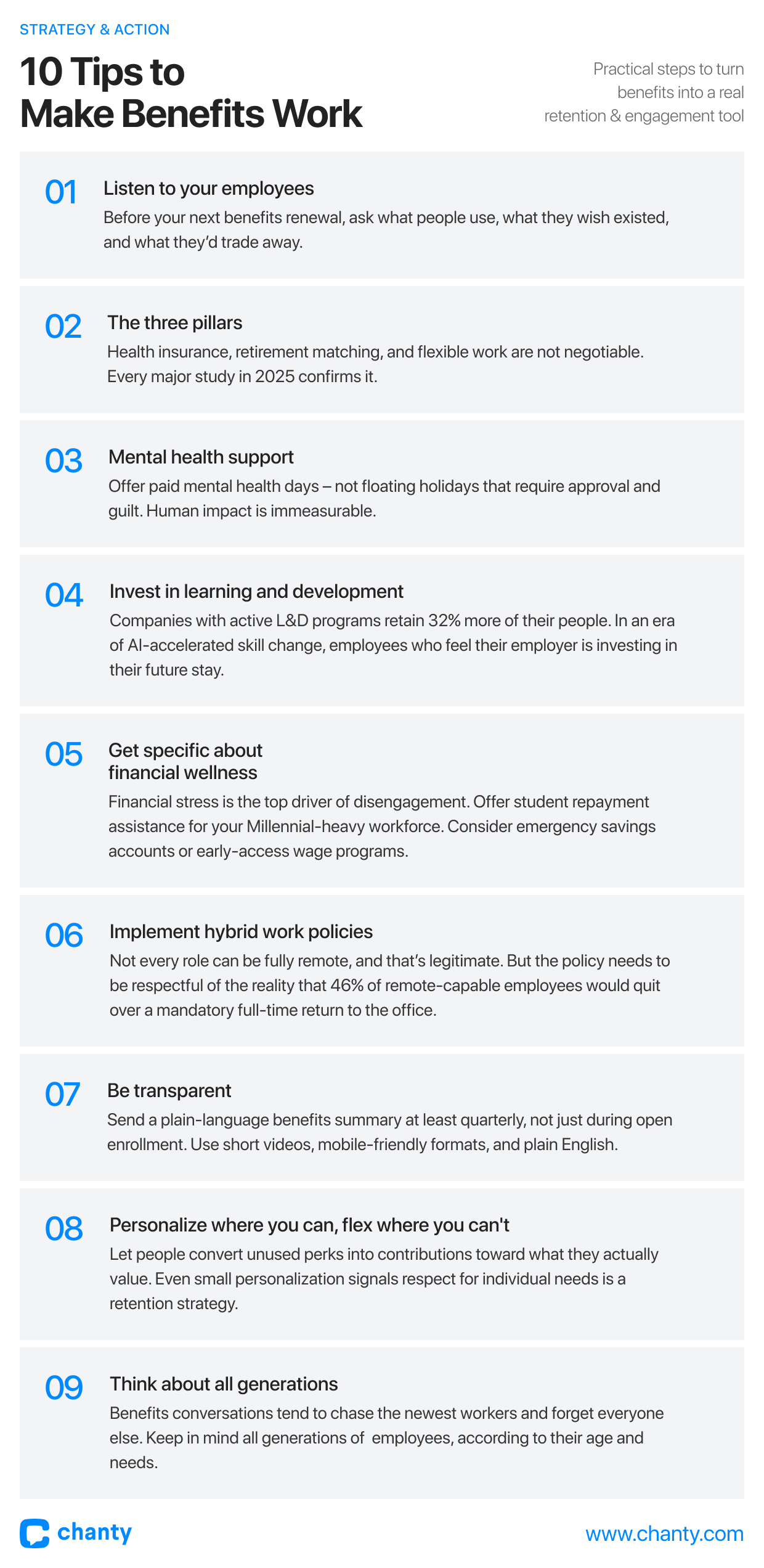
10 ways to make employee benefits actually work in 2026
- Listen before you design
Before your next benefits renewal, survey your workforce – broken down by generation, life stage, and role type. Ask what people use, what they wish existed, and what they’d trade away. The answers will surprise you, and they will cost far less to implement than the turnover you’re currently funding. - Protect the three pillars, even under budget pressure
Health insurance, retirement matching, and flexible work are not negotiable. Every major study in 2025 confirms it. If cost pressures require hard choices, cut the espresso machine before you cut the 401(k) match. Employees forgive a lot, but they remember when their security is compromised. - Make mental health support real, not symbolic.
An 800 number in a benefits packet is not mental health support. Partner with a quality EAP, offer actual paid mental health days – not floating holidays that require approval and guilt. Train your managers to talk about wellbeing without stigma. The ROI is measurable, and the human impact is immeasurable. - Invest in learning and development like it matters.
Companies with active L&D programs retain 32% more of their people. That is not a soft statistic – it’s a hard financial argument. And in an era of AI-accelerated skill change, employees who feel their employer is investing in their future stay. Those who feel left behind leave. - Get specific about financial wellness.
Stop treating financial wellbeing as a checkbox. Offer student repayment assistance for your Millennial-heavy workforce. Provide access to an independent financial advisor – not a vendor trying to sell products. Consider emergency savings accounts or early-access wage programs. Financial stress is the top driver of disengagement. Addressing it differently changes lives. - Design hybrid work policies you can defend and sustain.
Not every role can be fully remote, and that’s legitimate. But the policy needs to be honest, consistent, and respectful of the reality that 46% of remote-capable employees would quit over a mandatory full-time return to the office. Build something you can stand behind, and communicate it clearly. - Close the perception gap with radical transparency.
74% of employers think their benefits are well-received. Only 67% of employees agree. The difference lives in communication. Send a plain-language benefits summary at least quarterly, not just during open enrollment. Use short videos, mobile-friendly formats, and plain English. If people don’t know what they have, they can’t value it. - Personalize where you can, flex where you can’t.
You may not be able to build a fully modular, choose-your-own benefits architecture overnight. But you can start. Offer a lifestyle spending account that employees direct themselves. Let people convert unused perks into contributions toward what they actually value. Even small personalization signals respect for individual needs – and respect is a retention strategy. - Think about the generations you’re forgetting.
Benefits conversations tend to chase the newest workers and forget everyone else. Gen X caregivers need eldercare support and backup care options. Baby boomers need phased retirement pathways and recognition programs that honor experience. The cost of losing a senior leader to a competitor who pays more attention is extraordinary. - Measure, iterate, and show people you listened.
Run a benefits satisfaction survey. Track utilization data. Then – and this is the part most organizations skip – tell your employees what you changed based on what they said. “We heard you, and here is what we did.” That single act of follow-through builds more trust than a dozen new perks ever could.
Final word
Remember the two employees from the beginning of this article? Their story is fictional, but the pattern it illustrates is happening in hundreds of thousands of workplaces right now.
The good news, and there genuinely is good news here, is that the gap between what employees need and what employers provide is not a resources problem. It’s an attention problem. The organizations closing that gap are not necessarily the richest ones. They are the ones that take seriously the idea that work is something people do with their lives, not just their time.
In 2026, the best employee benefit of all remains what it has always been: the feeling of being seen. Benefits are the most concrete, measurable way an organization can express that. Use them wisely.