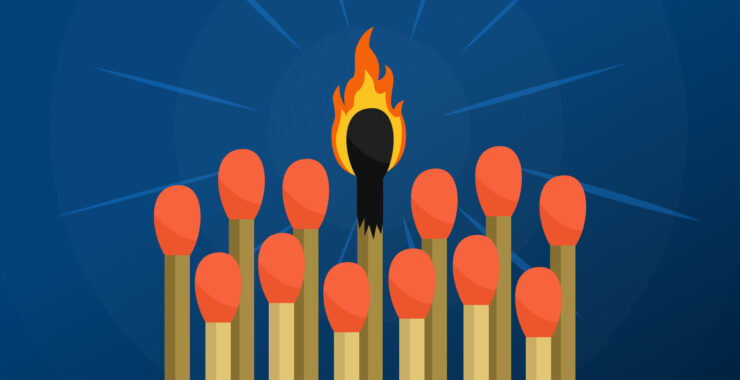
Think of a match. That first strike is extraordinary – a tiny, violent miracle of light and heat, bright enough to illuminate a dark room, warm enough to make you believe it could last forever. But a match was never designed to last. It burns because it has no choice. It gives everything it has, all at once, in a single brilliant flare – and then it’s done. A wirp of smoke. Ash.
Too many organizations have quietly decided that employees are matches. Strike them. Use the light. Discard them when they go dark. Hire another box.
But here is what the match metaphor misses – what the mythology gets right. There is a creature that burns too, but has a different ending. The phoenix, the ancient symbol of fire and renewal, does not simply combust and disappear. It burns down entirely – to nothing, to the very root of itself – and then, from that same ash, it rises again. Not diminished, but transformed, wiser, freer, full of ideas it couldn’t have had before the fire.
The difference between a match and a phoenix is not the flame. It is what happens after it goes out. It is whether anyone believed the burning was worth tending – whether anyone gave it time, space, and something to rise from.
This is burnout. Not the dramatic, cinematic breakdown, but the quiet, cumulative erasure of a person’s light. For decades, it was dismissed as a personal weakness – a failure of resilience. Today, the World Health Organization classifies it as an occupational syndrome, a measurable consequence of chronic, unmanaged workplace stress. And the data from 2024 and 2025 tells us, with uncomfortable clarity, that it is no longer the exception. It is the rule. Across industries, continents, and generations, the world’s workforce is going dark – not because people are fragile, but because they are being treated as disposable.
The question the numbers force us to ask is not why are so many employees burning out? The question is: what would it take to let them rise again?
Burnout crisis in numbers
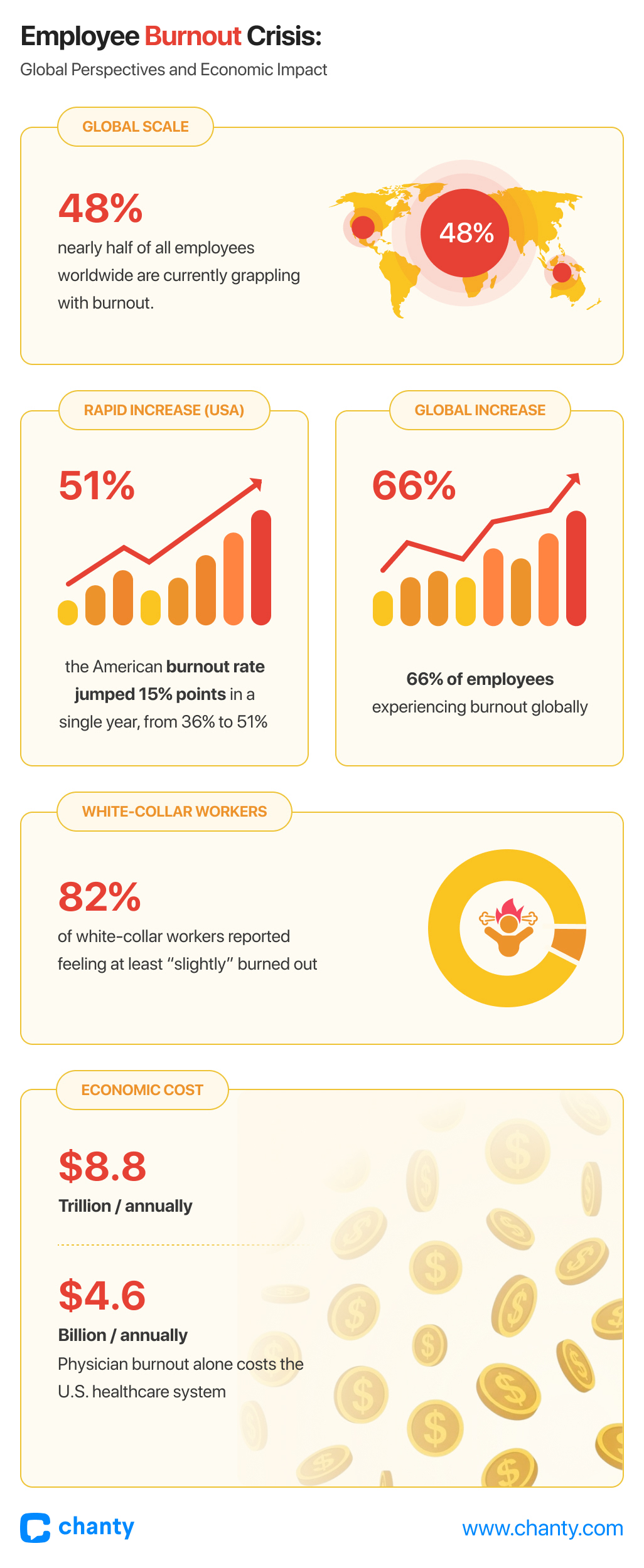
- In June 2024, the BostonConsulting Group published findings from a survey of more than 11,000 workers across eight countries – Australia, Canada, France, Germany, India, Japan, the United Kingdom, and the United States. Their conclusion was stark: 48% – nearly half of all employees worldwide are currently grappling with burnout. Not once in a while, not occasionally – right now.
- Grant Thortnton’s 2024 State of Work in America survey – tracking 1,500 full-time U.S. employees – found something even more alarming: the American burnout rate jumped 15% points in a single year, from 36% in 2023 to 51% in 2024. This is not just a trend, it’s a complete rapture.
- By early 2025, a Modern Health study published by Forbes had marked a new all-time high: 66% of employees experiencing burnout globally.
- DHR Global’s survey of 1,500 white-collar workers across North America, Asia, and Europe found that 82% report feeling at least “slightly” burned out – with no significant differences across geographies or job levels.
Burnout, in other words, doesn’t respect borders, industries, or pay grades. It is, inthe truest sense, a universal crisis.
- The economic cost is as breathtaking, as the human cost. Gallup’s 2024 State of the Global Workplace report – drawing on data from more than 128,000 workers across 160 countries – estimates that low engagement and burnout cost the global economy $8.8. Trillion annually. That figure represents approximately 9% of global GDP.
- The American Institute of Stress puts the U.S. portion alone at $300 billion per year.
- The AMA calculates that physician burnout alone costs the U.S. healthcare system $4.6 billion annually. These are not soft, qualitative losses. They are measurable, structural damage.
What are the main causes of employee burnout?
The temptation is to blame burnout on individual weakness – on people who can’t handle pressure, who lack discipline, who simply need to toughen up. This is both inaccurate and unfair. The research consistently points to systematic, structural causes that no amount of personal resilience can fully absorb.
Overwork is the foundation
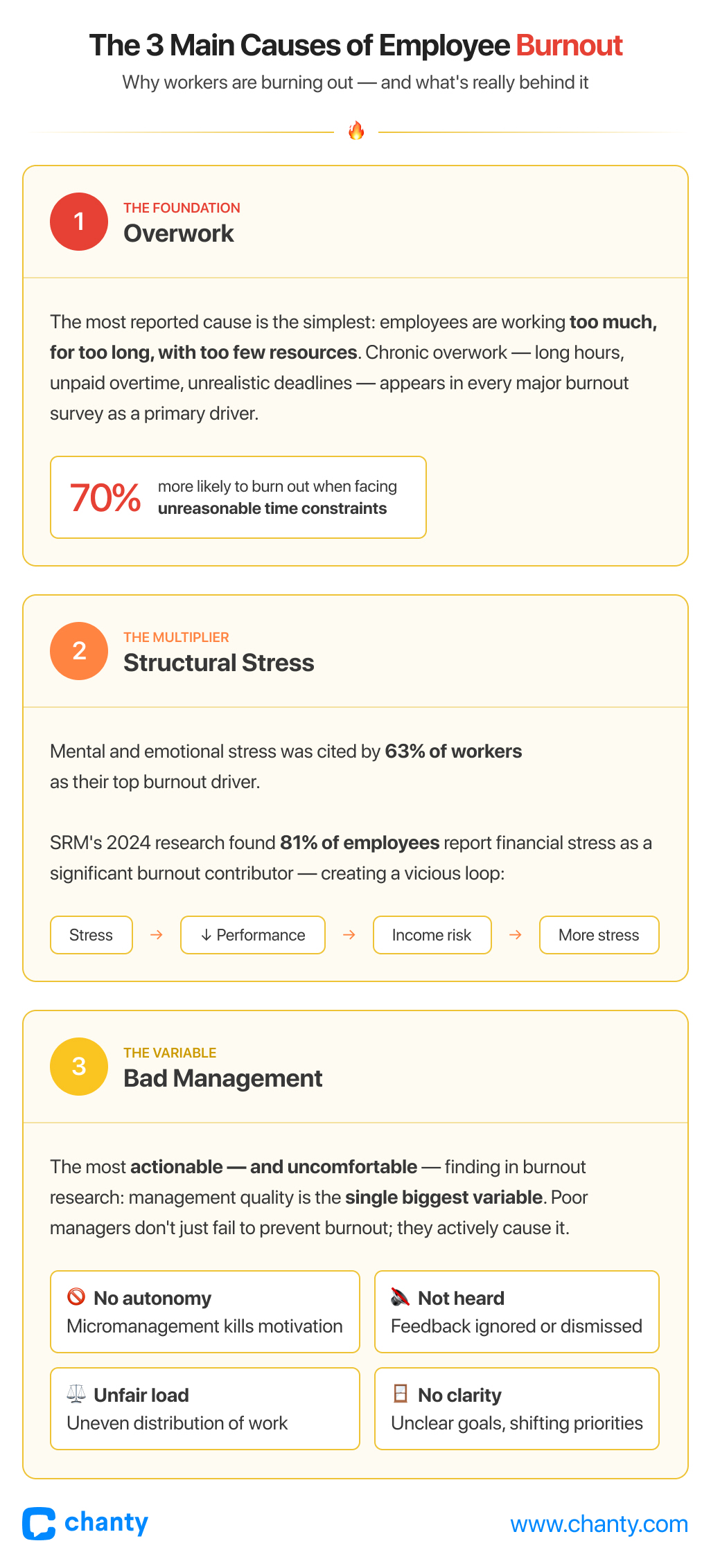
The most reported cause is the simplest: employees are working too much, for too long, with too few resources. Chronic overwork – long hours, unpaid overtime, unrealistic deadlines, the world in chaos – appears in every major burnout survey as a primary driver. Employees are 70% more likely to burn out when facing unreasonable time constraints, and 2024’s trend of cost-cutting and lean teams meant that many workers were quietly absorbing the workloads of colleagues who had been let go, with no recognition or compensation.
Stress has become structural
In 2024, mental and emotional stress was cited by 63% of surveyed workers as their top burnout driver. This is not simply about heavy inboxes. Post-pandemic anxiety, political volatility, cost-of-living pressure, geopolitical uncertainty, the relentless pace of AI-driven change in the workplace – all of this has combined into a kind of ambient dread that employees carry into every meeting, every task, every professional interaction. And then they carry it home, too. It’s difficult to stay energized and productive when every day feels like the world is on the verge of collapse.
The SRM’s 2024 research found that 81% of employees report financial stress as a significant contributor to burnout – creating a vicious loop: stress reduces performance, reduced productivity jeopardises income, income anxiety intensifies stress. And there is no off switch.
Bad management is the multiplier
Perhaps the most actionable finding in all the burnout research is also the most uncomfortable for organizations to accept: management quality is the single biggest variable.
McKinsey’s research on workplace toxicity shows that employees in high-toxicity environments are eight times more likely to burn out than their counterparts in healthy organizations.
Gallup found that workers in badly managed companies experience nearly 60% more daily stress than the global average. The problem, in other words, is not always the workload. It is the climate in which that workload is carried, and managers control this climate.
Key takeaway: Eliminating workplace toxicity: unapproachable leaders, micromanagement, lack of transparency – would reduce burnout risk by a factor of eight. Work culture is not a soft issue – it’s a measurable health variable.
Which industries and demographics have the highest burnout rates?
One of the most unsettling findings from the 2024-2025 research is how democratically burnout has spread. It does not discriminate neatly by age, gender, or seniority – though certain groups are bearing a disproportionate share of weight.
Younger workers are burning out earlier and harder. A Wellhub survey found that 68% of GenZ employees and 61% of Millennials report burnout – compared to 47% of Gen X and 30% of Boomers.
A poll published in March 2025 by Talker research found that one in four Americans is burned out before the age of 30, with peak burnout occurring at 25 – seventeen years earlier than the historical national average of 42. A generation is entering the workforce already running on empty.
Women continue to bear a heavier burden. CERP research found that women are three times more likely than men to experience clinical burnout – and that by age 40, one in seven women has burned out.
McKinsey’s 2024 Women in the Workplace report found 43% of women in senior leadership roles report burnout, versus 31% of their male counterparts. The higher the position, the wider the gender gap in exhaustion.
Even the sectors that built their identity around toughness and endurance are cracking. Healthcare burnout reached 82% in Emolument’s 2024 sector analysis. The tech industry, once synonymous with the romantic mythology of the grind, reports 82% of workers feeling close to burnout. Attorneys, teachers, financial professionals, and construction workers all show rates above 55%. There is nowhere left to hide.
Remote work and burnout: The loneliness no one’s talking about
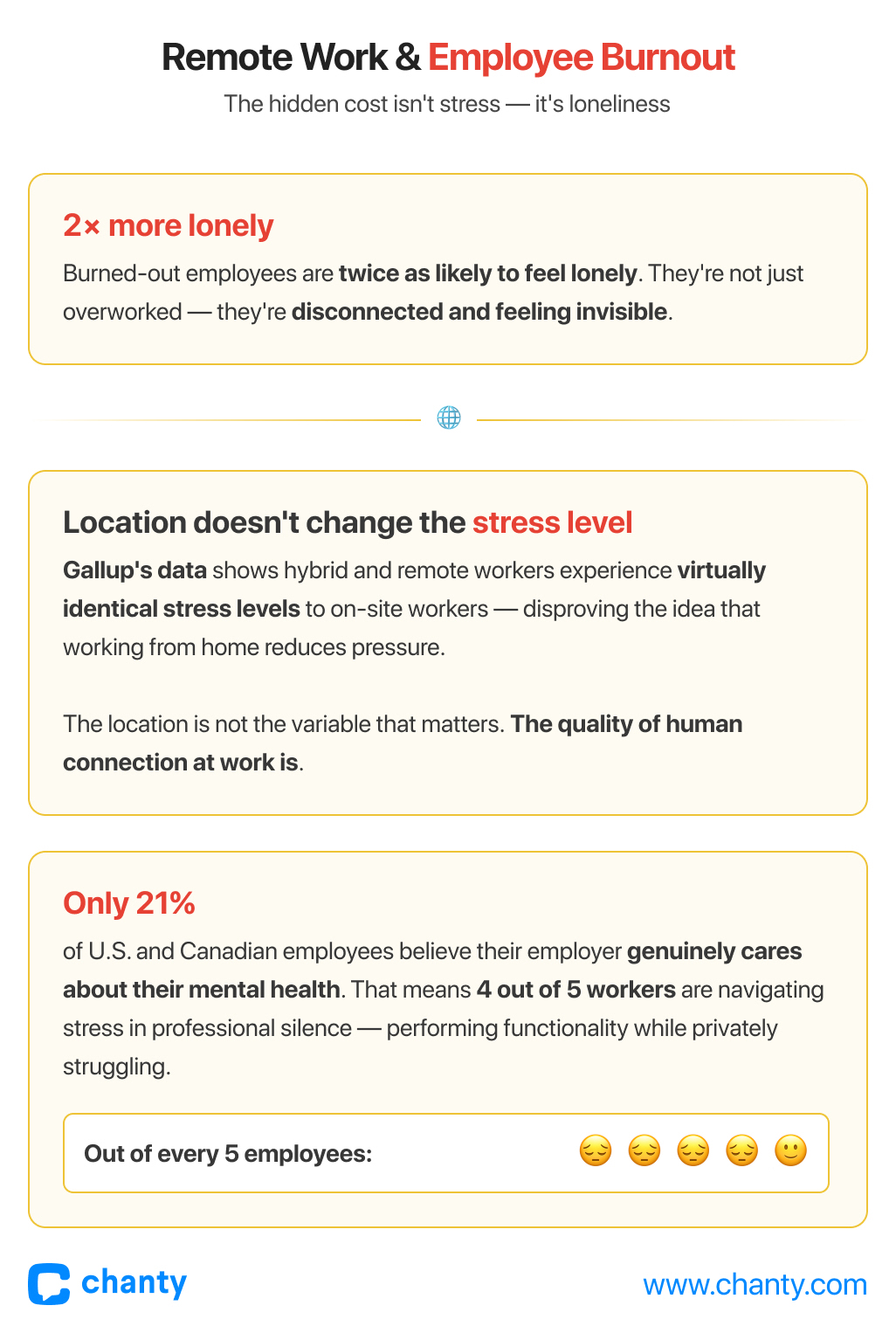
Buried within the statistics is a finding that deserves far more attention than it typically receives: burned-out employees are twice as likely to feel lonely. They’re not just overworked or stressed – they’re lonely, disconnected, and feeling invisible.
This is not a coincidence. It is causality – and it runs in both directions. Isolation accelerates burnout, and burnout breeds isolation. When you are exhausted and depleted, you withdraw. Your social battery is at its lowest. You send fewer messages. You skip the virtual coffee and gossip sessions. You decline the optional check-in. And the quieter you become, the harder it is for anyone around you to notice that something is wrong – because in a digital workspace, silence and absence look the same.
The shift to remote and hybrid work has made this dynamic significantly harder to manage. Gallup’s data shows that hybrid and remote workers experience virtually identical stress levels to on-site workers – disproving the early pandemic narrative that working from home would reduce pressure. It turns out, the location is not the variable that matters. The quality of human connection at work is.
Only 21% of U.S. and Canadian employees believe their employer genuinely cares about their mental health, according to Meditopia’s 2025 research. That means four out of five workers are navigating their stress in professional silence – showing up to meetings, meeting deadlines, performing their duties – while privately struggling to stay afloat. When the office was a physical space, there were moments of accidental humanity: the hallway conversation, the shared lunch, the look across the room that said something no Slack message ever could. Remote work didn’t kill connection. It simply forced us to build it intentionally, even when that feels like an introvert’s nightmare.
Connection isn’t a perc. It’s the antidote.
The research on what actually reduces burnout converges on something that is both simple and hard to engineer at scale: people need to feel seen, heard, and genuinely part of something. Not just informed or managed – connected.
This is what makes communication tools not just a productivity question, but a wellbeing question. When your team is scattered across cities and time zones, each person working from their kitchen table, their spare room, their coffee shop corner, the digital spaces where you show up for each other matter enormously. A fragmented, noisy, overwhelming communication environment adds to the cognitive load that’s already pushing people toward burnout.
Imagine reading the news, losing a few hours to TikTok, trying to stay on top of your tasks, while notifications from five different tools keep trying to create a symphony of corporate hell. I don’t even know how to comment on it. You just feel it deeply in my overstimulated soul. A calm, intentional, and human one toll can quietly do the opposite.
When work happens online, the quality of how we communicate isn’t a technical detail – it shapes whether people feel part of a team or alone inside one.
Chanty was built for exactly this reality. It’s a team communication and collaboration app designed to reduce digital noise rather than add to it – with messaging, tasks, calls, and shared history in one focused place, so your team doesn’t have to sprint across five different platforms just to have a human conversation. For remote and hybrid teams already carrying the weight of isolation and overload, that clarity isn’t a small thing. It’s the difference between a team that functions and a team that actually connects.
Because the antidote to burnout isn’t more motivational posters or another wellness webinar. It’s teams that genuinely know what’s happening with each other – teams that communicate well, check in often, and make space for people to be more than their output.
Wrapping up
The employee burnout crisis of recent years is not a temporary spike. It’s a structural reckoning – the accumulated result of decades of overwork culture, pandemic disruption, digital fragmentation, and the slow erosion of genuine human connection in professional life. The numbers are not going to improve on their own.
What they are telling us, clearly and loudly, is that the way we work is unsustainable, and that the companies and teams that will emerge healthiest from this moment are the ones willing to look honestly at their cultures, their communication, and their commitment to the actual human beings doing the work.
The numbers make the case in the coldest possible terms: employees with untreated depression incur 149% higher annual healthcare costs than their peers. Proactive behavioural health interventions, on the other hand, can reduce physical health claims by 14% and deliver $1,070 in net savings per participant in the first year alone. Addressing burnout early is not charity. It is the single most cost-effective decision an organisation can make.
Burnout isn’t personal failure. It is an organisational signal. And the question is whether we’re listening.