
Just imagine. You can work from anywhere. Your employer trusts you to manage your schedule. Meetings are productive instead of exhausting. At the end of the day, you close your laptop feeling fulfilled rather than drained.
Your manager supports your growth. Your personal goals align with your professional path. The career ladder feels stable enough that you don’t constantly worry about what comes next. Technology handles repetitive tasks, leaving more time for meaningful work, creativity, and collaboration. For a moment, it sounds like we’ve finally figured it out.
Then reality kicks in.
The biggest workplace story of the past few years may not be remote work, return-to-office mandates, or even AI. It’s the growing gap between what employees expected modern work to become and what it actually feels like.
This gap raises an important question: how satisfied are employees with their jobs today?
Yes, many employees have more freedom than ever before. But that freedom often comes with trade-offs. Remote work can mean weaker connections with colleagues, fewer mentoring opportunities, and a growing sense of isolation. Career stability also feels increasingly fragile.
Open LinkedIn on any given day, and you’re likely to see another round of layoffs, restructuring announcements, hiring freezes, or stories about professionals struggling to find their next role. Meanwhile, the rise of AI has created both excitement and uncertainty, leaving many employees wondering what their jobs will look like a few years from now.
Work-life balance remains another unresolved challenge. While some organizations genuinely support employee wellbeing, others still operate under the expectation that work should come first, leaving little time or energy for life outside the office.
At the same time, modern work isn’t entirely disappointing. Many employees value flexibility, autonomy, and opportunities that would have been difficult to imagine just a decade ago.
The reality isn’t all good or all bad. It’s far more complex.
Key takeaways:
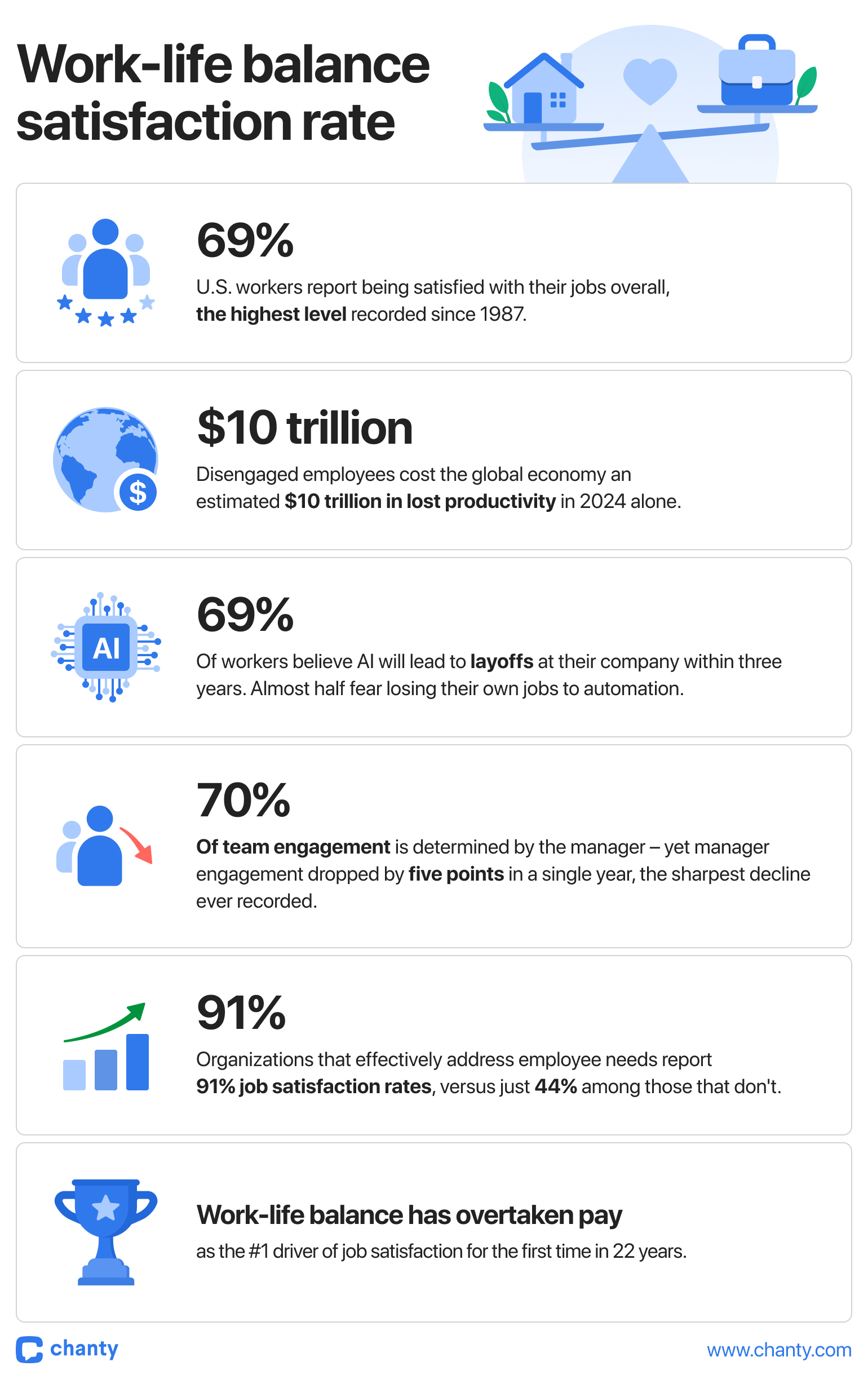
- 69% of U.S. workers report being satisfied with their jobs overall, the highest level recorded since 1987. (The Conference Board, 2025/2026)
- Disengaged employees cost the global economy an estimated $10 trillion in lost productivity in 2024 alone. (Gallup, 2026)
- Work-life balance has overtaken pay as the #1 driver of job satisfaction for the first time in 22 years. (Randstad, 2025)
- 69% of workers believe AI will lead to layoffs at their company within three years. Almost half fear losing their own jobs to automation. (Modern Health / Mercer, 2026)
- 70% of team engagement is determined by the manager – yet manager engagement dropped by five points in a single year, the sharpest decline ever recorded. (Gallup, 2026)
- Organizations that effectively address employee needs report 91% job satisfaction rates, versus just 44% among those that don’t. (SHRM, 2026)
What is employee satisfaction?
In organizational psychology, employee satisfaction is defined as the degree to which an individual’s expectations, needs, and values are met by their work experience. It is a multidimensional construct, shaped by factors ranging from compensation and autonomy to relationships with management, perceived fairness, and alignment between personal values and organizational purpose.
Unlike engagement, which measures behavioral investment in work, satisfaction is primarily attitudinal: it reflects how an employee feels about their job, not necessarily how much effort they pour into it. That distinction matters because a person can be satisfied without being engaged, and engaged without being satisfied. Both states carry different implications for performance, retention, and organizational health.
In plain words, employee satisfaction is the answer to the question every person asks themselves at the end of a workday, usually without realizing it. Was that worth it? Not just the paycheck. The energy spent, the hours given, the parts of yourself you brought to the table.
When the answer is consistently yes – when the work feels fair, meaningful, and human – people stay, contribute, and care. When the answer starts drifting toward not really, something quietly shifts. They’re still there. They still send the emails and attend the meetings. But a part of them has already left.
That quiet shift is what makes employee satisfaction so consequential for business. It doesn’t announce itself. It doesn’t show up in a resignation letter. It shows up in a meeting where nobody speaks up. In a project delivered on time but without imagination. In a talented person who stops raising their hand.
Key employee satisfaction statistics for 2026
Before we explore what’s driving satisfaction and what’s eroding it, here’s a snapshot of where things stand today. These numbers are worth holding in your head as you read, because they form the backdrop of everything that follows.
The satisfaction-engagement paradox. 69% of U.S. workers are satisfied with their jobs overall, the highest level since tracking began in 1987, according to Gallup data. But beneath that headline number, the reality is more uneven. Satisfaction gains are concentrated among higher-income workers, men, and those confident in AI’s impact on their careers. In contrast, women, lower-income workers, and employees who feel left behind in AI adoption report significantly lower satisfaction levels.
At the same time, global employee engagement – a deeper, more behavioral metric – fell to just 20% in 2025, its lowest level since 2020, according to Gallup’s State of the Global Workplace 2026 report. You can be satisfied with your job and still not be invested in your work. That gap is where the real story lives.
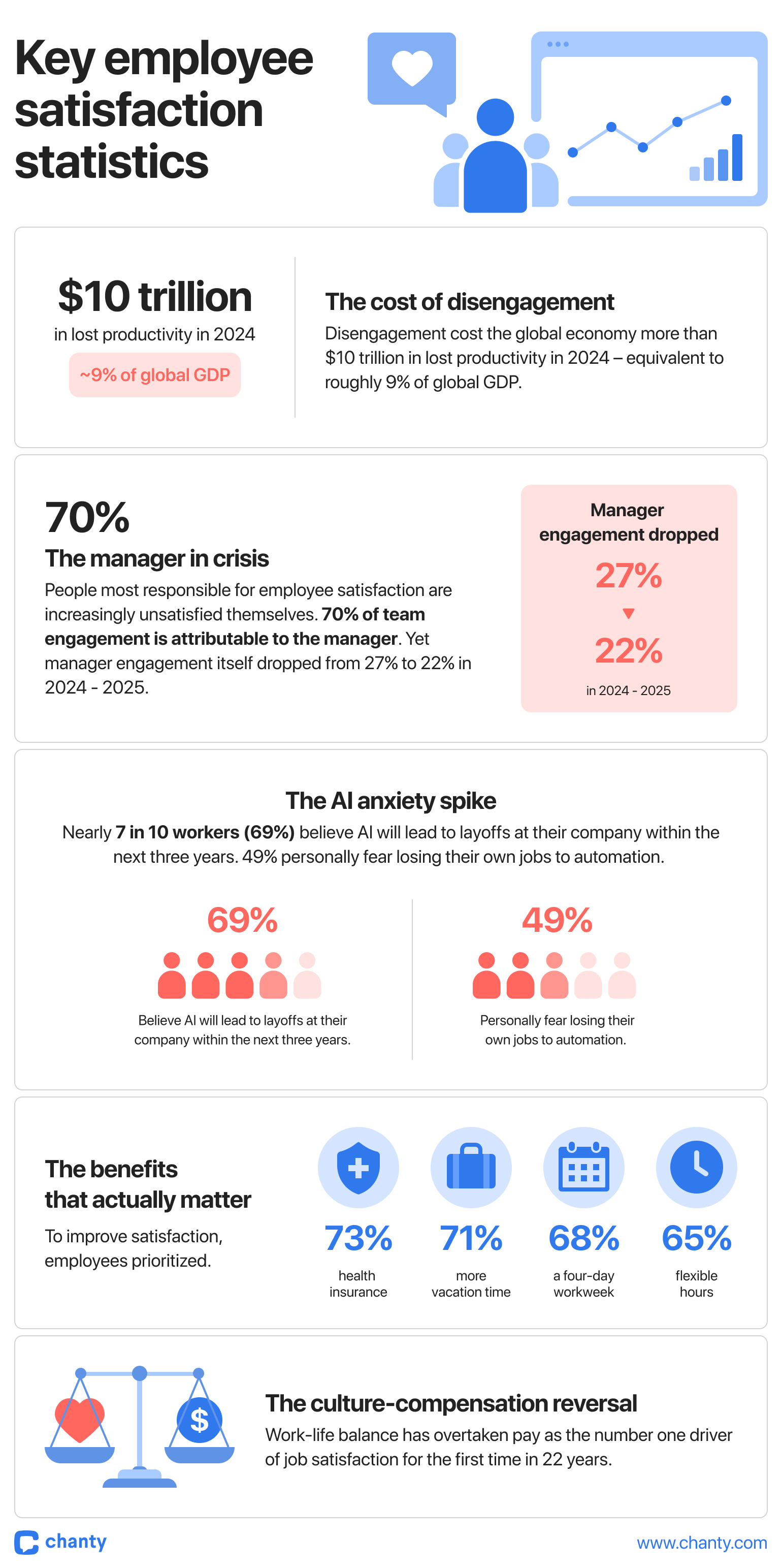
The cost of disengagement. Gallup estimates that disengagement cost the global economy more than $10 trillion in lost productivity in 2024, equivalent to roughly 9% of global GDP. This isn’t an abstract HR problem. It’s a business crisis playing out on a civilizational scale.
The manager in crisis. Gallup’s data shows that 70% of team engagement is attributable to the manager. Yet manager engagement itself dropped from 27% to 22% between 2024 and 2025 – the largest single-year decline on record. The people most responsible for employee satisfaction are increasingly unsatisfied themselves.
The AI anxiety spike. Nearly 7 in 10 workers (69%) believe AI will lead to layoffs at their company within the next three years, according to research published in 2026. Almost half (49%) personally fear losing their own jobs to automation. That fear is already affecting mental health for 24% of workers today.
The benefits that actually matter. When asked what would increase their satisfaction, employees prioritized better health insurance (73%), more vacation time (71%), a four-day workweek (68%), and flexible working hours (65%). Flashy office perks and foosball tables didn’t make the list.
The culture-compensation reversal. Work-life balance has overtaken pay as the number one driver of job satisfaction for the first time in 22 years, according to The Conference Board’s 2025 data. Culture has become the single most efficient lever for improving workforce satisfaction – more powerful than compensation alone.
These numbers point to a workforce that is increasingly disconnected from its own work, anxious about the future, and hungry for something more meaningful than a paycheck and a ping-pong table. The sections that follow explain why.
Employee engagement by world region
| Region | Engaged | Not Engaged | Actively Disengaged |
| U.S. & Canada | 31% | 52% | 17% |
| Latin America & Caribbean | 30% | 59% | 11% |
| South Asia (incl. India) | 21% | 59% | 20% |
| Sub-Saharan Africa | 19% | 63% | 18% |
| East Asia | 18% | 66% | 16% |
| Europe | 12% | 73% | 15% |
| Middle East & North Africa | 14% | 61% | 25% |
Source: Gallup State of the Global Workplace 2026.
Europe holds the lowest engagement rate of any measured region. The UK sits at 10% – near the bottom globally.
The European figures are striking enough to warrant a pause. In a region known for strong labor protections, generous leave policies, and relatively high wages, only 13% of workers are engaged. This is a reminder that satisfaction is not the same as security. People can have good conditions on paper and still feel disconnected from the meaning of their work.
What influences employee satisfaction most in 2026
Employee satisfaction has never been a simple equation. But the variables have shifted significantly over the past few years, and especially in 2026.
By the numbers
- 40% of workers would leave if required to give up flexible work (Owl Labs, 2025)
- 30% of workers are highly satisfied with their pay, the lowest-rated aspect of work (Pew Research)
- 44% of employees cite better career growth as their top reason for job searching (Owl Labs, 2025)
- 76% of U.S. workers report some level of burnout; over half experience it at moderate to severe levels (Mind Share Partners, 2025)
- 5.7 percentage points – the largest single-year jump in job satisfaction in survey history (The Conference Board, 2025)
Flexibility is no longer a perk – it’s a baseline
A few years ago, flexible work was something employers offered to attract talent. Today, it’s something employees expect as a minimum condition. Hybrid workers now report the highest satisfaction scores of any working arrangement. Remote employees show the highest engagement rates at 30% – but also experience greater stress, suggesting that flexibility without support creates its own problems.
The numbers are stark: 22% of workers say they would expect a pay raise if required to give up hybrid or remote options, and 40% say they would leave for a job with more flexibility. Flexibility and pay are now treated as interchangeable by a significant portion of the workforce.
Pay still matters, but it’s no longer enough
Only 30% of workers report being highly satisfied with their pay, consistently the lowest-rated aspect of work across surveys.
That dissatisfaction is real and shouldn’t be minimized. But what’s striking is that pay alone can no longer compensate for poor culture, bad management, or a lack of purpose. Employees in strong cultures report higher satisfaction regardless of pay level. Employees in weak cultures report lower satisfaction even at premium salaries.
This doesn’t mean companies should pay people less. It means they can’t outsource employee satisfaction to the payroll department anymore.
Career development has become a retention lever
The ask has shifted from promotions to visibility. One of the top reasons employees say they’re looking for new roles is the desire for stronger career growth opportunities (44%), according to Owl Labs’ 2025 State of Hybrid Work report.
Employees aren’t just asking for promotions. They’re asking for visibility into what their future looks like. When that visibility disappears, or when growth feels inconsistent or dependent on chance, people begin to look elsewhere even if they are not actively dissatisfied.
In many cases, the first signal is not resignation, it quiet disenagagement.
Workload is quietly breaking people
Headline satisfaction trends and burnout levels are not contradictory. They are happening at the same time.
Job satisfaction has increased in recent data, including a 5.7 percentage point jump in 2025, the largest single-year increase on record. At the same time, 76% of U.S. workers report some level of burnout, with more than half experiencing moderate to severe symptoms such as anxiety or emotional exhaustion, according to Mind Share Partners.
This combination reflects a simple reality. Many people are still glad to have work, but increasingly strained by how that work is structured.
One contributing factor is workload distribution. Around 36% of workers report heavier workloads due to unfilled positions. When companies reduce headcount but maintain output expectations, the remaining work doesn’t disappear. It accumulates.
In most cases, it lands with the people who stay.
Employee satisfaction varies sharply by industry
Not all sectors experience these pressures in the same way. Industry-level data shows significant variation in satisfaction, suggesting that the nature of work itself still plays a major role in how sustainable and meaningful it feels.
| Industry | Satisfaction level | Key trend |
| Construction | Highest – 22-point lead over #2 for 22 consecutive months | Consistent top performer; autonomy and craft identity cited |
| Agriculture, Forestry & Fishing | 89% say they love or like their work | Leads all sectors in job enjoyment |
| Professional Services | 53% in “quality jobs” (Gallup) | High autonomy; strong purpose alignment |
| Finance | 48% in “quality jobs”; eNPS up 18% in H1 2025 | Volatile but rebounding; AI-adjacent anxiety high |
| Technology | eNPS up 11% in H1 2025 | Recovering post-layoffs; satisfaction uneven by role |
| Travel & Hospitality | eNPS down 2% in H1 2025 | Workload pressure; post-pandemic fatigue |
| Retail & Warehousing | 26% in “quality jobs” | Lowest satisfaction concentration globally |
| Leisure & Hospitality | 29% in “quality jobs” | Chronic undervaluation; recognition gap severe |
| Education | Only sector to see satisfaction decline in Q1 2025 | Burnout, pay frustration, and policy uncertainty |
Sources: BambooHR Q1–Q2 2025 industry eNPS data; Gallup Quality Jobs Index 2025; YouGov 2025.
One pattern stands out across sectors.
The highest satisfaction is not always found in the highest-paying industries. In many cases, it appears in roles where people can see tangible outcomes of their work, maintain a sense of craft, and experience a direct link between effort and result.
Construction is a clear example of this. It is not typically associated with premium compensation or progressive workplace policies, but it consistently ranks among the highest in satisfaction. The defining factor is often not the benefits structure, but the sense of producing something real.
The emotional landscape of work in 2026
Numbers tell part of the story. But there’s an emotional subtext to the 2026 workplace that statistics alone can’t fully capture. To understand what employee satisfaction really means right now, you have to understand what people are carrying.
By the numbers
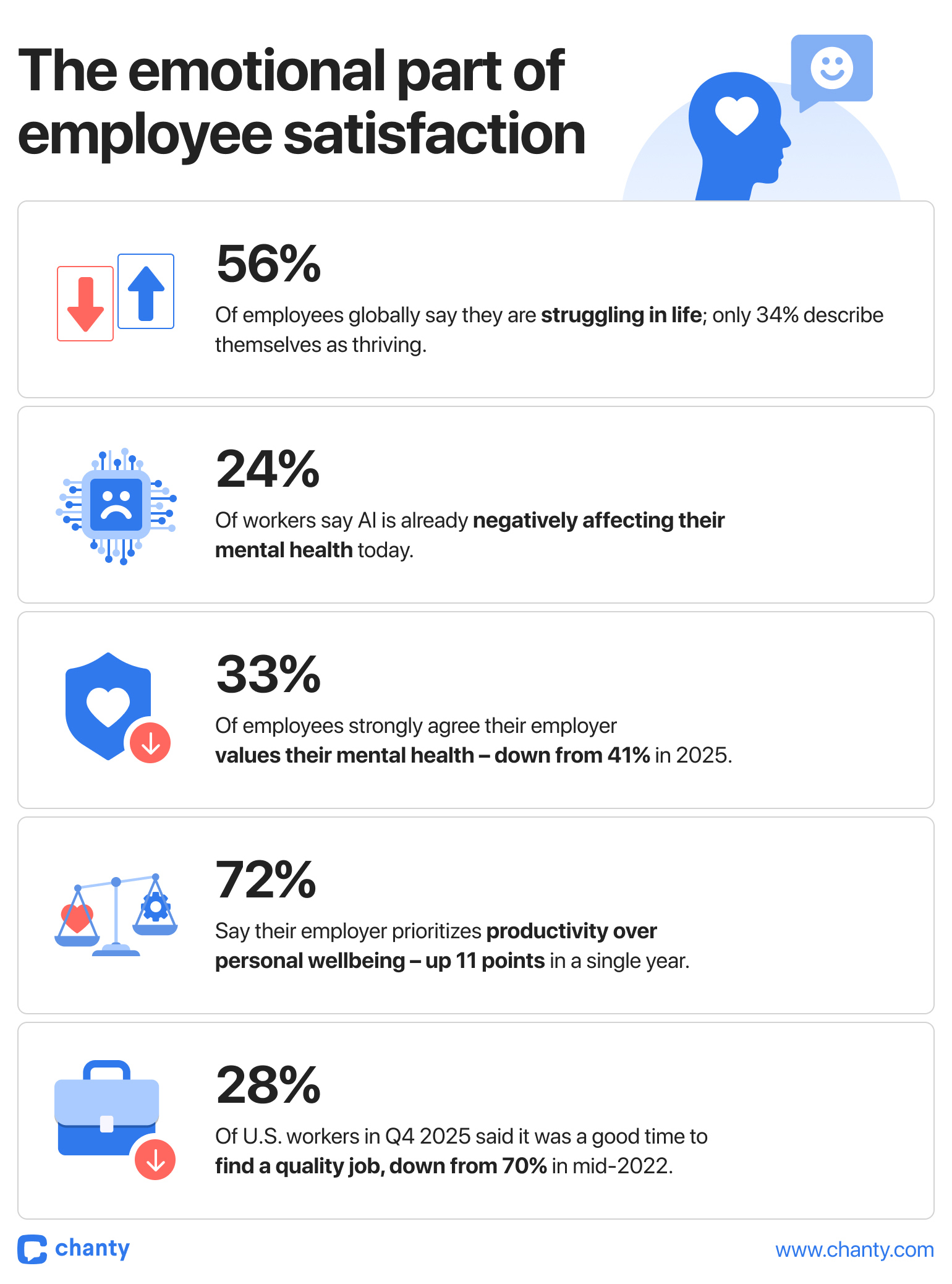
- 56% of employees globally say they are struggling in life; only 34% describe themselves as thriving (Gallup, 2026)
- 24% of workers say AI is already negatively affecting their mental health today (Modern Health, 2026)
- Only 33% of employees strongly agree their employer values their mental health – down from 41% in 2025 (Modern Health, 2026)
- 72% say their employer prioritizes productivity over personal wellbeing – up 11 points in a single year (Modern Health, 2026)
- Only 28% of U.S. workers in Q4 2025 said it was a good time to find a quality job, down from 70% in mid-2022 (Gallup, 2026)
The psychological climate has changed
Work doesn’t happen in a vacuum. The same employees clocking in for Zoom calls or commuting to the office are also following news cycles about war in Europe and the Middle East, absorbing the anxiety of a difficult economic environment, and watching their industries reshape in real time because of artificial intelligence. That weight doesn’t disappear when someone opens a spreadsheet or joins a team standup.
Gallup’s data confirms that worker stress remains at historic highs across both the U.S. and UK. Nearly 56% of employees globally say they are struggling in life. Only 34% would describe themselves as “thriving” – meaning positive about both their work and personal lives.
AI anxiety has become a mental health issue
A new term has entered the workplace lexicon: FOBO – the Fear of Becoming Obsolete. The rise of artificial intelligence is often framed as a business story. But for millions of workers, it’s a deeply personal one. FOBO captures something real about the psychological experience of working alongside increasingly capable AI systems.
January 2026 saw 108,000 U.S. layoffs announced – the highest for any January since the 2008–2009 financial crisis – with companies attributing 55,000 of 2025’s cuts to AI. Whether those attributions are accurate is a separate debate (analysts have warned of “AI washing,” where companies use AI as a convenient narrative to justify restructuring decisions). What matters for employee satisfaction is that workers believe it. And when people believe they might be replaced, their relationship with their work changes fundamentally.
Sixty-two percent of employees say that leaders underestimate the emotional and psychological impact of AI adoption. Yet only 19% of HR leaders report considering those impacts in their digital implementation strategy. That disconnect is quietly corroding trust across organizations. Meanwhile, fear around AI-driven job disruption increased sharply from 28% in 2024 to 40% in 2026.
The collapse of employer trust
Psychological safety – the sense that one can speak up, make mistakes, and be seen as a human being rather than a unit of productivity – has become one of the most critical (and most fragile) factors in employee satisfaction.
Only 33% of employees strongly agree that their employer values their mental health, down sharply from 41% in 2025. Only 49% of workers say they trust their employer to create a workplace where everyone can thrive. And 72% say their employer actively encourages productivity at the expense of personal wellbeing – up from 61% just one year earlier. That’s an 11-point swing in a single year.
These numbers don’t describe complacent employees looking for an easier life. They describe people who feel the terms of their employment have shifted without their consent, and who are quietly recalibrating their commitment as a result.
While most employees respond by reducing discretionary effort rather than engaging in misconduct, declining trust can also increase the risk of behaviours such as policy violations, misuse of company resources, and employee theft.
The great detachment
Gallup has named the current moment the “Great Detachment.” Workers aren’t quitting – the job market has tightened enough that quitting carries real risk. In Q4 2025, only 28% of U.S. workers said it was a good time to find a quality job, down from 70% in mid-2022. People feel stuck.
But being stuck is not the same as being engaged. The Great Detachment describes a workforce that shows up, completes tasks, doesn’t make waves – and has psychologically disengaged from any deeper investment in their organization’s success. It’s presenteeism dressed in modern clothing.
The difference between an engaged employee and a disengaged one is not effort. Its meaning. Engaged employees don’t work harder because they have to. They work harder because they feel their work matters – to the organization, to the world, and to themselves.
This is perhaps the most important psychological insight the data offers. Satisfaction without meaning is not sustainable. And meaning requires something that a salary review or an extra day of holiday cannot provide.
Company culture: the architecture of satisfaction
If psychological safety is the soil, culture is the architecture that determines whether anything healthy can grow. And in 2026, company culture has moved from being an HR talking point to a genuine strategic variable.
By the numbers
- 80% of employees say leadership has the greatest influence on company culture (Gallup / Ujji, 2025)
- 70% of team engagement is attributable to the manager – making every manager the de facto CEO of their team’s culture (Gallup, 2026)
- 82% of managers say the role is harder than ever; only 37% feel equipped to identify burnout in their teams (Modern Health, 2026)
- Only 66% of employees feel a sense of purpose at their organization; only 54% felt they accomplished something great in the past 30 days (O.C. Tanner, 2025)
- Employees recognized weekly have 10x higher odds of satisfaction than those who are never recognized (O.C. Tanner, 2025)
- Companies with strong cultures see 4x higher revenue growth (Gallup research, via Ujji, 2025)
Leaders set the temperature
Eighty percent of employees say leadership has the greatest influence on company culture. Not HR policy. Not values statements painted on office walls. Leaders.
This finding appears across almost every major workplace study. Culture is not built by committees. It is set daily, in small interactions: how a manager responds when someone makes a mistake, whether leadership communicates transparently during uncertainty, and whether executives model the behaviors they say they expect.
The problem is that those expected to carry this responsibility are struggling. Gallup’s data shows that manager engagement fell five percentage points between 2024 and 2025 – the sharpest single-year decline ever recorded for that group. Eighty-two percent of managers say the role is harder than ever, up five points from the year before. And only 37% feel strongly equipped to identify burnout in their teams.
Leaders who are burned out cannot reliably protect their teams from burnout. The crisis of managerial disengagement is upstream of almost every other employee satisfaction problem.
The manager crisis is now the workforce crisis. Gallup’s data shows 70% of team engagement flows from the manager. When managers disengage, the entire team’s satisfaction follows. Every investment in manager wellbeing is, by extension, an investment in everyone they lead.
Values are not culture
The gap between stated values and lived behavior is where trust goes to die. Many organizations have invested heavily in defining their values. Fewer have done the harder work of making those values real. The distinction matters enormously to employees.
When an organization’s stated values align with its actual behaviors – when “we put people first” is reflected in how layoffs are handled, how feedback is given, and how managers are developed – trust forms. When stated values and actual behavior diverge, employees don’t update their beliefs toward the values. They update them on the behaviour, and they stop trusting the organisation’s word.
Only 66% of employees feel a sense of purpose at their organizations. Only 54% feel they accomplished something great in the past 30 days. That’s a significant purpose gap – and it shows up directly in engagement and retention numbers.
Recognition is the fastest path to culture
Of all the levers available, recognition offers the most immediate return – and it costs the least to use. Research shows that employees recognized once during their first 30 days have three times higher odds of satisfaction with their experience. Those recognized weekly have ten times higher odds.
These figures are almost shocking in their implication. The impact of recognition is neither complicated nor expensive. It requires leaders to pay attention, to notice, and to say so out loud. The fact that so many organizations still underinvest here suggests not a lack of knowledge but a lack of deliberate practice.
What culture is actually worth
The business case for a strong culture is no longer speculative. Companies with positive cultures see a four-times increase in revenue growth. Organizations that address workplace needs effectively report a 91% employee satisfaction rate, versus just 44% among those perceived as ineffective. Among employees who view their organization as ineffective, 51% say they are at least somewhat likely to leave within the next year.
Eighty-three percent of employees say they stay with an organization because of its culture and people – not its product, its salary band, or its perks package. Culture isn’t soft. It’s the hardest business variable to build, and the most expensive to lose.
Why employee satisfaction is a business imperative
There is a quiet assumption in business that satisfaction is something you offer employees when times are good, and scale back when things get tight. The data from 2026 makes clear that this assumption is not just wrong – it’s costly.
Disengagement cost the global economy over $10 trillion in lost productivity last year. Each percentage point of global engagement lost represents roughly 21 million workers who have psychologically disconnected from their organizations. These aren’t employees who have stopped working. They’ve stopped caring about the outcome of their work – and that distinction makes an enormous difference to innovation, customer experience, and organizational resilience.
The fulfilled employee brings the future to life
Ideas don’t come from process. They come from people who are present. Satisfied, engaged employees don’t just perform better on existing tasks. They’re the ones who solve problems no one asked them to solve, who build things that weren’t on the roadmap, who notice what’s going wrong before it becomes a crisis.
Disengaged employees don’t innovate. Not because they’re incapable, but because innovation requires a kind of psychological investment that disengagement, by definition, withholds.
The organizations that will navigate the disruptions of the next decade – AI transformation, economic volatility, generational shifts in the workforce – are the ones whose people feel genuinely invested in the outcome. Not the ones with the best perks. Not the ones with the most sophisticated productivity tools. The ones where people wake up in the morning and feel like their work matters.
SHRM’s 2026 State of the Workplace research made this clear: 91% of workers who believe their organiяation effectively addresses their needs report being satisfied with their jobs. Among those who feel their organization is ineffective, the figure collapses to 44%.
Effectiveness at meeting employee needs doesn’t require unlimited budgets. It requires genuine attention, consistent communication, managers who are themselves supported, and cultures that treat stated values as commitments rather than aspirations.
Employee satisfaction, at its most essential, is the degree to which an organization keeps its promises to the people who do its work. When those promises are kept – even imperfectly, even under pressure – people give more than is asked of them. When they aren’t, something quietly switches off.
Conclusion
Taken together, the findings in this report point to a clear shift in how employee satisfaction is formed. It is no longer determined primarily by compensation or benefits alone, but by a combination of trust in leadership, quality of management, opportunities for growth, and overall workplace culture. These elements reinforce each other. When trust is weak, culture deteriorates. When culture weakens, engagement declines. And when engagement falls, retention and performance follow.
The workplace in 2026 is not broken. But it is strained, and it is asking something that organizations have historically been reluctant to offer: honesty. Honesty about the impact of AI. Honesty about what managers are actually expected to carry. Honesty about whether the culture that exists matches the one that’s described.
Employees aren’t asking for perfection. They’re asking to be leveled with. In survey after survey, the organizations where satisfaction is highest aren’t necessarily the ones with the best compensation or the most innovative office spaces. They’re the ones where people feel seen, where their concerns are taken seriously, and where the distance between what leadership says and what leadership does is small enough to trust.
That’s what employee satisfaction, in its most human form, comes down to. Not a score. Not a percentage point on a Gallup chart. But the quiet knowledge, held by each person who works somewhere, that their presence there means something.
Building that knowledge – consistently, honestly, and in the face of real difficulty – is the work that only organizations willing to look clearly at the numbers, and at what lies beneath them, can do.