
Project management is the art of surviving chaos with a straight face. It’s fast, messy, and often overwhelming – and yet, with structure, grit, and a stubborn love for the craft, the chaos starts making sense. What once felt impossible begins to feel like a path teams can walk with purpose, not just luck.
Most teams don’t arrive here on day one. The journey begins with confusion, shifting priorities, and days where everyone is one ping away from burnout. Add a surprise request from the client, a miscommunication between teams, or a sudden deadline change, and the entire plan falls apart. That’s why strong team communication and the right project management software matter more than we like to admit.
Project management statistics aren’t just boring numbers – they act as a mirror showing what really happens inside organizations. They explain why some projects fail, why teams burn out, and why certain companies consistently deliver results while others constantly rebuild from scratch.
For teams looking to tame chaos, tools like Chanty offer a practical solution. Its built-in calendar makes scheduling painless, and the Kanban board provides a clear visual of progress, showing who is driving each task forward. In 2025, clarity isn’t optional – it’s the foundation of success.
The project management market is booming (and growing smarter)
If you manage projects daily, you’ve likely felt it yourself: work moves faster than ever, expectations are sky-high, and old-school systems just can’t keep up. The 2025 statistics confirm what seasoned PMs already know: adopting the right tools isn’t about following trends; it’s about gaining clarity, structure, and the visibility needed to deliver reliably in a world where priorities can change overnight.
Project management software is becoming a core business tool
The global project management software market is expected to reach $12.02 billion by 2030. Impressive, yes, but what’s more interesting is that only a fraction of teams are using these tools to their full potential.
According to Capterra:
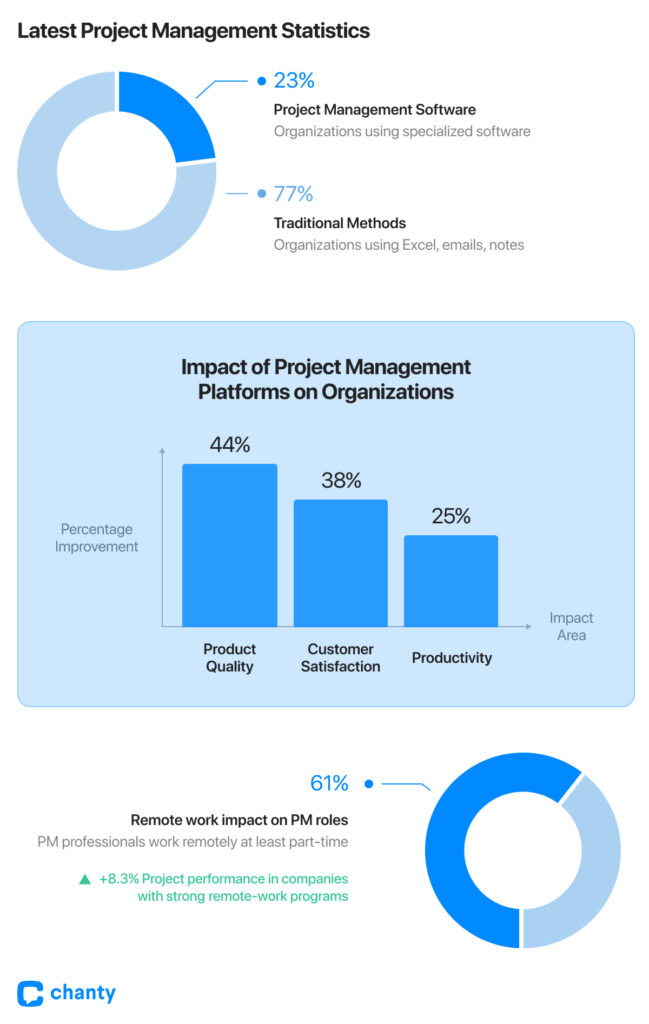
- Only 23% of organizations use project management software at all.
- Which means 77% still rely on Excel sheets, emails, and even paper notes.
Why does this matter?
Operating without proper tools creates chaos in everyday project management:
- Scattered conversations slow decisions
- Unclear responsibilities lead to duplicated tasks
- Forgotten deadlines disrupt timelines
- Broken communication loops increase risk of errors
In short, companies skipping PM software leave efficiency and quality on the table, while exposing themselves to delays and unhappy clients.
The upside is equally clear. Organizations that adopt project management platforms see measurable results:
- 44% improvement in final product quality
- 38% improvement in customer satisfaction
- 25% higher productivity across the project lifecycle
These gains aren’t minor – they mark the difference between “barely delivering’ and consistently achieving results.
Even a simple solution like Chanty, with its built-in Kanban board and calendar, can give teams immediate clarity, reduce confusion over responsibilities, and keep projects moving smoothly.
Agile, hybrid, and visual workflows keep growing
By now, it’s clear: rigid, traditional project approaches struggle in the fast-paced modern world. Teams crave flexibility, transparency, and speed. Agile, hybrid, and visual workflows now the ones, that reshaping how work actually gets done.
According to Zippia, Agile teams show up to 25% higher productivity. No wonder 71% of U.S. companies now embrace Agile – it’s not just a methodology; it’s a response to the pressures of modern business.
The most common reasons teams switch? Better productivity, accountability, collaboration, prioritization, and continuous feedback. These benefits align perfectly with what today’s teams need to stay efficient under constant change.
Here’s how adoption breaks down:
| Methodology | Adoption Rate | Key Benefit |
| Agile | +25% annually | Faster response to changing priorities |
| Hybrid (Agile + Traditional) | 58% | Combines structure with adaptability |
| Kanban | +22% | Visualizes progress and workload clearly |
Why do these trends matter?
Because projects today are unpredictable: client requirements shift, priorities evolve, and remote work adds another layer of complexity. Traditional processes often crumble under this pressure.
Agile, hybrid, and Kanban workflows let teams:
- Adjust scope in real time
- Identify bottlenecks before they escalate
- Make faster, more informed decisions
- Balance workloads effectively
- Keep everyone aligned without drowning in endless reports
Visual workflows are now the project manager’s reality check
Kanban growth is not accidental. Teams want to see the work, not dig for it.
Visualization gives immediate answers:
- Who is working on what
- Which tasks are stuck
- Where progress is lagging
- Which priorities need urgent attention
And this is exactly why tools with built-in Kanban boards fit perfectly into modern project environments – they turn visibility from a “nice to have” into a core part of modern project management.
AI is reshaping project management – slowly, but unstoppably
Artificial intelligence isn’t replacing project managers – it’s here to empower them. In 2025, AI in project management is transforming how work is planned, executed, and analyzed, giving teams insights and capabilities that were unimaginable just a few years ago.
AI usage in project management today
Recent research shows where teams stand on AI adoption:
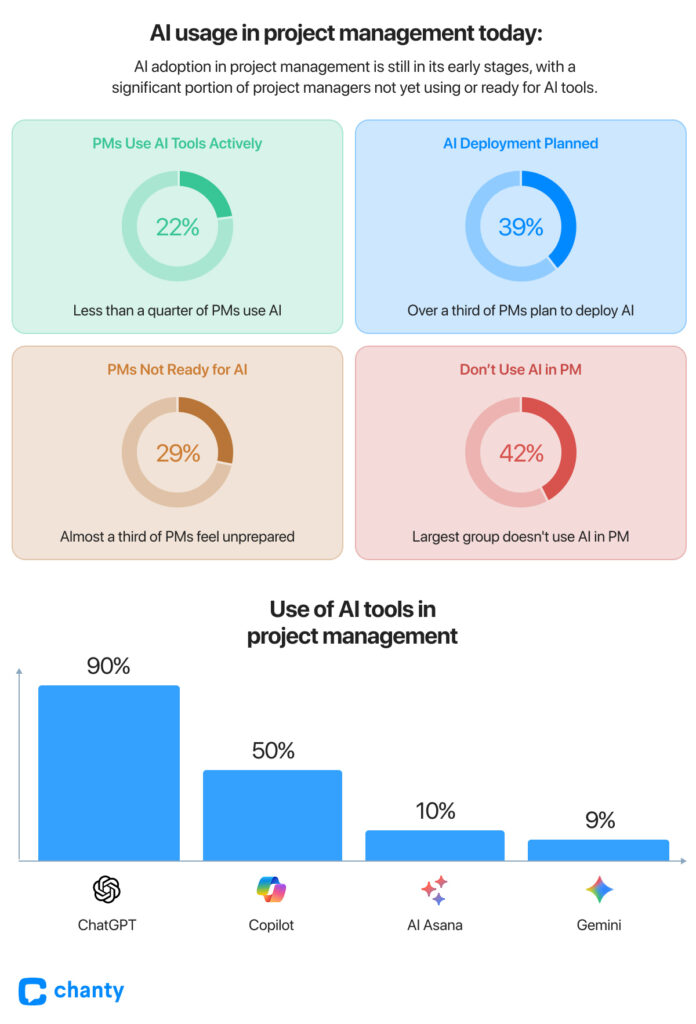
- 22% of PMs use AI tools actively (Capterra)
- 39% have AI deployment planned
- 42% don’t use AI in PM at all (IPMA)
- 29% of PM specialists say they’re not ready for AI adoption
If you’ve ever watched a senior PM refuse to touch anything more complex than a spreadsheet, this “readiness gap” will feel familiar. Resistance usually comes from fear of complexity or lack of clear integration pathways.
Interestingly, according to the Initial AI Survey Report, among those who do use AI, adoption looks like this:
- ChatGPT – 90%
- Copilot – 50%
- Asana’s AI – 10%
- Gemini – 9%
The takeaway is simple: teams gravitate toward AI tools that simplify workflows rather than add layers of complexity. The future of project management technology will reward tools that are intuitive, actionable, and seamlessly integrated.
The AI market for PM is growing fast
The AI-in-project-management market is projected to hit $7.4 billion by 2029. This growth is not just hype; it’s driven by real, time-consuming pain points:
- Predictive risk analysis – spotting potential pitfalls before they happen
- Automated resource planning – assigning tasks without endless spreadsheets
- Writing status updates and reports – freeing PMs from repetitive work
- Cleaning messy communication threads – ensuring team alignment
In real-world teams, these tasks can eat hours every week. AI reduces them to minutes, letting PMs focus on strategy, collaboration, and high-value decision-making.
Why this matters
Adopting AI is not about replacing humans – it’s about enhancing their impact. Teams embracing AI are faster, more accurate, and better equipped to handle complex projects. Teams that lag risk slower responses, higher error rates, and missed opportunities in the rapidly evolving 2026 project landscape.
The global talent shortage: more projects, fewer people
One of the most dramatic shifts in project management today is not technology – it’s people. Projects are multiplying, complexity is rising, and the pool of qualified project professionals isn’t keeping pace.
The world needs millions of new PMs
The scale of the gap is staggering:
- Up to 30 million new project professionals needed by 2035 (PMI)
- PM is the 12th fastest-growing job globally (World Economic Forum)
- Right now, there are about 40 million project professionals – far short of global demand
This isn’t just a PM statistic on page. It translates into overworked teams, delayed projects, and overstretched PMs – a horrifying reality every PM has felt in 2025.
Regions feeling the pressure
According to Global Project Management Talent Gap report, demand is rising fastest in high-growth regions:
- South Asia
- China
- Sub-Saharan Africa
Meanwhile, mature markets like North America and Europe face slower workforce growth due to aging populations.
The implication is clear: organizations in these regions must compete harder for talent, create attractive career paths, and rethink team structures to maintain efficiency.
Sector demand driving the gap
Certain industries are experiencing explosive PM demand, sometimes up to 66% growth:
- Construction
- Manufacturing
- IT services
- Healthcare
This growth translates directly into the modern project environment:
- More cross-functional PM roles, requiring broader skill sets
- Project managers hired at earlier career stages, often without extensive experience
- Greater onboarding pressure, as new PMs must be brought up to speed quickly
- Teams needing clearer structures and workflow visibility to handle complexity
Why this matters
The global PM talent shortage is not abstract – it’s reshaping hiring, team structure, and project delivery strategies. Organizations that invest in talent development, workflow clarity, and adaptable roles will outperform competitors in high-demand markets. Those that ignore it risk project delays, burnout, and operational inefficiency in 2026 and beyond.
Project success vs. failure: why projects still go off the rails
Even with more digital tools than ever, failure rates remain stubbornly high. The reason? The root causes are still deeply human: miscommunication, unclear goals, unrealistic timelines, and weak stakeholder engagement.
The hard truth about failure rates
Access to modern software doesn’t guarantee success. Projects often falter due to internal issues:
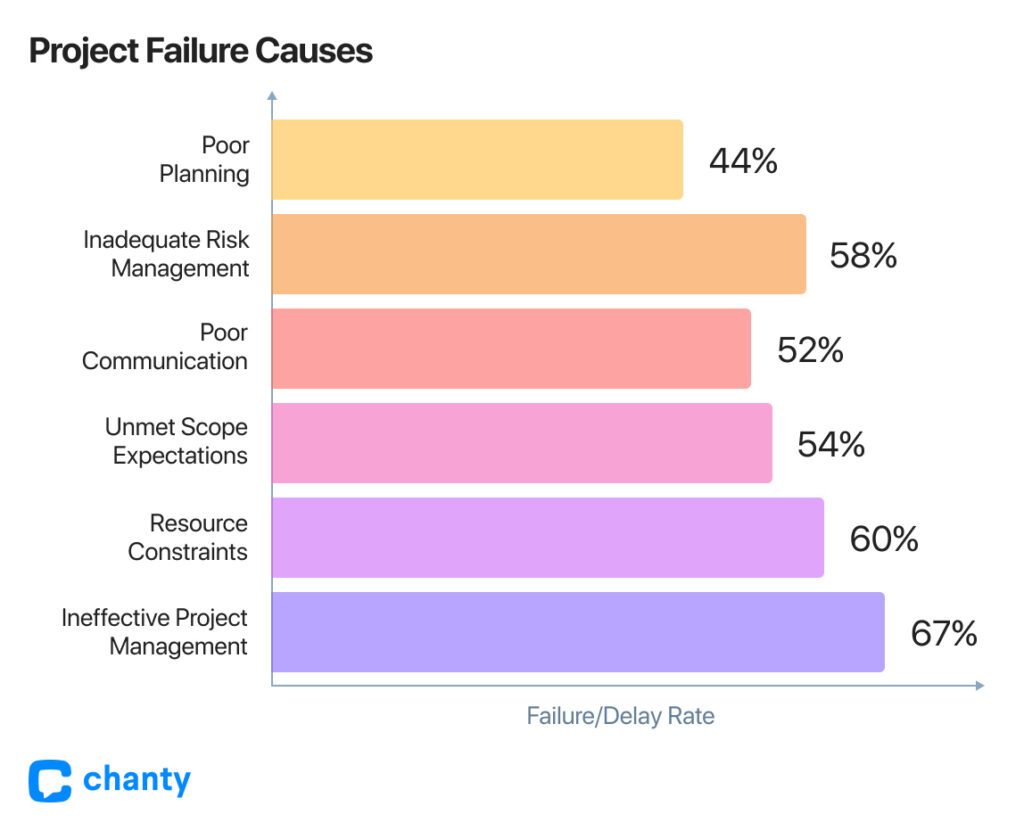
- 44% fail because of poor planning (ZipDo)
- 58% fail due to inadequate risk management
- 52% fail from poor communication
- 54% fail because scope expectations weren’t met
- 60% are delayed due to resource constraints
- 67% fail due to ineffective project management practices (Forbes)
- Over 60% of failures are linked to internal issues like bad estimates, missed deadlines, scope creep, and insufficient resources (PwC)
High failure rates often correlate with under-trained or “accidental” project managers. Even the hardest-working teams can see projects unravel if structure is missing.
What actually improves success
Statistics on project management show specific factors dramatically increase the likelihood of project success:
| Factor | Impact on Success |
| Clear goals | 74% success |
| Stakeholder engagement | 2× more likely to succeed |
| Professional PMs | +33% success |
| Risk management | +28% outcomes |
| Agile methodologies | +30% success |
| Realistic timelines | +25% fewer failures |
| Good communication | Prevents 30–49% of failures |
The pattern is obvious: clarity + structure + communication = predictable outcomes.
Failure is not about laziness or lack of effort – it’s about alignment. Teams fail when they’re not working toward the same map, and fixing clarity often prevents problems before they even start.
This naturally leads to another reality shaping modern PM: remote work.
Remote work’s impact on PM roles
Remote work for now it’s the default for knowledge workers, and project managers feel this shift more than most. Their role, built around alignment, clarity, and communication, is reshaped by distributed teams.
How PM roles look today
Current project management industry statistics highlight a clear shift:
- 61% of PM professionals work remotely at least part-time (PMI)
- Remote PMs in the U.S. earn $108,817 on average – that’s 16% above the national average
- Organizations with supportive remote-work programs see an 8.3% increase in project performance
Why remote PM work requires a different skill set
Remote teams aren’t inherently harder – they just expose weak processes. Without the physical proximity that covers gaps, every missed detail can snowball into delays. Remote PMs need:
- Strong communication flows to avoid unclear expectations
- Tool standardization to keep everyone synchronized
- Clear documentation to reduce dependency on real-time explanations
- Transparency around timelines so hidden bottlenecks don’t derail progress
Facts about project management confirm it: gaps that might be invisible in one-site teams become critical vulnerabilities in distributed environments.
Remote work isn’t just a trend – it’s a new lens through which project managers must view every decision. From workflows to timelines, clarity and visibility are no longer conveniences – they’re strategic imperatives.
Salaries & Compensation: Project Management Pays Well (If You Have the Skills)
Project management isn’t just challenging – it’s rewarding, especially for those who combine technical skill with business acumen. The numbers show one simple truth: skills, experience, and strategic insight directly shape earning potential.
Global salary overview
Top-paying countries for project management roles in 2025 include:
| Country | Average Salary (USD) |
| United States | $120,000 |
| Australia | $103,789 |
| Germany | $99,512 |
| United Kingdom | $87,993 |
| Singapore | $79,464 |
Seniority Matters
Salaries aren’t just about location – they shaped by experience and project scale. In regions like Saudi Arabia, South Africa, and the UAE, moving from Level I PM to Level III PM can increase salaries by 60% or more.
Experience = Higher Pay
One of the strongest correlations in the profession is between experience and salary. According to the Institute of Project Management:
| Years of Experience | Average Salary (USD) |
| 0–3 years | $65,000 |
| 3–5 years | $76,992 |
| 5–10 years | $87,895 |
| 10+ years | $119,000 |
The progression is clear and steep. Why? Because more experienced PMs can:
- Navigate complex dependencies
- Manage multi-level stakeholder expectations
- Predict risks before they escalate
- Keep teams aligned across functions and time zones
- Deliver consistent results
Organizations pay a premium for predictability and leadership, not just task coordination.
The cost of poor project performance
Compensation reflects much more than years spent in the field – it reflects the scale and stakes of the projects you can manage. High-performing PMs directly influence revenue, outcomes, and efficiency.
This becomes even more important when you consider the real cost of project failures:
- For every $1 billion invested, U.S. companies waste $122 million due to poor project performance. (PMI)
And the reasons are overwhelmingly avoidable:
- unclear scope
- weak planning
- no risk analysis
- miscommunication
- poor follow-up
- improvised task management
As management statistics show, a skilled project management reduces waste, protects budgets, and accelerates delivery – making their role one of the highest-impact positions in modern organizations.
Business acumen drives success and pay
According to the Pulse of the Profession 2025 report:
- PMs with strong business acumen hit alignment goals 83% vs. 78%
- They stay on schedule more often 63% vs. 59%
- They deliver on budget more consistently 73% vs. 68%
- They experience fewer failures 8% vs. 11%
These aren’t small differences – they are the reason experienced PMs command higher pay. Business acumen shows up in every decisions:
- “This feature doesn’t support the core KPI – let’s postpone it.”
- “We need a phased rollout to reduce risk.”
- “Client expectations shifted – we need a scope adjustment now, not later.”
Why this matter
Project management pays well, but skills, experience, and business judgment matter as much as geography or company size. Investing in risk management, scope clarity, and strategic decision-making not only drives project success – it also enhances earning potential and career longevity in 2026’s competitive PM landscape.
What All These Numbers Mean for Real Teams in 2026
Stepping back from the PM statistics, one thing becomes clear: project management in 2026 isn’t just about tools or methodologies – it’s about clarity, alignment, and adaptability.
1. Clarity beats everything else
Every metric points to the same core lesson:
Projects fail when people aren’t aligned.
Lack of clarity leads to scope creep, slow decisions, duplicated work, and last-minute crises that could have been prevented. Teams don’t fail because they’re lazy – they fail because they’re not working toward the same map.
Fix clarity, and you fix half your problems before they even start.
2. Communication isn’t “soft” – it’s structural
Up to 49% of project failures stem from poor communication or even miscommunication. And that’s not a soft skill issue – it’s a structural risk.
When communication becomes clear, consistent, and centralized, half of the friction points disappear. When it isn’t teams lose hours unraveling misunderstandings instead of doing the work.
3. Tools aren’t optional anymore
Not having a project management system in place isn’t “lean.”
It’s vulnerable
It’s expensive.
It’s risky.
In 2025, skipping proper tooling creates:
- higher error rates
- shorter attention spans
- scattered information
- wasted hours hunting for updates
The cost of not using tools now outweighs the cost of adopting them.
4. AI won’t replace PMs, but PMs who use AI will replace those who don’t
The data already shows a divide forming between teams using AI for reporting, planning, and risk detection, and teams ignoring it altogether.
AI isn’t taking jobs – it’s reshaping how the job is done.
PMs who use AI gain a strategic advantage: faster insights, cleaner documentation, and fewer repetitive tasks.
5. Talent shortages will rewrite hiring strategies
With global demand far outpacing, companies will increasingly need to:
- train PMs internally
- rely more on junior PMs stepping into bigger responsibilities
- simplify mental load through clearer structures
- standardize processes to minimize onboarding complexity
The gap is real, and organizations that adapt early will avoid long-term performance risk.
6. Remote PM roles are becoming the default
Distributed teams aren’t a temporary trend anymore – they are the new norm.
That means workflows must remain consistent across:
- Time zones
- Platforms
- Devices
- Hybrid schedules
Inconsistent systems break distributed teams faster that anything else.
7. Business skills matter more than technical PM knowledge
Technical PM framework matter – but business context decides outcomes.
PMs who understand budgets, client expectations, trade-offs, and opportunity costs consistently outperform those who only follow templates or checklists.
In 2026, the most valuable PMs are the ones who can explain why a project matters, not just how to execute it.