
By the time you finish reading this sentence, somewhere a manager has just reviewed a screenshot of an employee’s screen. Mind you, that’s not a hyperbole. That’s just a modern workplace in 2026.
Employee monitoring statistics tell two very different stories depending on who’s telling them. Employers see dashboards, productivity metrics, and security systems designed to reduce risk. At the same time, employees experience creeping distrust, exhaustion, and the feeling that every corner of the workday is slowly turning into a monitored performance.
Both groups are reacting to the same work management transformation. And the numbers behind it are more extreme and more human than most statistics roundups let on.
This article covers the pandemic pivot that normalized the mass surveillance, the RTO mandates that brought it back indoors, the software people use to watch, the trics employees use to escape, and the very real psychological toll sitting underneath all of it.
What the employee monitoring numbers actually look like in 2026
Let’s start with the scale, because it’s staggering.
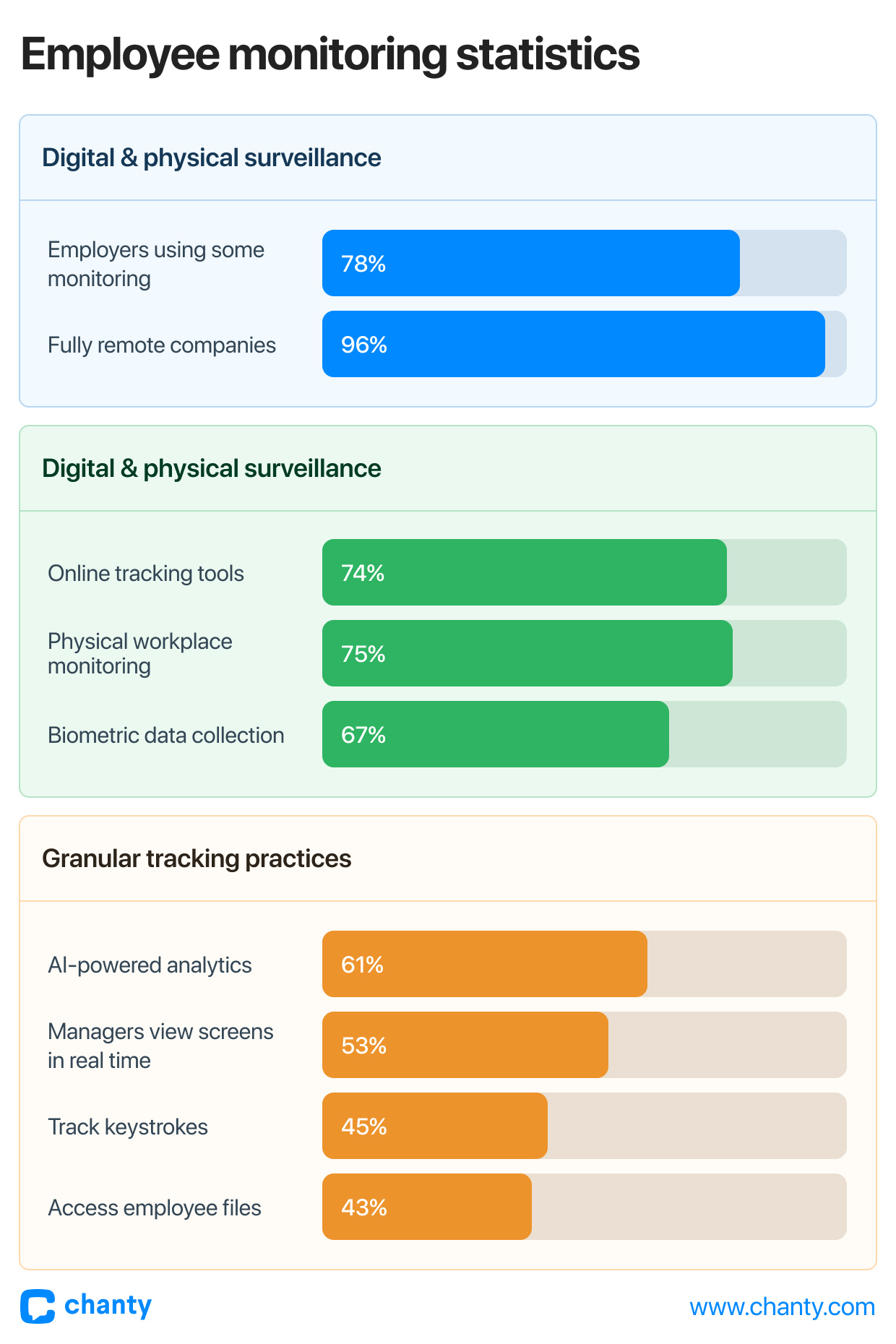
78% of employers now use some form of employee monitoring, up from 60% before the pandemic. Among companies with fully remote workers, that figure jumps to 96%. The global employee surveillance software market, valued at $648.8 million in 2025, is projected to reach $1.78 billion by 2034. For context, that’s nearly a tripling of the industry in under a decade.
Here’s what that monitoring looks like in practice:
- 74% of U.S. employers use online tracking tools – screen monitoring, web logs, app usage.
- 75% monitor physical workplaces through video surveillance, badge systems, and biometric access
- 67% collect biometric data, including fingerprints or facial recognition
- 61% use AI-powered analytics to evaluate employee behavior and productivity
- 53% of managers have viewed employees’ screens in real time
- 45% track keystrokes; 43% access employee files
These aren’t edge cases – this is mainstream.
The scale feels shocking until you remember what happened next. Remote work didn’t just change where people worked. It fundamentally changed how companies tried to control the work itself.
How we got here: The pandemic, WFH, and the surveillance surge
The story didn’t start overnight. It started in March 2020, when millions of office workers packed their laptops and disappeared into spare bedrooms and kitchen tables across the world.
Employers panicked. Not only about the virus, but about the visibility. For more than a century, management had relied heavily on physical presence as a proxy for productivity.
If workers weren’t in the office, how would anyone know they were actually working, who was overwhelmed with tasks, and who had quietly checked out? The answer, almost immediately, was software.
In January 2022 alone, companies purchasing employee monitoring software increased by 75%, marking the sharpest single-month spike since the pandemic began. Organizations that had previously tracked little beyond timesheets suddenly deployed tools capable of capturing screenshots every few minutes, logging keystrokes, monitoring application usage, and generating daily productivity scores.
- 73% of companies that adopted monitoring during COVID-19 have kept it permanently.
The pandemic didn’t create the surveillance impulse. It accelerated it, normalized it, and gave it infrastructure. By the time offices reopened, monitoring was no longer an emergency measure – it was a policy.
Return to office, return to control
Then came the RTO mandates.
Starting in late 2022 and intensifying through 2024 and 2025, major employers began pushing workers back to physical offices. The official reasons varied: collaboration, culture, mentorship, and innovation. But employee monitoring statistics suggest another thread running through the mandate logic – visibility and control.
Physical offices made monitoring feel natural. Managers could see who arrived late, who spent long stretches away from their desks, and who looked busy during the afternoon slump. Visibility created a sense of managerial certainty, even when it said very little about the actual quality of work.
Remote work disrupted that dynamic. Suddenly, millions of employees were productive somewhere managers couldn’t physically see. That is where monitoring software stepped in to close the gap.
But when workers returned to the office, the surveillance systems built for remote work didn’t disappear. They came along with them.
Meanwhile, the push for RTO itself has become a flashpoint:
- 40% of employees would look for another job if hybrid or remote options were withdrawn.
- 44% of employees say they are hesitant about returning to the office, citing concerns over constant monitoring and invasive practices like biometric access controls.
- According to Gartner, over 50% of knowledge workers will still operate in hybrid or fully remote roles through 2026.
The tension is real, and it’s structural. Workers who built their lives around flexibility are being asked to return to environments that are, if anything, more monitored than before. That’s not just a logistics problem – it’s a whole trust problem.
Why companies monitor employees ( even though work is good)
It’s worth understanding why employers do this – and the reasons go beyond distrust or micromanagement, even if those are sometimes the reality.
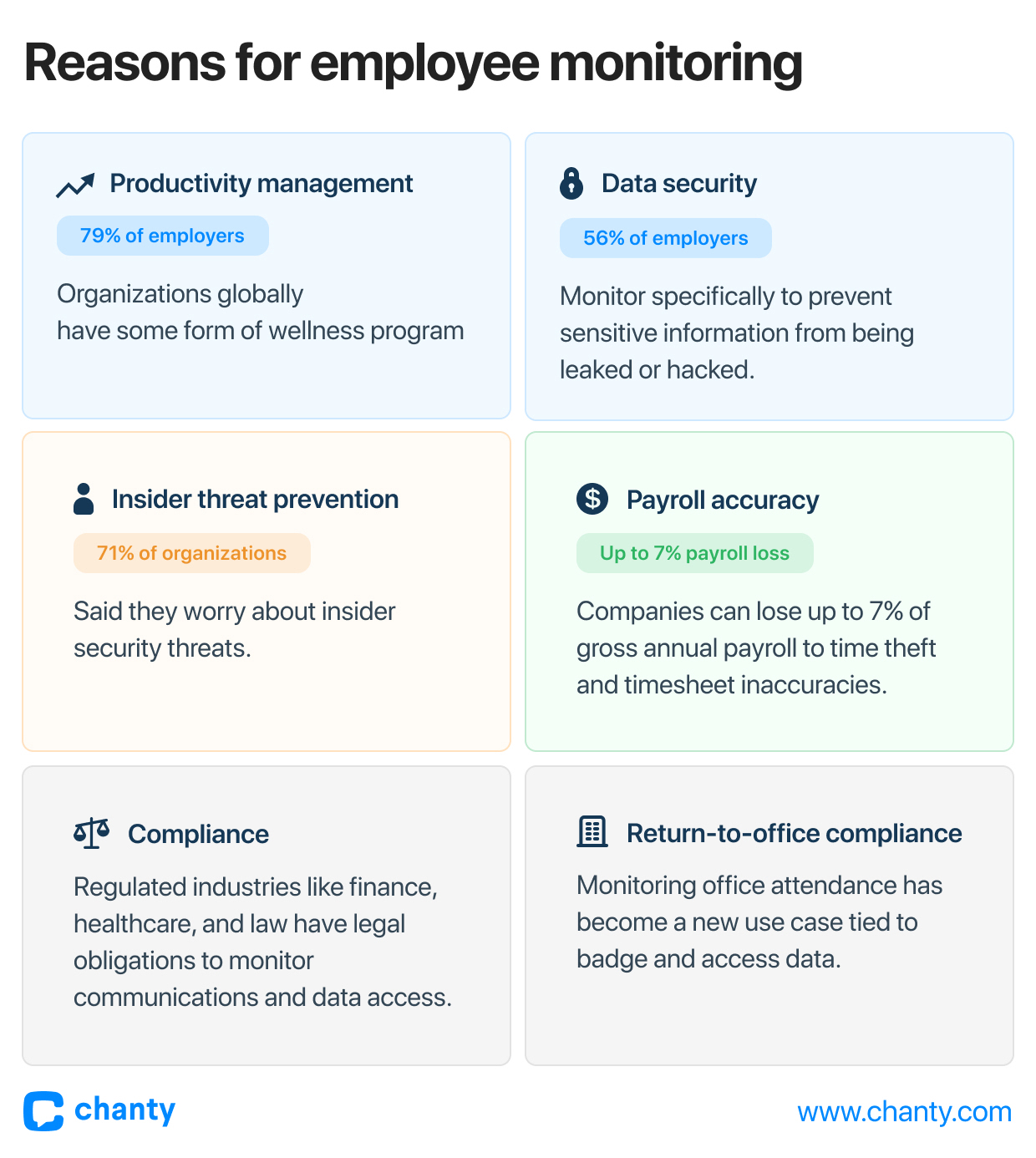
The top reasons employers cite for monitoring their workforce:
- Productivity management – 79% of employers monitor to understand how employees spend their time (Apploye).
- Data security – 56% monitor specifically to prevent sensitive information from being leaked or hacked.
- Insider threat prevention – in a 2024 report, 71% of organizations said they worry about insider security threats.
- Compliance – regulated industries like finance, healthcare, and law have legal obligations to monitor communications and data access.
- Payroll accuracy – according to data widely attributed to the American Payroll Association (APA), companies can lose up to 7% of gross annual payroll to time theft and timesheet inaccuracies.
- Return-to-office compliance – monitoring office attendance has become a new use case tied to badge and access data.
And there is, genuinely, a business case. Time theft costs U.S. employers over $11 billion annually (APA). Data breaches attributed to insider threats are rising. Gartner predicts that half of all medium and large enterprises will adopt formal insider threat programs by 2025, up from just 10% in 2023.
But here’s the paradox: 68% of employers believe monitoring improves work output. Meanwhile, 72% of employees disagree, saying it has no positive impact whatsoever.
Both groups have data on their side. The disconnect itself is a data point.
The employee monitoring arsenal: A hundred ways to watch
Modern employee monitoring software is not your old-fashioned punch clock. These tools are sophisticated, layered, and in many cases, invisible to the person being watched.
What companies are tracking right now, according to the ExpressVPN study:
| Method | Adoption Rate |
| Web browsing logs | 66% of employers |
| Real-time screen monitoring | 59% of U.S. employers |
| Video surveillance (in-office) | 69% of U.S. employers |
| Biometric access controls | 58.3% of U.S. employers |
| Keystroke logging | 45% of employers |
| Employee file access monitoring | 43% of employers |
| Email content scanning | 23% of organizations |
| AI productivity scoring | 61% of U.S. companies |
| GPS location tracking | Growing rapidly among mobile/field workers |
Microsoft Security Research found that over 85% of enterprise Microsoft 365 deployments have some level of email content scanning enabled. If you use Slack, Teams, or Google Chat on a company account, every message is stored and potentially reviewable.
As a result, communication tools are increasingly being evaluated not only on functionality, but also on how they handle visibility, data access, and internal trust. Platforms like Chanty are often considered in this context, especially by teams looking for a balance between security, simplicity, and a less intrusive day-to-day communication experience.
The newest layer is AI. AI-powered monitoring is now widely used in different industries. These tools don’t just log data – they analyze it. They detect anomalies in behavior, score the ”sentiment” of communications, flag unusual file access patterns, and generate automated productivity ratings. A single number, generated by an algorithm, can influence your next performance review – or even your termination.
The employee experience: stress, resistance, and the art of gaming the system
Here is where the employee monitoring statistics stop being abstract and start being human.
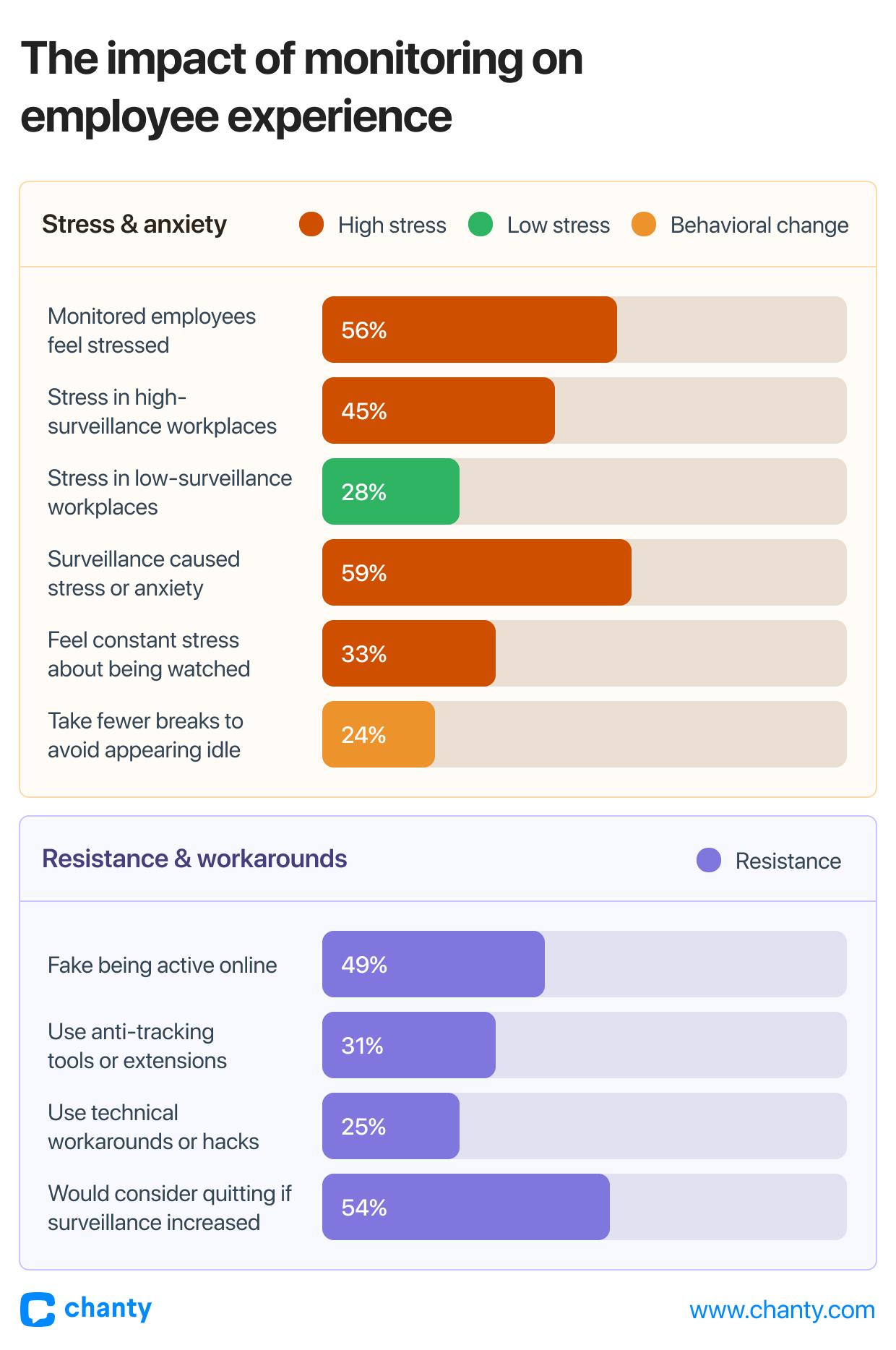
- 56% of monitored employees feel stressed.
- In high-surveillance workplaces, reported stress levels hit 45%, compared to 28% in low-surveillance environments.
- 59% of employees report that workplace surveillance has caused them stress or anxiety.
- 33% say they feel constant stress about being watched.
- 24% take fewer breaks specifically to avoid appearing idle.
And then there’s resistance.
Workers have gotten creative. Elaborate, sometimes ingenious, always human:
- 49% of employees fake being active online – mouse jigglers, keyboard simulators, auto-clickers
- 31% use anti-tracking tools or browser extensions designed to obscure their activity
- 25% use technical workarounds or hacks to avoid constant monitoring
- 54% say they would consider quitting if their employer increased surveillance
The mouse jiggler has become, quietly, one of the most purchased office accessories of the remote work era. You plug it in, it moves your mouse at random intervals, and your status shows “Active.” Nothing accomplished, but the dashboard is satisfied.
The irony is brutal: companies install monitoring software to increase productivity, then employees spend hours learning how to outsmart the monitoring software instead of doing actual work.
This is what surveillance culture produces: performance theater. Workers are optimizing not for output, but for the appearance of output. The metric becomes the thing, not the work.
What employees are actually worried about
According to the Pew Research Center’s survey data:
- 81% of workers say AI monitoring would lead them to feel inappropriately watched
- Majorities oppose AI tracking of movement, desk presence, and computer habits
- 61% of Americans oppose employers using AI to track workers’ movements
- 56% oppose AI monitoring of desk presence specifically
The opposition to AI-specific monitoring cuts across demographics, but younger workers are notably more resistant. 64% of workers ages 18-29 oppose AI being used to track what they do on work computers, compared with 38% of those 65 and older.
The generation gap in surveillance tolerance
The generational divide in workplace monitoring statistics is significant, and HR leaders should pay close attention to it.
SHRM’s 2025 reporting, citing a Checr survey of employees across all age groups, found that 65% of workers feel online monitoring during work hours is an invasion of privacy – or at least aren’t sure it isn’t. But agreement wasn’t uniform:
- 72% of Gen Z workers feel that monitored online activity invades their privacy
- 67% of Millennials agree or are undecided
- 63% of Gen X feel the same
- 60% of Baby Boomers hold this view
Gen Z – the group entering the workforce now, the group companies most need to recruit and retain – is the most resistant. They are also, as a 2024 Cisco survey confirms, the most privacy-literate: more aware of data laws, more active in protecting their own information, more attuned to what monitoring actually means.
SHRM frames it directly: “ a one-size-fits-all approach to privacy won’t work.” The companies that figure that out first will have a significant talent advantage.
The AI question: From tracking to predicting
The frontier of employee surveillance statistics is no longer about what happened – it’s about what’s predicted to happen.
AI monitoring tools in 2026 go far beyond logging websites visited. They now:
- Analyze the sentiment and tone of internal communications using natural language processing
- Score the “positivity” of messages sent through corporate platforms
- Flag frustration or negative sentiment in Slack messages or emails
- Build behavioral profiles showing who employees communicate with most frequently
- Generate productivity scores from aggregated keystroke, app usage, and meeting data
- Predict disengagement before a resignation happens
PwC’s 2025 Global Workforce Survey offers a striking counterpoint to this surveillance arms race: employees with the highest levels of psychological safety are 72% more motivated than those who feel the least safe. Monitoring doesn’t build psychological safety. Transparency and trust do.
The Pew Research Center’s survey of employed U.S. adults found that 52% of workers worry about how AI will be used in the workplace in the future. Only 6% believe AI use at work will lead to more job opportunities for them. And just 16% say any of their current work is already done with AI – suggesting the anxiety is running well ahead of the actual deployment.
The Stanford HAI 2026 AI Index adds global texture: 58% of employees worldwide now use AI at work on at least a semi-regular basis. The share saying AI offers more benefits than drawbacks rose from 55% to 59% between 2024 and 2025. But the share saying it makes them nervous also rose – reaching 52%.
People are using it more, believing in it more, and fearing it more. Simultaneously.
The legal and compliance dimension
Employee monitoring doesn’t just raise ethical questions. It raises legal ones.
The regulatory environment is tightening rapidly, and the gap between what employers can monitor and what they should monitor is narrowing:
- GDPR (EU): Requires explicit consent and transparency – employers must inform employees of what is monitored and why
- HIPAA (U.S. healthcare): Mandates monitoring of certain data access for compliance, but with strict rules on what can be captured and stored
- CCPA (California): Employees have the right to know what personal data is collected about them
28% of risk and compliance professionals said their organization experienced a data privacy or cybersecurity breach in the past three years – a statistic that cuts both ways. Monitoring can prevent breaches. Poorly governed monitoring data can be a breach.
When monitoring works, and when it doesn’t
Not all employee monitoring statistics point toward failure. The reality is more uncomfortable than that. It depends less on the tools themselves and more on the psychological environment they are placed into.
The case for transparent monitoring
Across recent workplace studies and industry research, a consistent pattern appears. Monitoring is far less rejected when it is understood, limited in scope, and paired with employee access to their own data.
When monitoring is transparent and clearly explained, employees are significantly more likely to accept it. In some surveys, more than half of workers report that they become comfortable with tracking once the purpose is clearly communicated, especially when it is tied to safety, workload balance, or operational clarity.
The strongest acceptance appears in environments where employees can see the data themselves rather than being silently evaluated by it. In those cases, monitoring shifts from “surveillance” to something closer to feedback infrastructure.
Research from workplace productivity studies also consistently shows a practical pattern: teams that use data to support employees rather than evaluate them tend to maintain higher engagement and more stable output over time. Break patterns, workload visibility, and burnout prevention often improve when monitoring is used as a diagnostic layer rather than a scoring system.
In simple terms, monitoring tends to work when it behaves less like a judgment tool and more like a mirror.
The case against heavy-handed surveillance
The picture changes sharply when monitoring becomes opaque, continuous, or tied directly to performance pressure.
Multiple workplace psychology studies and HR analytics reports across recent years consistently link high-surveillance environments with increased stress, lower psychological safety, and more defensive work behaviour. Employees in heavily monitored settings are more likely to reduce natural breaks, avoid experimentation, and shift toward “visible activity” instead of meaningful work.
Some organisations that introduced intensive remote monitoring during and after the pandemic have reported a paradoxical effect: longer working hours without proportional productivity gains. In several documented cases, output per hour declined while coordination between teams also weakened. Employees interacted less freely across departments, often defaulting to safer, more measurable tasks.
The behavioural pattern behind this is relatively well understood in organisational psychology. When people feel constantly observed, they don’t necessarily work less – they work differently. They optimise for what is measurable, not what is valuable.
Unsurprisingly, resistance also increases under these conditions. Across multiple recent workforce surveys in the US and Europe, a significant portion of employees say they would consider leaving jobs where surveillance becomes too intrusive or constant. The sentiment is especially strong in knowledge work roles, where autonomy is closely tied to perceived professional value.
The pattern underneath it all
Across studies, industries, and geographies, one pattern repeats.
Monitoring does not automatically improve or damage performance. It amplifies whatever environment already exists.
In high-trust workplaces, where monitoring is transparent and limited, it can function as a support infrastructure. In low-trust environments, it tends to reinforce the very behaviours it was meant to prevent – disengagement, compliance-driven work, and quiet resistance.
The difference is not technical. It is psychological.
And that is where most organisations still miscalculate.
The human reality behind the statistics
Step back from the numbers for a moment.
There is a person – maybe someone like you – sitting at a desk or a kitchen table, knowing that something is watching. Counting their keystrokes. Measuring the seconds between mouse movements. Flagging the fifteen minutes they spent on a personal email during a day they worked twelve hours straight.
The mouse jiggler exists because the person felt they needed it. The anti-tracking tools exist because the anxiety became unbearable. The fake activity, the performance of productivity – these aren’t signs of laziness. They’re signs of a system that substituted measurement for trust, and lost both.
PwC’s 2025 Global Workforce Survey found that more than half of global workers are dealing with financial strain, and nearly as many report feeling fatigued. Adding surveillance to that load doesn’t make people work harder. It makes them feel watched, suspected, and ultimately – disposable.
The question for 2026 isn’t whether companies can monitor their employees. The technology is here, the market is growing, the legal frameworks mostly allow it. The question is what kind of workplace it produces.
Monitoring that supports people – that shows a manager where a team member is overloaded, that flags a security threat before it becomes a breach, that gives workers access to their own data – can be useful. Even welcome.
Monitoring that treats every employee as a potential fraud risk, that reduces complex human work to a productivity score generated at 2 a.m. by an algorithm – that produces something else. It produces anxiety, resistance, and people who spend their energy gaming the system instead of contributing to it.
The employee monitoring statistics don’t lie. But they don’t tell the whole story, either. The whole story is about the person on the other side of the dashboard.