

There’s a particular kind of panic that sets in when a critical role sits open for too long. The pressure mounts, the team feels the gap, and the instinct is almost always the same: post the job, call the agencies, widen the search, look outside.
Somewhere in that scramble, it’s easy to forget the people already sitting three desks away – the ones who’ve quietly absorbed the company’s culture, who know where the process breaks and who to call when it does, and who might know exactly the right person for the job, if only someone thought to ask.
That’s the quiet irony at the center of modern hiring. Companies spend weeks – sometimes months – chasing talent in the open market while overlooking two things at once: the potential inside their current employees and the people in their networks.
Under the weight of deadlines and deliverables, it’s easy to miss the traits that don’t show up in a performance review – the mentor instinct, the connector who knows five people who’d be perfect for the open req, the quiet expert everyone forgets to ask. They need the moment and the invitation to shine.
The numbers back up what many recruiters have suspected for years: 45% of referred hires remain with a company for more than four years, compared to just 25% of hires sourced through job boards. That’s not a marginal difference – it’s nearly double the staying power, from a channel that costs a fraction of what agencies charge.
In 2026, as hiring budgets tighten and retention becomes the metric that actually moves the needle, that gap is hard to ignore.
This article breaks down what the most recent, verifiable data says about employee referrals – what they are, how they perform, how they move through an organization, and what they do to the people involved in giving and receiving them.
What is an employee referral?
An employee referral is a hiring method where a current employee recommends someone from their personal or professional network for an open role at their company.
Instead of a candidate applying cold via a job board, they enter the pipeline with an internal advocate – someone who already understands the job, the team, and the culture, and is willing to put their own reputation behind the recommendation.
Most formal referral programs follow a similar mechanical flow:
- An open role is shared internally, often through an ATS-integrated referral platform, Slack, email, or an SMS campaign for frontline and deskless staff.
- An employee submits a referral, usually a name, contact details, and a short note on fit.
- The candidate is fast-tracked into the recruiting pipeline, often skipping the initial resume-screening stage.
- If the candidate is hired and stays past a set milestone (commonly 90 days or six months), the referring employee receives a bonus – cash, gift cards, extra PTO, or recognition-based rewards.
What separates a referral from a standard application is the layer of pre-vetting that happens before a recruiter ever sees the resume. The referring employee has already done an informal assessment of whether this person can do the job and would fit the team – and because their own credibility is on the line, they tend not to refer people carelessly.
Key employee referral statistics for 2026
Here are the most recent, independently corroborated data points shaping referral hiring this year, each with context for the number.
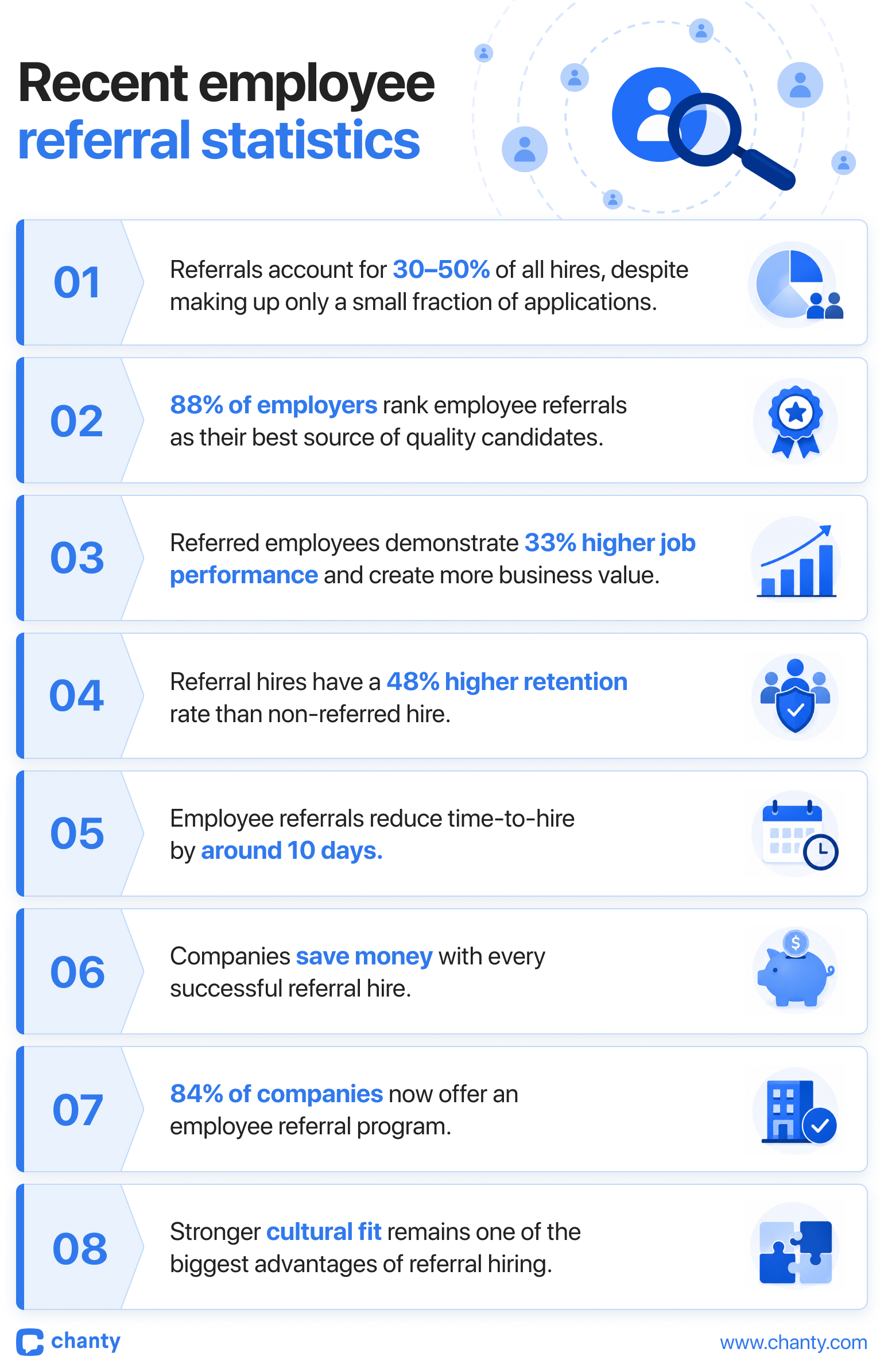
- Referrals account for up to half of all hires, despite making up only a small fraction of applications
Employee referrals represent just 6–7% of all job applications, yet they account for 30–50% of new hires, with some studies putting the figure at 37% of all hires. No other recruiting channel converts candidates into employees at a comparable rate. Rather than reviewing hundreds of resumes, recruiters begin with candidates who have already been informally vetted by someone who understands both the role and the company. That extra layer of trust helps explain why referrals consistently outperform traditional sourcing methods. - 88% of employers rank employee referrals as their best source of quality candidates
Nearly nine in ten employers (88%) consider employee referrals their most effective source of high-quality applicants. That places referrals ahead of job boards, career sites, recruiting agencies, and paid social campaigns in employer rankings. Unlike external candidates, referred applicants often arrive with realistic expectations about the role and company culture because they’ve already spoken with someone inside the organization before applying. - Referred employees perform better and create more business value
Research shows that referred employees demonstrate 33% higher job performance and generate 27% more profit than hires from other recruiting channels. While skills still need to be assessed through the hiring process, referred candidates often require less time to understand team dynamics, workflows, and company expectations. As a result, many organizations see faster productivity and stronger long-term performance. - Referral hires stay longer than employees hired through other channels
Enterprise research shows referred employees have a 48% higher retention rate than non-referred hires, while 45% remain with their employer for more than four years, compared with just 25% of hires sourced through job boards. Part of that advantage comes from social accountability. Employees are unlikely to recommend someone they don’t believe will succeed, since their own credibility is tied to the outcome. Candidates also enter the company with a clearer understanding of the role, making mismatched expectations less common. - Employee referrals reduce time-to-hire by around 10 days
Referral hires join organizations in an average of 29 days, compared with 39 days for candidates from other recruiting channels. In many organizations, referrals bypass the earliest sourcing stages because recruiters receive candidates who have already been recommended by trusted employees. That shorter hiring cycle helps companies reduce vacancy costs while bringing critical talent into the business more quickly. - Companies save money with every successful referral hire
Organizations save an average of about $1,634 for every employee hired through a referral program compared with traditional recruiting methods. In healthcare, the financial impact can be even greater. Hospitals that replace a travelling registered nurse with a successful employee referral can save around $157,000 annually in staffing costs. Lower advertising expenses, fewer agency fees, shorter hiring cycles, and stronger retention all contribute to the long-term savings. - Employee referral programs have become a standard part of modern recruiting
Around 84% of companies now operate an employee referral program, making referrals one of the most widely adopted recruitment strategies. Companies are also increasingly using technology to encourage participation. Research shows that AI-powered referral recommendations and reminders can increase employee participation by 65%, helping companies keep referral programs active year-round instead of relying on occasional hiring campaigns. - Stronger cultural fit remains one of the biggest advantages of referral hiring
While cultural fit is more difficult to measure than hiring speed or retention, it appears consistently across employer surveys and hiring research. Recruiters frequently report that referred employees integrate more quickly, build relationships faster, and adapt to company norms with less friction. That’s partly because referrals come into the organization with realistic expectations about the team, leadership, and day-to-day work, reducing the adjustment period that often accompanies external hires.
How employee referrals actually happen: channels, preferences, and speed
Not all referrals move through the same pipeline, and recent platform-level research gives a clear picture of where referrals actually originate and which channels convert.
A SHRM analysis of over 1.1 million referrals across enterprise programs found a distinct channel breakdown:
- Email remains the dominant channel. More than half of all referrals – 55% – are sent by email, reflecting a level of intentionality that other channels don’t carry.
- Social media is high-volume but lower-converting. Around 30% of referrals are shared over social platforms, but only about 14% of actual hires come from that channel – proof that broad, low-effort shares don’t convert as well as direct, personal outreach.
- SMS/text is the smallest share overall, but the fastest-growing for frontline roles. Only around 10% of referrals company-wide come through text, yet SMS campaigns are the primary way many deskless and frontline employees first learn about referral bonuses and open roles, with roughly 47% of frontline employees becoming aware of programs this way.
The funnel itself is unusually efficient. Industry data on enterprise referral pipelines shows that out of every ten candidates who receive a referral notice, roughly eight respond, six go on to apply, four make it to an interview, and one is hired – a conversion rate that dwarfs the typical 50–60 applicants needed per hire through job boards.
A few other behavioural patterns worth noting:
- The average employee submits around 1.6 referrals per year, but a small core of “super-referrers” – under 4% of participants – account for a disproportionate share of total submissions (Hellora The State of Employee Referral Programs in 2026).
- Roughly a third of employees who make one referral go on to make a second, suggesting that a positive first experience with the program (a fast response, a fair process) is what drives repeat participation.
The fastest referrals to convert tend to be direct, one-to-one recommendations made by email or through an internal portal, where the referrer has taken the time to speak specifically to the candidate’s fit. The most preferred channel by volume is still email, though SMS is closing the gap fast in frontline-heavy industries like retail, healthcare, and logistics, where most employees don’t sit at a desk all day.
The psychological side of employee referrals
Referral programs don’t just move resumes faster – they change how people feel about their own role in the company, and that effect cuts in more than one direction.
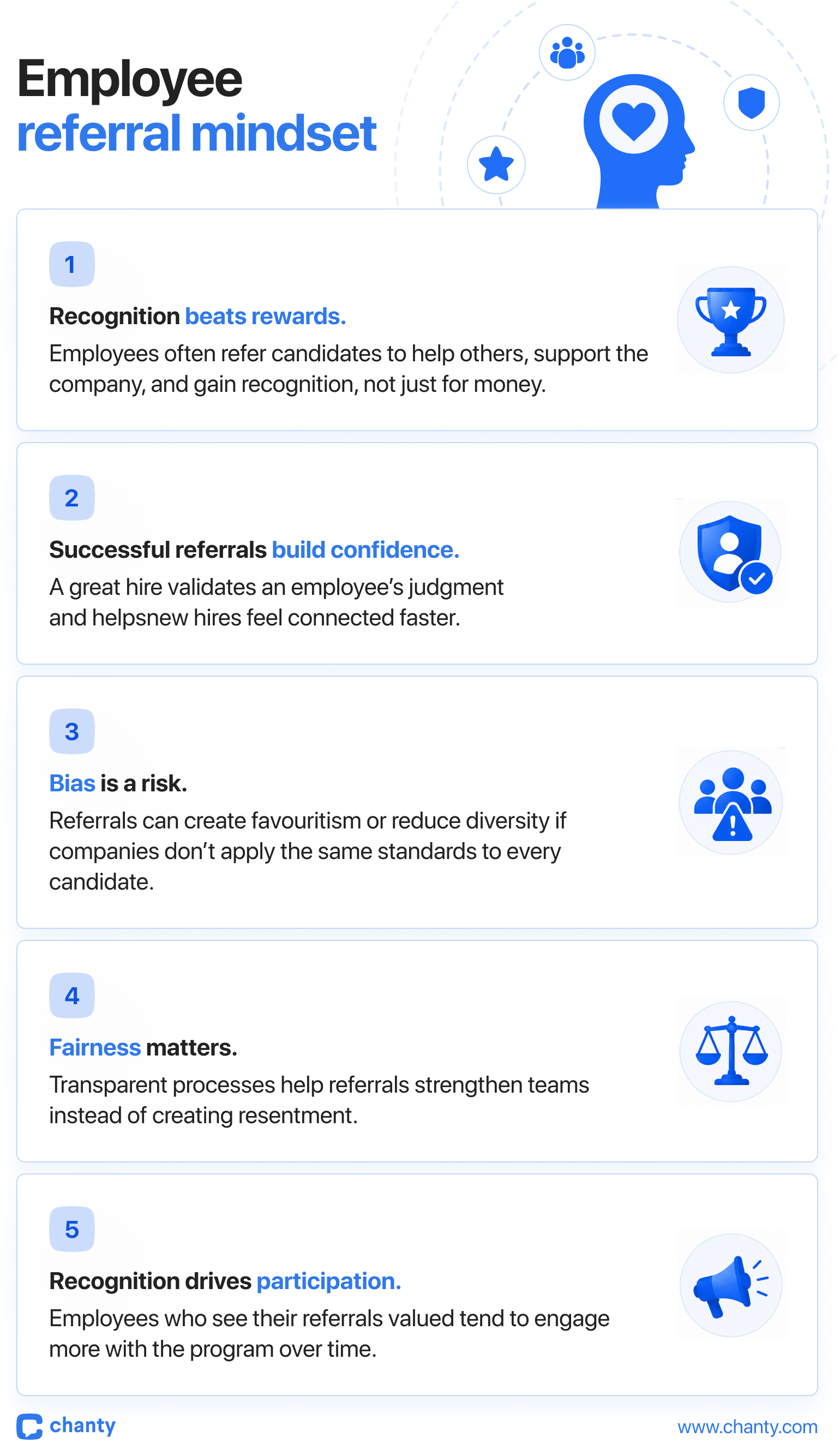
Recognition, not cash, is the primary motivator. Only around 6% of employees say they refer candidates purely for the financial bonus, while roughly 35% refer to help a friend find an opportunity, 32% to help the company grow, and 26% cite professional recognition as their main reason. That matters for program design – a $25 gift card paired with genuine public acknowledgement often does more than a large bonus offered in isolation.
A successful referral is a quiet confidence boost. When someone’s recommendation results in a great hire, it reinforces their own judgment and standing inside the company. Research from the University of Maryland on referral behaviour found that employees treat making a referral as a personal reputational risk, not a casual favor – the person they vouch for reflects directly on them, which is part of why successful referrers tend to feel more invested in the new hire’s outcome. Referred employees themselves report higher satisfaction too – Demandsage’s 2026 referral marketing analysis found 71% of employees hired through a successful referral feel satisfied with their role, compared to 56% of employees from other hiring sources, likely because they arrive already knowing someone, which shortens the awkward early weeks of not belonging.
But referrals carry a real bias risk that shouldn’t be waved away. Hiring experts caution that referred candidates – particularly those recommended by senior or well-liked employees – can receive less rigorous scrutiny than candidates who apply cold, simply because the personal vouching creates a halo effect. Left unmanaged, this can quietly narrow the talent pool: people tend to refer people like themselves, which over time can work against diversity of background and thought, even when no one intends it to.
Team dynamics can shift too, in both directions. When referral hiring is transparent and merit-based, it tends to strengthen team cohesion – new hires arrive with a built-in relationship and a faster path to trust. But when referrals are seen as a shortcut around fair process, or when unsuccessful referrers feel their recommendation was dismissed without real consideration, it can create quiet resentment. The difference almost always comes down to whether the company holds referred candidates to the same evaluation standard as everyone else, and communicates clearly when a referral doesn’t move forward.
On productivity, the recognition effect is measurable. Employees who see their referrals valued and acted on – not just collected – tend to engage more with the program over time, and organizations that pair referral participation with visible recognition (leaderboards, shout-outs, team credit) see meaningfully higher repeat participation than those relying on cash incentives alone.
Employee referral bonuses: what companies are actually paying in 2026
Referral bonus amounts vary widely by industry, role scarcity, and geography. Broadly, the average employee referral bonus is $2,500, with amounts typically ranging from $1,000 to $5,000. Specialized and hard-to-fill roles command a premium – in healthcare, for instance, referral bonuses for advanced practice roles regularly run into the thousands, while entry-level or seasonal positions often see smaller, flat incentives.
A few patterns show up consistently across industries:
- Roles that are genuinely hard to fill (specialized clinical staff, senior engineers) carry the highest bonuses.
- Frontline and seasonal roles tend to use smaller, faster incentives paired with instant recognition rather than large deferred bonuses.
- Many programs split the payout – part on the new hire’s start date, part after they clear a retention milestone like 90 days or six months – which protects the company against referrals made purely to collect a bonus.
Employee referrals by industry: where they work best (and where they don’t)
Employee referrals don’t create the same value in every industry. Hiring a senior software engineer, an ICU nurse, and a seasonal retail associate presents three very different recruiting challenges, so it’s no surprise that referral programs look different across each of them. Bonus amounts, participation rates, and even the reasons referrals succeed depend on what employers are actually trying to solve.
| Industry | Typical Referral Bonus (2026) | Hiring challenge | Why referrals help |
| Technology | ~$5,000 (up to $2,000–$5,000 for individual contributor roles) | Global shortage of specialized software and AI talent | Employees can recommend proven specialists with relevant experience. |
| Healthcare | $1,700–$4,000+ depending on role (up to $8,500 for specialized roles like CRNAs) | Ongoing shortage of qualified clinical staff | Referrals improve retention and help fill difficult-to-staff positions. |
| Financial services | ~$1,400–$2,500 | High demand for experienced and trustworthy professionals | Referrals add an extra layer of confidence when hiring for sensitive roles. |
| Construction | ~$2,500–$3,000 | Shortage of licensed tradespeople | Workers often recruit experienced colleagues from their professional networks. |
| Manufacturing | ~$1,000 | Difficulty recruiting skilled technicians and production workers | Referrals help identify dependable candidates for hard-to-fill roles. |
| Retail | ~$500–$700 | High employee turnover | Referrals improve first-year retention and reduce replacement hiring. |
| Hospitality | ~$500–$840, often smaller and instant for hourly roles | Seasonal staffing needs | Employees can quickly recommend reliable candidates during hiring peaks. |
A clear pattern emerges from the data. Industries struggling to find specialized talent invest the most in employee referrals, while industries facing high turnover use referrals to improve reliability and retention. In both cases, referrals solve a hiring problem, just not the same one.
Why referrals are especially valuable in tech, healthcare, and finance
In highly specialized industries, hiring mistakes are expensive. A resume can show certifications and years of experience, but it says very little about how someone performs when the pressure is on.
Two nurses may hold identical qualifications, yet only someone who’s worked with them knows how they communicate during an emergency or support colleagues on a difficult shift. The same applies to software engineers managing a production outage or financial analysts making time-sensitive decisions. Referrals add an extra layer of real-world insight that resumes and interviews can’t always provide.
That’s one reason employers in these industries are willing to offer referral bonuses worth several thousand dollars. When qualified candidates are scarce and replacing a bad hire is costly, a trusted recommendation becomes significantly more valuable.
Why referrals look different in retail, hospitality, and manufacturing
In retail, hospitality, and many manufacturing roles, the challenge isn’t finding rare technical expertise. It’s finding dependable employees who show up, learn quickly, work well with others, and stay beyond the first few months.
Employees are generally reluctant to recommend someone they don’t trust, so referrals naturally filter out many candidates who might otherwise leave quickly or prove unreliable. That’s why referral bonuses in these industries are usually smaller and paid sooner. The goal isn’t to attract a handful of specialists. It’s to encourage a steady flow of qualified applicants for roles that need to be filled continuously.
Even with lower bonus amounts, referrals still outperform many traditional recruiting channels. In retail, for example, referred employees are 32% more likely to remain with the company through their first year, giving employers a meaningful advantage in an industry where turnover often exceeds 60%.
Where employee referrals have their limits
Despite their strengths, referral programs have a natural ceiling. Every workforce has a limited network of friends, former colleagues, and professional contacts, so referrals alone can’t support every hiring need.
Industry benchmarking suggests most organizations eventually level off, with referrals accounting for roughly 20% to 35% of external hires. Beyond that point, generating additional high-quality referrals becomes increasingly difficult.
Referral programs are also less effective when:
- Expanding into a new geographic market where employees have few local connections.
- Hiring for emerging skills that don’t yet exist within the current workforce.
- Scaling seasonal or high-volume hiring faster than employee networks can realistically support.
The strongest hiring strategies don’t rely exclusively on referrals. Instead, they combine referrals with job boards, recruiting agencies, employer branding, campus recruiting, and other sourcing channels. Referrals consistently perform well, but they deliver the greatest value when they’re part of a broader, balanced recruitment strategy rather than the only one.
Building a referral program that actually works in 2026
What the data says works:
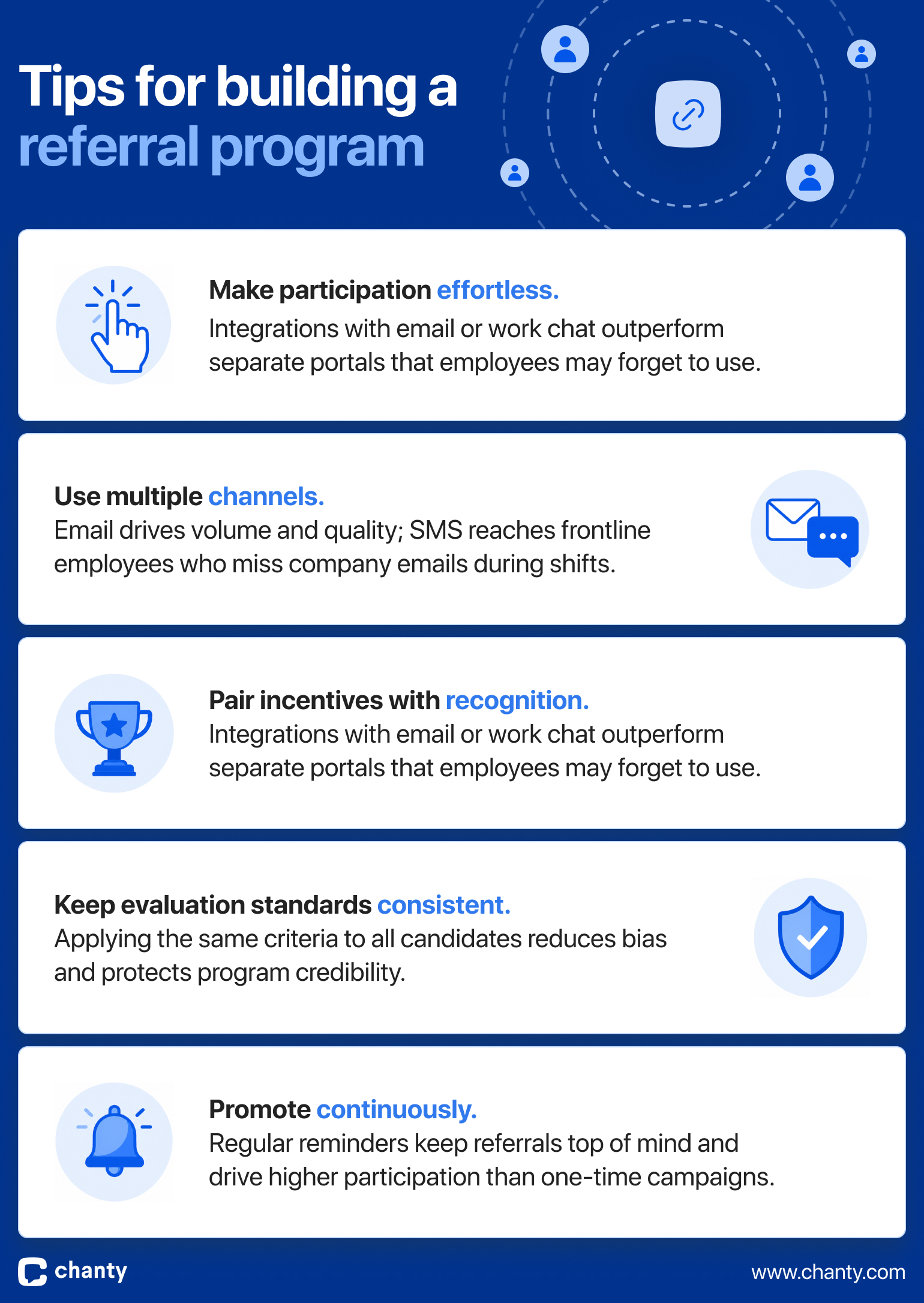
- Make participation effortless. Programs integrated directly into email, Slack, or an ATS convert far better than ones requiring employees to log into a separate portal they’ll forget about.
- Use multiple channels, not just one. Email drives volume and quality; SMS reaches frontline employees who don’t check a company inbox during their shift.
- Pair incentives with recognition. Since money isn’t the primary motivator for most referrers, visible appreciation – a shout-out, a leaderboard, a note from leadership – often outperforms a bigger check.
- Keep the evaluation bar identical for referred and non-referred candidates. This is the single biggest lever against the bias risk described above, and it protects the long-term credibility of the program.
- Promote continuously, not just once a quarter. Awareness fades fast; the organizations with the highest participation treat referral promotion as an ongoing rhythm, not a one-time campaign.
Common mistakes to avoid:
- Treating the referral bonus as the entire strategy. Without genuine communication about open roles and why they matter, even a generous bonus goes unused.
- Letting referred candidates skip real evaluation. This is where bias creeps in and where a referral program can quietly undermine hiring quality and team diversity.
- Ignoring unsuccessful referrers. An employee whose referral doesn’t move forward, with no explanation, is unlikely to refer again. A short, honest update costs little and protects future participation.
- Restricting referral bonuses to specific departments. Programs that apply company-wide consistently outperform those limited to hard-to-fill technical roles, since good candidates don’t sort themselves neatly by department.
- Forgetting frontline and deskless employees. A referral program built only around email and a corporate intranet will miss a large share of the workforce in retail, healthcare, and logistics.
The bottom line
The case for employee referrals isn’t a hunch – it’s one of the most consistently documented advantages in modern hiring, showing up across cost, speed, retention, and performance metrics year after year.
But the numbers also carry a quieter message: the advantage only holds if companies actually build the conditions for it – genuine promotion, fair evaluation, and real recognition for the people willing to put their name behind a candidate.
The talent showing up in your inbox from an agency search might be exactly who you need. But it’s worth pausing, before that search begins, to ask who’s already sitting in the room – and who they might know.
Frequently asked questions
What percentage of hires come from employee referrals in 2026?
Employee referrals typically account for 30–50% of all new hires across industries, despite representing only 6–7% of total job applications submitted.
Are referred employees more likely to stay?
Yes, consistently across studies. Beyond the four-year retention gap covered earlier, separate Zippia research found an even sharper split at the three-year mark: half of referred employees stay with a company for at least three years, while half of non-referred hires are gone within roughly a year and a half.
Do employee referral programs actually save money?
Yes, and the savings show up in more than one place. Beyond the direct per-hire savings covered earlier, the bonus itself tends to be far cheaper than the alternative: Salesso’s 2026 benchmarking puts typical referral bonuses at around 2–3% of a new hire’s annual salary, compared to the 20–30% of salary that external recruiting agencies commonly charge.
What’s the average employee referral bonus?
Most referral bonuses fall between $1,000 and $5,000, with a commonly cited average around $2,500. Specialized and hard-to-fill roles, particularly in healthcare and tech, tend to carry the highest bonus amounts.
Do employee referrals help with diversity hiring, or hurt it?
Both effects are documented. Structured, well-monitored referral programs – especially those with diversity-focused incentives – can widen the pool of candidates from underrepresented backgrounds. Left unmanaged, referrals can also narrow diversity, since people tend to refer others similar to themselves. The outcome depends heavily on whether the company actively tracks and manages this tendency.