

According to Gallup’s State of the Global Workplace 2025 report, most employees feel their company doesn’t truly care about their well-being. This finding sits next to another one that seems to flatly contradict it: 87% of organizations worldwide report having some form of formal wellness initiative.
So most companies have a program. And most employees feel unsupported anyway.
That gap – between program and culture, between policy and practice, between checkbox and genuine care – is the real story of employee wellness in 2026. And the stakes couldn’t be higher, because this isn’t just an HR problem. It’s quietly and catastrophically a whole business problem.
Employee well-being is the secret ingredient to business success. Not secret in the sense that nobody talks about it – plenty of people do actually. But a secret in the sense that organizations keep acting as though it’s optional. When it isn’t.
The data is in, and the costs of ignoring it are compounding. And the employers who are finally getting it right are pulling ahead in ways that are hard to recover from if you’re still standing still.
Understanding that gap and closing it is what separates employers who win talent from those who keep wondering why people leave.
What employee wellness actually means in 2026
Before diving into the data, it’s worth being precise about the term. “Employee wellness” is not a synonym for a gym discount or a step challenge. In 2026, it refers to the full architecture of a person’s health and quality of life – everything that shapes how they show up at work and whether they can sustain that over time.
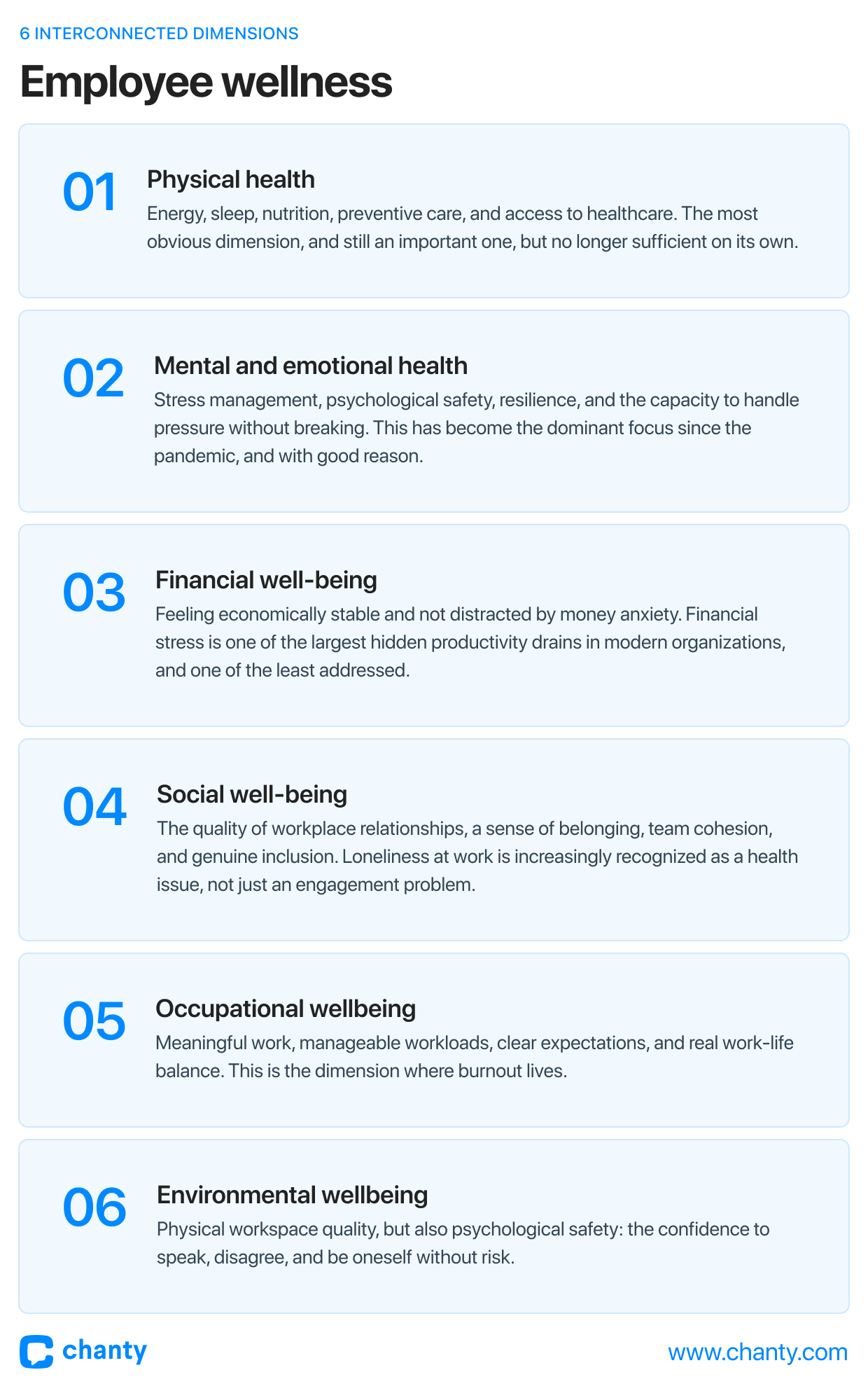
That means six interconnected dimensions:
- Physical health – energy, sleep, nutrition, preventive care, and access to healthcare. The most obvious dimension, and still an important one, but no longer sufficient on its own.
- Mental and emotional health – stress management, psychological safety, resilience, and the capacity to handle pressure without breaking. This has become the dominant focus since the pandemic, and with good reason.
- Financial well-being – feeling economically stable and not distracted by money anxiety. Financial stress is one of the largest hidden productivity drains in modern organizations, and one of the least addressed.
- Social well-being – the quality of workplace relationships, a sense of belonging, team cohesion, and genuine inclusion. Loneliness at work is increasingly recognized as a health issue, not just an engagement problem.
- Occupational wellbeing – meaningful work, manageable workloads, clear expectations, and real work-life balance. This is the dimension where burnout lives.
- Environmental wellbeing – physical workspace quality, but also psychological safety: the confidence to speak, disagree, and be oneself without risk.
Most wellness programs address only one or two of these dimensions. Most employees experience all six every day. This mismatch explains the gap. And Wellhub’s research drives the point home: companies offering four or more wellness dimensions – fitness, mental health, nutrition, and financial support – are far more likely to see strong ROI. Among them, 24% hit 150%+ returns, compared to under 50% ROI for programs covering only one or two areas.
The state of employee wellness in 2026: what the data shows
The market is booming – but results are mixed
The global corporate wellness market is projected to hit $100 billion in 2026, growing at approximately 9% annually. That number signals something real: wellness is no longer a niche perk offered by progressive tech companies. It has become a mainstream business investment pursued by organizations of every size and sector.
But scale doesn’t guarantee impact.
Despite the spending, global employee engagement fell to 20% – matching the lowest levels since the pandemic – with Europe recording just 13% engagement and the UK at a troubling 10%. The money is going in, but the outcomes are not always coming out as expected.
Key employee well-being statistics that paint this picture:
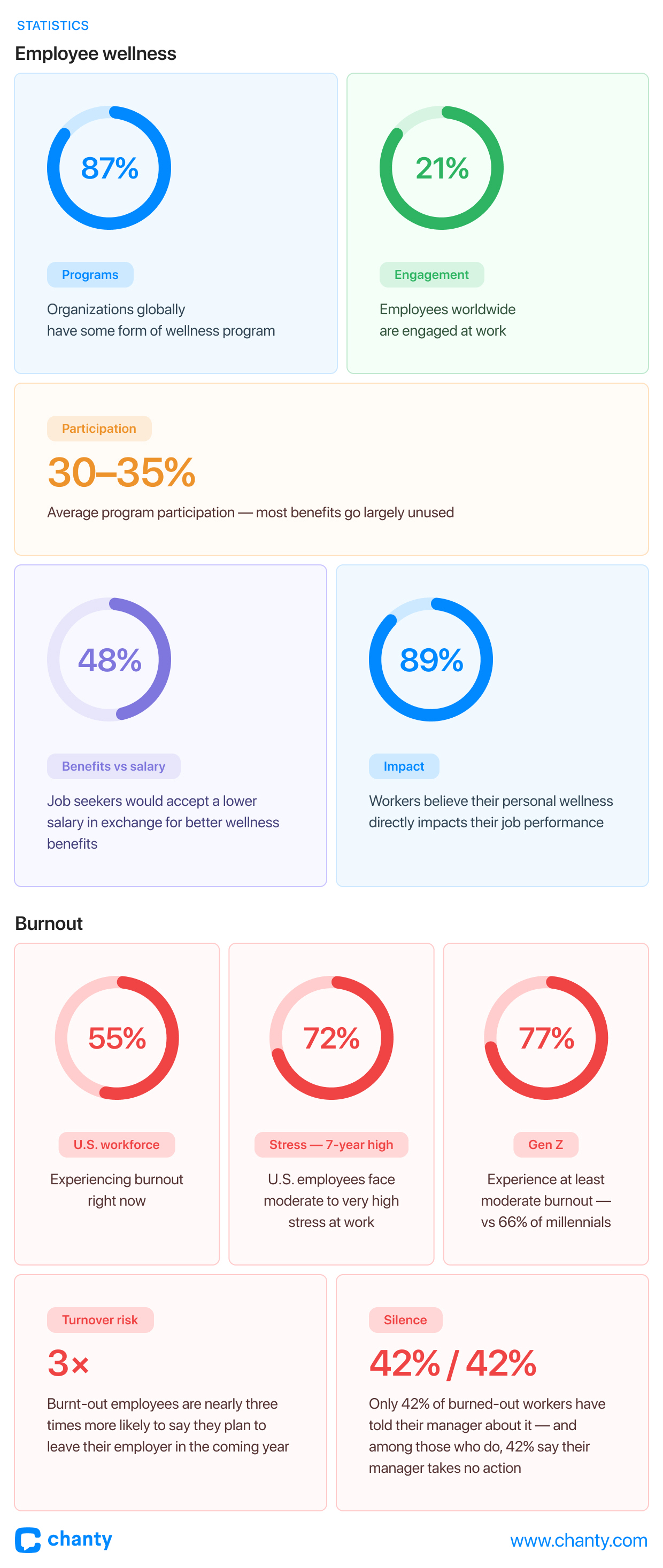
- 87% of organizations globally have some form of wellness program
- Only 21% of employees worldwide are engaged at work
- The average wellness program participation rate sits at 30–35%, meaning most benefits go largely unused
- 89% of workers believe their personal wellness directly impacts their job performance
- 48% of job seekers say they would accept a lower salary in exchange for better wellness benefits
The paradox is sharp: employees want to be well. They understand the impact of this on their work. But the programs designed to support them are often the ones they don’t use.
Burnouts are not getting better: the most alarming employee well-being part of 2026
If there is one set of employee wellness statistics that demands immediate action is is the burnout data. And it’s still not improving.
- 55% of the U.S. workforce is experiencing burnout right now
- 72% of U.S. employees face moderate to very high stress at work – a seven-year high
- Gen Z has surpassed millennials as the most burned-out generation: 74% experience at least moderate burnout, compared to 66% of millennials
- Burnt-out employees are nearly three times more likely to say they plan to leave their employer in the coming year
- Only 42% of burned-out workers have told their manager about it – and among those who do, 42% say their manager takes no action
The causes are mostly structural, not personal. According to Aflac’s data, the top drivers of workplace stress is heavy workloads (35%), followed by long hours. Burnout is not a character flaw among fragile employees. It’s an organisational failure that requires solutions at the organisational level.
How employee well-being benefits the business: the financial case
Let’s make the business case explicit, because it has to be made in every boardroom where wellness is still treated as a line item rather than a lever.
Healthcare costs
A landmark Harvard meta-analysis established that medical costs fall by approximately $3.27 for every $1 invested in wellness programs, and absenteeism costs fall by an additional $2.73 per dollar – meaning comprehensive programs can return up to $6 in savings for every dollar spent.
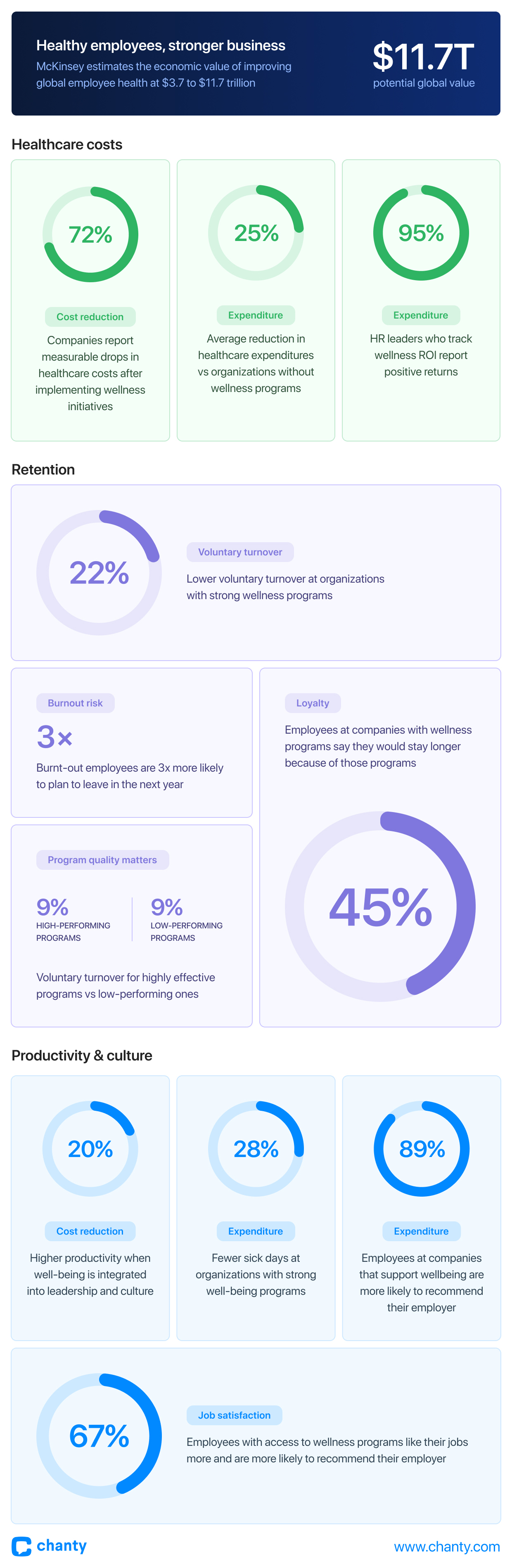
- 72% of companies report measurable drops in healthcare costs after implementing wellness initiatives
- Organizations with wellness programs experience an average 25% reduction in healthcare expenditures compared to those without
- 95% of HR leaders who track wellness ROI report positive returns
Retention and turnover
Here is where employee well-being statistics translate most directly into dollars and cents.
- Organizations with strong wellness programs report up to 22% lower voluntary turnover compared to those without
- Companies with highly effective programs see just 9% voluntary turnover, versus 15% for those with low-performing programs
- Burnt-out employees are 3x more likely to plan to leave in the next year
- 45% of employees at companies with wellness programs say they would stay longer because of those programs
- 67% of employees with access to wellness programs like their jobs more and are more likely to recommend their employer
For a company with 1,000employees and a 20% baseline turnover rate, a 22% reduction means 44 fewer departures per year – each costing $15,000-$20,000 or more to replace. That’s $660,000 to $800,000 in savings from well-being investment alone.
Productivity and engagement
- Companies that integrate well-being into leadership and culture can see up to 20% higher productivity
- Organizations with strong well-being programs see 28% fewer sick days
- 89% of employees at companies that support wellbeing are more likely to recommend their employer
- McKinsey estimates the potential economic value of improving global employee health at $3.7 to $11.7 trillion
The financial case is no longer speculative. The cost of ignoring employee well-being – in healthcare spending, absenteeism, turnover, and disengagement – is measurably higher than the cost of addressing it. Gallup estimates that low engagement now costs the global economy nearly 9% of GDP.
When employee well-being needs immediate attention
Some organisations discover their wellbeing problem right on the exit interview. By then, it’s shocking and costs a fortune.
Is it preventable? The answer is – yes. Because the signs appear much earlier, and they cluster around a consistent pattern for those willing to notice them.
Red flags that require immediate intervention:
- High workload without recovery time. When 35% of employees cite heavy workloads as their primary stressor and managers take no action, burnout is not a future risk – it is already happening.
- Declining confidence in employer care. In 2025, only 48% of employees felt confident their employer cares about their mental health – down from 54% in 2024. That’s a six-point drop in a single year. When trust erodes, programs lose credibility regardless of their quality.
- Untrained managers. Globally, only 44% of managers have received any formal management training. Since research consistently shows the immediate manager is the single biggest factor in employee stress and retention at the same time, this is a structural vulnerability.
- Gen Z burnout rates are above 66%. This generation is the future of most workforces. If they are burning out before age 30 at rates exceeding their older colleagues, you are facing a talent pipeline problem, not just a benefits problem.
- Low program participation. If fewer than 30% of your employees are using wellness benefits, the problem isn’t program quality – it’s integration, awareness, or psychological safety. All three are solvable, but only if they’re diagnosed.
The best employee wellness programs for 2026
The programs showing the strongest outcomes in 2026 share a common structure. They aren’t built around what’s easiest to administer. They’re built around what employees actually need.
Mental health and resilience infrastructure: EAP access that employees can actually navigate, on-demand teletherapy, structured resilience training, manager coaching programs, and psychological safety initiatives embedded in team culture. Not a tab on the benefits portal – a system.
Financial wellness as a first-class benefit: Digital financial coaching, emergency savings matching, student loan repayment, tiered financial education that speaks to different life stages, and transparent communication about compensation. When employees feel financially stable, they show up present.
Flexible work as a health intervention: Flexible scheduling – not just remote vs. in-person, but true schedule autonomy – reduces burnout, improves work-life balance, and costs remarkably little. This is one of the highest-ROI wellness tools available, and one of the most underutilized.
AI-powered personalization: Platforms that adapt to the individual – tracking participation, surfacing relevant resources, respecting privacy, and giving employees agency over their own wellbeing journey. Programs gain stickiness when employees feel seen rather than processed.
Physical wellness that doesn’t assume gym culture: Flexible wellness stipends that employees can spend on their own definition of physical health – Pilates, running clubs, massage therapy, yoga – drive higher participation than one-size-fits-all gym memberships. Physical health is a gateway to all other dimensions.
Life-stage inclusive benefits: Menopause support, fertility coverage, parental leave, neurodiverse employee accommodations, and caregiving resources. Fifty-six percent of employers are moving in this direction. The ones that arrive first win the loyalty of their most committed people.
The honest reckoning
Here is the uncomfortable truth beneath all the market growth numbers: most wellness programs are architecturally set up to underperform.
They’re offered as add-ons rather than integrated into the flow of work. They ask employees to opt in, find time, remember to log in, and navigate platforms that sit outside their actual jobs. In organizations where workload is already the primary barrier to wellbeing, asking employees to spend extra time on wellness is asking them to solve the problem with the very resource they don’t have. Time.
The result is predictable. A growing library of underused benefits and an employee population that still doesn’t feel supported.
This is the paradox defining the 2026 wellness landscape. Organizations are investing more in well-being than ever before, and yet most employees still feel the gap. The issue here is the allocation, not original intent. Too much of the investment goes into programs that check boxes, and not enough into changing the conditions people actually work in.
Because employees are not waiting to be “given” wellbeing like a perk. They’re not some version of Dobby, set free the moment a company hands them a wellness app or a meditation subscription.
What they respond to is something much simpler, and much harder to engineer. Work that is sustainable. Expectations that are realistic. Environments that don’t quietly drain them.
The organizations that will close this gap are the ones willing to ask better questions. Not “do we have a wellness program?” but “do our employees actually feel well?” Not “what benefits do we offer?” but “what in our day-to-day work makes wellbeing difficult?”
In 2026, the answers to those questions are becoming a competitive edge.
Because the truth was never really hidden, employee well-being is business performance.
Treat people like it matters, and they tend to stay. Ignore it, and no program will be enough to make them.