
Every new hire runs the same quiet experiment, whether they mean to or not. They compare what they were told during the interview to what they’re actually experiencing during the first weeks, and they draw conclusions long before anyone asks for their feedback.
At its heart, onboarding is the process of helping a new employee move from “I’ve been hired” to “I understand how this company works, what is expected of me, and how I can contribute.” It connects the practical details of starting a job with the human side of becoming part of a team.
Done well, it can shorten the path to productivity, reduce early mistakes and uncertainty, and give employees a reason to believe they made the right choice.
Yet onboarding gets treated, almost everywhere, as an administrative phase: paperwork, accounts, a training calendar. For the person living through it, it’s something closer to a trial, not of their competence, but of the company’s honesty.
And that trial has business consequences. The first weeks can influence how quickly someone becomes productive, how confident they feel in their role, how connected they become to the organization, and ultimately whether they see themselves staying.
That’s why onboarding statistics are worth looking at. They turn what can feel like a soft employee experience issue into something much easier to measure: employee retention, productivity, engagement, and the cost of getting a new hire off to a bad start.
So, what does the data actually say about employee onboarding in 2026?
The employee onboarding numbers at a glance
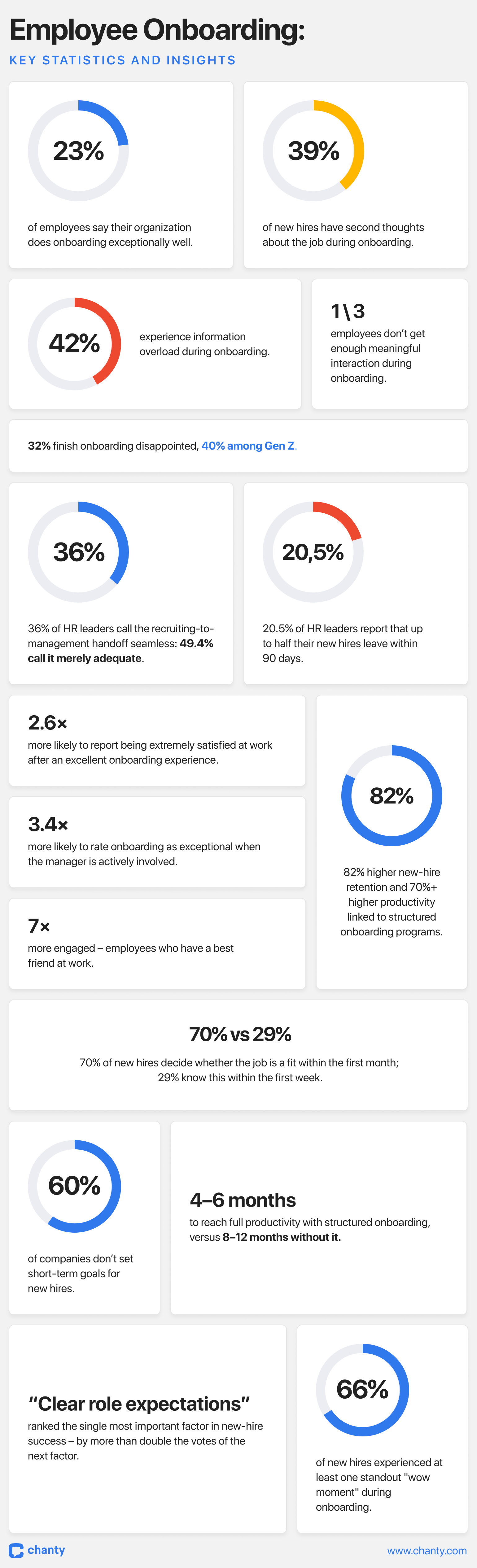
- 23% of employees say their organization does onboarding exceptionally well (Gallup)
- 39% of new hires have second thoughts about the job during onboarding (BambooHR)
- 32% finish onboarding disappointed – 40% among Gen Z ( BambooHR)
- 42% experience information overload during onboarding
- 1 in 3 employees don’t get enough meaningful interaction during onboarding (BambooHR)
- 36% of HR leaders call the recruiting-to-management handoff seamless; 49.4% call it merely adequate (Enboarder)
- 20.5% of HR leaders report that up to half their new hires leave within 90 days
- 60% of companies don’t set short-term goals for new hires (LinkedIn)
- 82% higher new-hire retention and 70%+ higher productivity linked to structured onboarding programs (Brandon Hall Group)
- 2.6× more likely to report being extremely satisfied at work after an excellent onboarding experience (Gallup)
- 3.4× more likely to rate onboarding as exceptional when the manager is actively involved (Gallup)
- 4–6 months to reach full productivity with structured onboarding, versus 8–12 months without (SHRM)
- 66% of new hires experienced at least one standout “wow moment” during onboarding (Guidde)
- 70% of new hires decide whether the job is a fit within the first month; 29% know it within the first week (BambooHR)
- “Clear role expectations” ranked the single most important factor in new-hire success – by more than double the votes of the next factor (Enboarder, “Winning the First 90 Days”)
- 7× more engaged – employees who have a best friend at work (Gallup, general engagement data)
The decision that keeps getting reopened
One of the most uncomfortable figures here: 39% of new hires have second thoughts about the job during onboarding. It’s tempting to read that as buyer’s remorse, but the mechanism is more specific than regret. The employee already made the decision – interviewed, negotiated, resigned somewhere else, told people, arrived. What onboarding does is quietly reopen a case that was supposedly closed.
Here’s the contradiction worth sitting with: none of the individual moments that trigger this doubt are dramatic.
A manager who’s unreachable in week one. A role that doesn’t resemble the job description. A team that seems too busy to answer a basic question. On their own, these things are forgivable. Accumulated, they start to look like a pattern, and the brain is very good at pattern-matching from incomplete evidence.
That helps put another finding into context: 32% of new hires report finishing onboarding disappointed, rising to 40% among Gen Z employees. Disappointment isn’t usually one bad event; it’s the compounding effect of several small ones, charged against expectations that were set unusually high during recruitment.
Which raises the real question behind the 23% of new hires who describe their onboarding as exceptional. Why is that number so low when most onboarding programs aren’t actually badly run? Because “not disastrous” and “exceptional” are separated by a wide, boring middle ground, and that middle ground is where most companies live.
A new hire can finish onboarding and still be wondering:
What exactly am I supposed to be doing? Who do I ask when I get stuck? How does work actually get done here?
Completion was never the same thing as confidence.
What this means in practice: the important gap isn’t necessarily between a good onboarding program and a bad one. It’s between what recruiting promises and what the first weeks actually deliver.
More information was never the fix
It would be easy to assume the solution to onboarding friction is simply more – more documentation, more sessions, more welcome materials. The data argues against that. 42% of new hires report information overload, while 60% of companies never set short-term goals for them. That combination captures the contradiction in miniature: companies over-deliver on volume and under-deliver on sequence.
A new employee is trying to learn the company, the role, the tools, the people, the official process, and the unofficial one running quietly underneath it – all at once. Handing them a sixty-page handbook doesn’t reduce that cognitive load; it just gives them more things to process.
What’s actually missing isn’t the information; it’s triage – a sense of what matters today versus what can wait until it’s relevant. Without that, even correct, well-intentioned information starts to feel like noise.
The 1 in 3 employees who report insufficient meaningful interaction sit on the other side of the same problem. Information overload and social isolation look like opposite complaints – too much of one thing, not enough of another – but they share a root cause: nobody designed the experience of the first weeks, only the content of them.
An employee in an office absorbs hundreds of unplanned social cues just by being present – who eats lunch with whom, how disagreements actually get resolved. A remote hire gets none of that by accident; if it isn’t built in deliberately, their onboarding can flatten into meeting, document, meeting, silence.
Technically complete. Not remotely integrated.
What it means in practice: the fix for overload usually isn’t less content – it’s a clearer answer to “what do i actually need to know this week,” with everything else allowed to wait.
Everyone did their job, but handoff still failed
Onboarding isn’t owned by one department. Recruiting owns the candidate relationship. HR handles much of the administrative process. IT provides access. The hiring manager owns the role. The team becomes responsible for helping the new employee function within it.
That division of responsibility makes sense on paper. It can also create gaps in practice.
Enboarder’s 2025 research of 1,000 HR leaders found that only 36% described the handoff between recruiting, HR, and hiring managers as seamless, while nearly half described it as merely “adequate.”
That’s a revealing result because it doesn’t necessarily point to one department doing a bad job. Recruiting can do its part. HR can do its part. IT can do its part. The manager can do theirs.
And the employee can still fall through the space between them.
“Your manager will cover that” meets “I assumed HR already did,” and the new hire is left holding whatever fell in between.
This matters because early turnover is expensive regardless of where the original problem started. Enboarder’s research also found that 20.5% of HR leaders reported that up to half of their new hires leave within 90 days.
That figure doesn’t prove that poor onboarding causes all of those departures. Early turnover can have many causes, including role fit, compensation, management, personal circumstances, and the original hiring decision.
But it does highlight why the first 90 days deserve attention. A company has already invested in sourcing, interviewing, hiring, and preparing the employee. Losing that person before the investment has had time to pay off starts the cycle again.
Source the candidate. Interview the candidate. Hire the candidate. Onboard the candidate. Then start over.
What this means in practice: the handoff between departments needs to be treated as part of the onboarding process itself. Someone should be accountable for the spaces between teams, not just for completing one department’s part of the process.
The cheapest fix is the least systemized one
If there’s a genuinely hopeful number in this data, it’s this one: employees are 3.4 times more likely to call their onboarding exceptional when their manager takes an active role.
Of everything measured here, this is the one lever that doesn’t require new software, new budget, or a redesigned process. It requires a manager who makes time, explains that matter first, sets expectations, makes introductions, answers questions, and checks in a few days later.
That sounds almost embarrassingly simple, which may be why it’s easy to underestimate.
HR can own the paperwork and the welcome email, but neither of those answers the questions a new hire actually lives with: what should I be working on, who do I ask, am I doing okay?
Managers are uniquely positioned to answer those questions in context.
The relationship side matters, too. Gallup’s research has found a strong relationship between having a best friend at work and employee engagement. That isn’t strictly an onboarding statistic, so it shouldn’t be treated as proof that introducing a “work buddy” will automatically improve onboarding.
But it points toward the same broader lesson: organizational attachment isn’t built from information alone. People become connected to a workplace through relationships.
And those relationships start forming early.
What this means in practice: manager involvement shouldn’t be treated as an optional addition to an onboarding program. It is one of the clearest human factors companies can influence during the first weeks.
What makes onboarding work and what makes it fail?
So far, the numbers have mostly described friction: doubt, overload, weak handoffs, limited interaction, and early turnover. The success research tells a complementary story.
One of the most widely cited findings is that structured onboarding programs are linked to roughly 82% higher retention and 70%+ higher productivity. These figures are commonly attributed to Brandon Hall Group research and have been widely republished over the years.
There’s an important caveat here. The original research is roughly a decade old, and a statistic that has been recycled this often deserves the same scepticism applied to any other. The broader direction of the finding is more useful: structured onboarding tends to outperform unstructured onboarding. That conclusion continues to appear in newer research, but that is not the same as confirming that the specific figures remain a precise benchmark today.
More recent and more specific: SHRM data suggests structured onboarding roughly halves time to full productivity – new hires in unstructured programs typically take 8 to 12 months to become fully productive, compared with roughly 4 to 6 months in structured ones. Gallup separately found that employees who go through excellent onboarding are 2.6 times more likely to report being extremely satisfied at work.
But the most useful finding for anyone deciding where to actually spend effort comes from Enboarder’s Winning the First 90 Days research. When HR leaders were asked which single factor mattered most to new-hire success, “clear role expectations” won by more than double the votes of the next-ranked factor.
Not culture videos. Not a packed week-one schedule. Not swag. Just an unambiguous answer to “what does good look like in this job” – which lines up exactly with the earlier finding that 60% of companies never set short-term goals at all. The factor HR leaders say matters most is also the one most commonly skipped. That gap, more than any single statistic here, is the success gap.
The psychological moments that tip the scales
The process statistics tell us where onboarding tends to break down. But some of the most interesting findings point to something smaller: the individual moments that shape how a new hire interprets the company.
Enboarder’s research found that 66% of new hires experienced at least one “wow moment” during onboarding. These weren’t necessarily expensive gestures. They were specific, unexpected signs of attention: a genuinely personalized welcome, recognition for an early contribution, or a senior leader making real time for a first conversation.
That distinction matters.
A checklist item satisfies an expectation that was already there. A genuinely thoughtful moment can change the expectation itself. It tells a new employee, in a very concrete way, that someone is paying attention to the employee experience rather than simply moving them through a process.
And timing matters.
70% of new hires decide within the first month whether a job is the right fit, while 29% make that decision within the first week. These figures put the earlier finding that 39% of new hires have second thoughts into a more useful timeframe. The employee isn’t evaluating the job only after onboarding is finished. They’re evaluating it while onboarding is happening.
That creates a potential mismatch. Companies may spend the first few days concentrating information and administration, while the employee is simultaneously trying to answer a much bigger question:
Did I make the right decision by coming here?
The window starts before the first day, too. Research from Deel found that 64% of new hires receive no preboarding experience between accepting an offer and starting work.
That period may look like dead time from the company’s perspective. For the employee, it can be filled with uncertainty. What happens on the first day? Who will be there? What should I bring? Will anyone know I’m starting?
Preboarding doesn’t need to become another full program. Sometimes it means something as simple as a welcome message, clear first-day instructions, an introduction to the manager, or making sure the necessary equipment is already on its way.
The same principle applies to peer connection. Research on buddy programs has linked structured peer support with better onboarding outcomes, including employee retention and faster time to productivity. The underlying reason is straightforward: having one person who has already navigated the organization gives a new hire somewhere to take the questions that feel too small, too obvious, or too awkward to ask in a formal meeting.
What this means in practice: onboarding is not only a sequence of tasks. It’s a sequence of signals. The first few weeks tell employees whether the company is organized, whether people have time for them, whether expectations match reality, and whether they have someone to turn to when they don’t know what to do.
What the pattern actually says
Put these numbers together, and the problem starts to look less like a lack of resources and more like a lack of continuity.
Most companies already have the handbook, the training platform, the HR portal, the checklist. What tends to break is everything between them: the handoff nobody owns, the information delivered too early, the question nobody knows who should answer, the manager who assumes HR covered it, the employee who doesn’t know what happens next.
The employees who have a good onboarding experience don’t necessarily describe a spectacular one. More often, they describe an experience that felt strangely easy. They knew what was expected. They knew where to go. They knew who to ask. One step led naturally to the next.
That may be the simplest way to understand what the onboarding statistics are really measuring.
Not how much a company gives a new hire, but how much the new hire has to figure out alone.
A successful onboarding process doesn’t make the organization look impressive. It makes the organization easy to enter.
And perhaps that’s the question worth putting at the end of every onboarding process: Could this person find their way through the organization, or did they have to figure the organization out first?